Kirjailija
Ron S. Kenett
Kirjat ja teokset yhdessä paikassa: 13 kirjaa, julkaisuja vuosilta 1998-2024, suosituimpien joukossa Software Process Quality. Vertaile teosten hintoja ja tarkista saatavuus suomalaisista kirjakaupoista.
13 kirjaa
Kirjojen julkaisuhaarukka 1998-2024.
Using actual examples of software process improvement from the private sector and government, this work demonstrates how quality systems, measurement techniques and performance evaluations work. It presents a methodology for analyzing an ongoing software development process and establishing a rational plan for process improvement.
Process Improvement and CMMI for Systems and Software
Ron S. Kenett; Emanuel Baker
CRC Press
2019
nidottu
Process Improvement and CMMI® for Systems and Software provides a workable approach for achieving cost-effective process improvements for systems and software. Focusing on planning, implementation, and management in system and software processes, it supplies a brief overview of basic strategic planning models and covers fundamental concepts and approaches for system and software measurement, testing, and improvements. The book represents the significant cumulative experience of the authors who were among the first to introduce quality management to the software development processes. It introduces CMMI® and various other software and systems process models. It also provides readers with an easy-to-follow methodology for evaluating the status of development and maintenance processes and for determining the return on investment for process improvements. The authors examine beta testing and various testing and usability programs. They highlight examples of useful metrics for monitoring process improvement projects and explain how to establish baselines against which to measure achieved improvements. Divided into four parts, this practical resource covers: Strategy and basics of quality and process improvementAssessment and measurement in systems and software Improvements and testing of systems and softwareManaging and reporting data The text concludes with a realistic case study that illustrates how the process improvement effort is structured and brings together the methods, tools, and techniques discussed. Spelling out how to lay out a reasoned plan for process improvement, this book supplies readers with concrete action plans for setting up process improvement initiatives that are effective, efficient, and sustainable.
Process Improvement and CMMI for Systems and Software
Ron S. Kenett; Emanuel Baker
Auerbach Publishers Inc.
2010
sidottu
Process Improvement and CMMI® for Systems and Software provides a workable approach for achieving cost-effective process improvements for systems and software. Focusing on planning, implementation, and management in system and software processes, it supplies a brief overview of basic strategic planning models and covers fundamental concepts and approaches for system and software measurement, testing, and improvements. The book represents the significant cumulative experience of the authors who were among the first to introduce quality management to the software development processes. It introduces CMMI® and various other software and systems process models. It also provides readers with an easy-to-follow methodology for evaluating the status of development and maintenance processes and for determining the return on investment for process improvements. The authors examine beta testing and various testing and usability programs. They highlight examples of useful metrics for monitoring process improvement projects and explain how to establish baselines against which to measure achieved improvements. Divided into four parts, this practical resource covers: Strategy and basics of quality and process improvementAssessment and measurement in systems and software Improvements and testing of systems and softwareManaging and reporting data The text concludes with a realistic case study that illustrates how the process improvement effort is structured and brings together the methods, tools, and techniques discussed. Spelling out how to lay out a reasoned plan for process improvement, this book supplies readers with concrete action plans for setting up process improvement initiatives that are effective, efficient, and sustainable.
Industrial Statistics
Ron S. Kenett; Shelemyahu Zacks; Peter Gedeck
BIRKHAUSER VERLAG AG
2024
nidottu
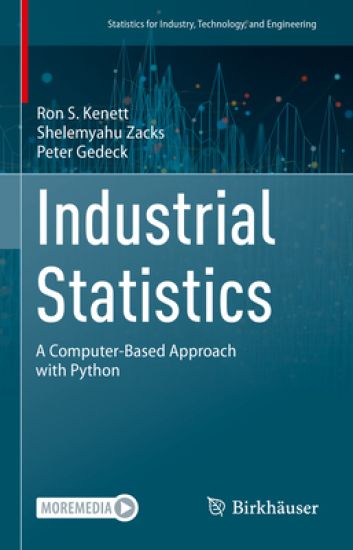
This innovative textbook presents material for a course on industrial statistics that incorporates Python as a pedagogical and practical resource. Drawing on many years of teaching and conducting research in various applied and industrial settings, the authors have carefully tailored the text to provide an ideal balance of theory and practical applications. Numerous examples and case studies are incorporated throughout, and comprehensive Python applications are illustrated in detail. A custom Python package is available for download, allowing students to reproduce these examples and explore others.The first chapters of the text focus on the basic tools and principles of process control, methods of statistical process control (SPC), and multivariate SPC. Next, the authors explore the design and analysis of experiments, quality control and the Quality by Design approach, computer experiments, and cyber manufacturing and digital twins. The text then goes on to cover reliability analysis, accelerated life testing, and Bayesian reliability estimation and prediction. A final chapter considers sampling techniques and measures of inspection effectiveness. Each chapter includes exercises, data sets, and applications to supplement learning.Industrial Statistics: A Computer-Based Approach with Python is intended for a one- or two-semester advanced undergraduate or graduate course. In addition, it can be used in focused workshops combining theory, applications, and Python implementations. Researchers, practitioners, and data scientists will also find it to be a useful resource with the numerous applications and case studies that are included.A second, closely related textbook is titled Modern Statistics: A Computer-Based Approach with Python. It covers topics such as probability models and distribution functions, statistical inference and bootstrapping, time series analysis and predictions,and supervised and unsupervised learning. These texts can be used independently or for consecutive courses.The mistat Python package can be accessed at https://gedeck.github.io/mistat-code-solutions/IndustrialStatistics/."This book is part of an impressive and extensive write up enterprise (roughly 1,000 pages!) which led to two books published by Birkhäuser. This book is on Industrial Statistics, an area in which the authors are recognized as major experts. The book combines classical methods (never to be forgotten!) and "hot topics" like cyber manufacturing, digital twins, A/B testing and Bayesian reliability. It is written in a very accessible style, focusing not only on HOW the methods are used, but also on WHY. In particular, the use of Python, throughout the book is highly appreciated. Python is probably the most important programming language used in modern analytics. The authors are warmly thanked for providing such a state-of-the-art book. It provides a comprehensive illustration of methods and examples based on the authors longstanding experience, and accessible code for learning and reusing in classrooms and on-site applications."Professor Fabrizio RuggeriResearch Director at the National Research Council, ItalyPresident of the International Society for Business and Industrial Statistics (ISBIS)Editor-in-Chief of Applied Stochastic Models in Business and Industry (ASMBI)
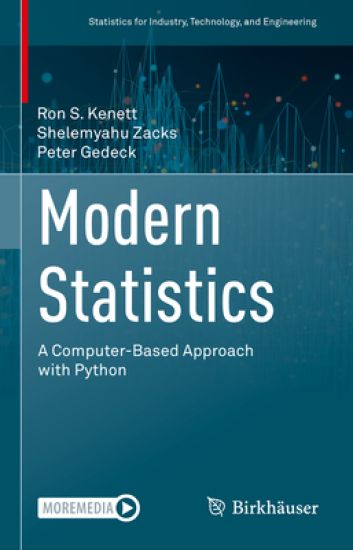
This innovative textbook presents material for a course on modern statistics that incorporates Python as a pedagogical and practical resource. Drawing on many years of teaching and conducting research in various applied and industrial settings, the authors have carefully tailored the text to provide an ideal balance of theory and practical applications. Numerous examples and case studies are incorporated throughout, and comprehensive Python applications are illustrated in detail. A custom Python package is available for download, allowing students to reproduce these examples and explore others.The first chapters of the text focus on analyzing variability, probability models, and distribution functions. Next, the authors introduce statistical inference and bootstrapping, and variability in several dimensions and regression models. The text then goes on to cover sampling for estimation of finite population quantities and time series analysis and prediction, concluding with two chapters on modern data analytic methods. Each chapter includes exercises, data sets, and applications to supplement learning.Modern Statistics: A Computer-Based Approach with Python is intended for a one- or two-semester advanced undergraduate or graduate course. Because of the foundational nature of the text, it can be combined with any program requiring data analysis in its curriculum, such as courses on data science, industrial statistics, physical and social sciences, and engineering. Researchers, practitioners, and data scientists will also find it to be a useful resource with the numerous applications and case studies that are included. A second, closely related textbook is titled Industrial Statistics: A Computer-Based Approach with Python. It covers topics such as statistical process control, including multivariate methods, the design of experiments, including computerexperiments and reliability methods, including Bayesian reliability. These texts can be used independently or for consecutive courses.The mistat Python package can be accessed at https://gedeck.github.io/mistat-code-solutions/ModernStatistics/"In this book on Modern Statistics, the last two chapters on modern analytic methods contain what is very popular at the moment, especially in Machine Learning, such as classifiers, clustering methods and text analytics. But I also appreciate the previous chapters since I believe that people using machine learning methods should be aware that they rely heavily on statistical ones. I very much appreciate the many worked out cases, based on the longstanding experience of the authors. They are very useful to better understand, and then apply, the methods presented in the book. The use of Python corresponds to the best programming experience nowadays. For all these reasons, I thinkthe book has also a brilliant and impactful future and I commend the authors for that."Professor Fabrizio RuggeriResearch Director at the National Research Council, ItalyPresident of the International Society for Business and Industrial Statistics (ISBIS)Editor-in-Chief of Applied Stochastic Models in Business and Industry (ASMBI)
Industrial Statistics
Ron S. Kenett; Shelemyahu Zacks; Peter Gedeck
BIRKHAUSER VERLAG AG
2023
sidottu
This innovative textbook presents material for a course on industrial statistics that incorporates Python as a pedagogical and practical resource. Drawing on many years of teaching and conducting research in various applied and industrial settings, the authors have carefully tailored the text to provide an ideal balance of theory and practical applications. Numerous examples and case studies are incorporated throughout, and comprehensive Python applications are illustrated in detail. A custom Python package is available for download, allowing students to reproduce these examples and explore others.The first chapters of the text focus on the basic tools and principles of process control, methods of statistical process control (SPC), and multivariate SPC. Next, the authors explore the design and analysis of experiments, quality control and the Quality by Design approach, computer experiments, and cyber manufacturing and digital twins. The text then goes on to cover reliability analysis, accelerated life testing, and Bayesian reliability estimation and prediction. A final chapter considers sampling techniques and measures of inspection effectiveness. Each chapter includes exercises, data sets, and applications to supplement learning.Industrial Statistics: A Computer-Based Approach with Python is intended for a one- or two-semester advanced undergraduate or graduate course. In addition, it can be used in focused workshops combining theory, applications, and Python implementations. Researchers, practitioners, and data scientists will also find it to be a useful resource with the numerous applications and case studies that are included.A second, closely related textbook is titled Modern Statistics: A Computer-Based Approach with Python. It covers topics such as probability models and distribution functions, statistical inference and bootstrapping, time series analysis and predictions,and supervised and unsupervised learning. These texts can be used independently or for consecutive courses.The mistat Python package can be accessed at https://gedeck.github.io/mistat-code-solutions/IndustrialStatistics/."This book is part of an impressive and extensive write up enterprise (roughly 1,000 pages!) which led to two books published by Birkhäuser. This book is on Industrial Statistics, an area in which the authors are recognized as major experts. The book combines classical methods (never to be forgotten!) and "hot topics" like cyber manufacturing, digital twins, A/B testing and Bayesian reliability. It is written in a very accessible style, focusing not only on HOW the methods are used, but also on WHY. In particular, the use of Python, throughout the book is highly appreciated. Python is probably the most important programming language used in modern analytics. The authors are warmly thanked for providing such a state-of-the-art book. It provides a comprehensive illustration of methods and examples based on the authors longstanding experience, and accessible code for learning and reusing in classrooms and on-site applications."Professor Fabrizio RuggeriResearch Director at the National Research Council, ItalyPresident of the International Society for Business and Industrial Statistics (ISBIS)Editor-in-Chief of Applied Stochastic Models in Business and Industry (ASMBI)
This innovative textbook presents material for a course on modern statistics that incorporates Python as a pedagogical and practical resource. Drawing on many years of teaching and conducting research in various applied and industrial settings, the authors have carefully tailored the text to provide an ideal balance of theory and practical applications. Numerous examples and case studies are incorporated throughout, and comprehensive Python applications are illustrated in detail. A custom Python package is available for download, allowing students to reproduce these examples and explore others.The first chapters of the text focus on analyzing variability, probability models, and distribution functions. Next, the authors introduce statistical inference and bootstrapping, and variability in several dimensions and regression models. The text then goes on to cover sampling for estimation of finite population quantities and time series analysis and prediction, concluding with two chapters on modern data analytic methods. Each chapter includes exercises, data sets, and applications to supplement learning.Modern Statistics: A Computer-Based Approach with Python is intended for a one- or two-semester advanced undergraduate or graduate course. Because of the foundational nature of the text, it can be combined with any program requiring data analysis in its curriculum, such as courses on data science, industrial statistics, physical and social sciences, and engineering. Researchers, practitioners, and data scientists will also find it to be a useful resource with the numerous applications and case studies that are included. A second, closely related textbook is titled Industrial Statistics: A Computer-Based Approach with Python. It covers topics such as statistical process control, including multivariate methods, the design of experiments, including computerexperiments and reliability methods, including Bayesian reliability. These texts can be used independently or for consecutive courses.The mistat Python package can be accessed at https://gedeck.github.io/mistat-code-solutions/ModernStatistics/"In this book on Modern Statistics, the last two chapters on modern analytic methods contain what is very popular at the moment, especially in Machine Learning, such as classifiers, clustering methods and text analytics. But I also appreciate the previous chapters since I believe that people using machine learning methods should be aware that they rely heavily on statistical ones. I very much appreciate the many worked out cases, based on the longstanding experience of the authors. They are very useful to better understand, and then apply, the methods presented in the book. The use of Python corresponds to the best programming experience nowadays. For all these reasons, I thinkthe book has also a brilliant and impactful future and I commend the authors for that."Professor Fabrizio RuggeriResearch Director at the National Research Council, ItalyPresident of the International Society for Business and Industrial Statistics (ISBIS)Editor-in-Chief of Applied Stochastic Models in Business and Industry (ASMBI)
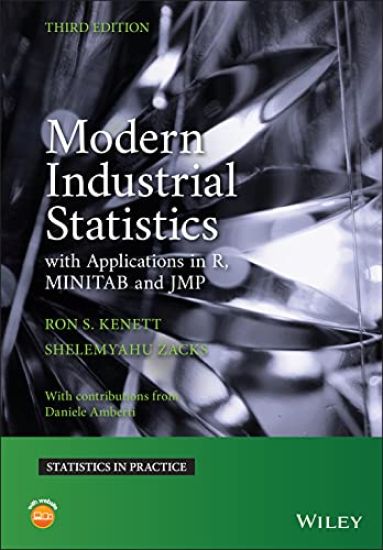
Modern Industrial Statistics The new edition of the prime reference on the tools of statistics used in industry and services, integrating theoretical, practical, and computer-based approachesModern Industrial Statistics is a leading reference and guide to the statistics tools widely used in industry and services. Designed to help professionals and students easily access relevant theoretical and practical information in a single volume, this standard resource employs a computer-intensive approach to industrial statistics and provides numerous examples and procedures in the popular R language and for MINITAB and JMP statistical analysis software. Divided into two parts, the text covers the principles of statistical thinking and analysis, bootstrapping, predictive analytics, Bayesian inference, time series analysis, acceptance sampling, statistical process control, design and analysis of experiments, simulation and computer experiments, and reliability and survival analysis. Part A, on computer age statistical analysis, can be used in general courses on analytics and statistics. Part B is focused on industrial statistics applications.The fully revised third edition covers the latest techniques in R, MINITAB and JMP, and features brand-new coverage of time series analysis, predictive analytics and Bayesian inference. New and expanded simulation activities, examples, and case studies—drawn from the electronics, metal work, pharmaceutical, and financial industries—are complemented by additional computer and modeling methods. Helping readers develop skills for modeling data and designing experiments, this comprehensive volume:Explains the use of computer-based methods such as bootstrapping and data visualizationCovers nonstandard techniques and applications of industrial statistical process control (SPC) chartsContains numerous problems, exercises, and data sets representing real-life case studies of statistical work in various business and industry settingsIncludes access to a companion website that contains an introduction to R, sample R code, csv files of all data sets, JMP add-ins, and downloadable appendicesProvides an author-created R package, mistat, that includes all data sets and statistical analysis applications used in the bookPart of the acclaimed Statistics in Practice series, Modern Industrial Statistics with Applications in R, MINITAB, and JMP, Third Edition, is the perfect textbook for advanced undergraduate and postgraduate courses in the areas of industrial statistics, quality and reliability engineering, and an important reference for industrial statisticians, researchers, and practitioners in related fields. The mistat R-package is available from the R CRAN repository.
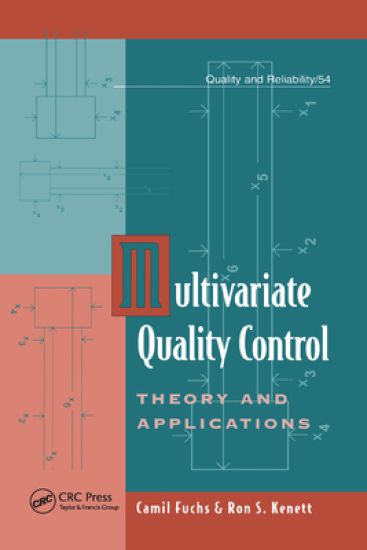
Provides a theoretical foundation as well as practical tools for the analysis of multivariate data, using case studies and MINITAB computer macros to illustrate basic and advanced quality control methods. This work offers an approach to quality control that relies on statistical tolerance regions, and discusses computer graphic analysis highlighting multivariate profile charts.
The essential guide for data scientists and for leaders who must get more from their data science teams The Economist boldly claims that data are now "the world's most valuable resource." But, as Kenett and Redman so richly describe, unlocking that value requires far more than technical excellence. The Real Work of Data Science explores understanding the problems, dealing with quality issues, building trust with decision makers, putting data science teams in the right organizational spots, and helping companies become data-driven. This is the work that spells the difference between a good data scientist and a great one, between a team that makes marginal contributions and one that drives the business, between a company that gains some value from its data and one in which data truly is "the most valuable resource." "These two authors are world-class experts on analytics, data management, and data quality; they've forgotten more about these topics than most of us will ever know. Their book is pragmatic, understandable, and focused on what really counts. If you want to do data science in any capacity, you need to read it."—Thomas H. Davenport, Distinguished Professor, Babson College and Fellow, MIT Initiative on the Digital Economy "I like your book. The chapters address problems that have faced statisticians for generations, updated to reflect today's issues, such as computational Big Data."—Sir David Cox, Warden of Nuffield College and Professor of Statistics, Oxford University "Data science is critical for competitiveness, for good government, for correct decisions. But what is data science? Kenett and Redman give, by far, the best introduction to the subject I have seen anywhere. They address the critical questions of formulating the right problem, collecting the right data, doing the right analyses, making the right decisions, and measuring the actual impact of the decisions. This book should become required reading in statistics and computer science departments, business schools, analytics institutes and, most importantly, by all business managers." —A. Blanton Godfrey, Joseph D. Moore Distinguished University Professor, Wilson College of Textiles, North Carolina State University
Provides an important framework for data analysts in assessing the quality of data and its potential to provide meaningful insights through analysis Analytics and statistical analysis have become pervasive topics, mainly due to the growing availability of data and analytic tools. Technology, however, fails to deliver insights with added value if the quality of the information it generates is not assured. Information Quality (InfoQ) is a tool developed by the authors to assess the potential of a dataset to achieve a goal of interest, using data analysis. Whether the information quality of a dataset is sufficient is of practical importance at many stages of the data analytics journey, from the pre-data collection stage to the post-data collection and post-analysis stages. It is also critical to various stakeholders: data collection agencies, analysts, data scientists, and management. This book: Explains how to integrate the notions of goal, data, analysis and utility that are the main building blocks of data analysis within any domain.Presents a framework for integrating domain knowledge with data analysis.Provides a combination of both methodological and practical aspects of data analysis.Discusses issues surrounding the implementation and integration of InfoQ in both academic programmes and business / industrial projects.Showcases numerous case studies in a variety of application areas such as education, healthcare, official statistics, risk management and marketing surveys.Presents a review of software tools from the InfoQ perspective along with example datasets on an accompanying website. This book will be beneficial for researchers in academia and in industry, analysts, consultants, and agencies that collect and analyse data as well as undergraduate and postgraduate courses involving data analysis.
Modern Analysis of Customer Surveys: with applications using R Customer survey studies deal with customer, consumer and user satisfaction from a product or service. In practice, many of the customer surveys conducted by business and industry are analyzed in a very simple way, without using models or statistical methods. Typical reports include descriptive statistics and basic graphical displays. This book demonstrates how integrating such basic analysis with more advanced tools, provides insights into non-obvious patterns and important relationships between the survey variables. This knowledge can significantly affect the conclusions derived from a survey. Key features: Provides an integrated case studies-based approach to analysing customer survey data.Presents a general introduction to customer surveys, within an organization’s business cycle.Contains classical techniques with modern and non standard tools.Focuses on probabilistic techniques from the area of statistics/data analysis and covers all major recent developments.Accompanied by a supporting website containing datasets and R scripts. Customer survey specialists, quality managers and market researchers will benefit from this book as well as specialists in marketing, data mining and business intelligence fields. www.wiley.com/go/modern_analysis STATISTICS IN PRACTICE A series of practical books outlining the use of statistical techniques in a wide range of applications areas: HUMAN AND BIOLOGICAL SCIENCESEARTH AND ENVIRONMENTAL SCIENCESINDUSTRY, COMMERCE AND FINANCE
Provides a theoretical foundation as well as practical tools for the analysis of multivariate data, using case studies and MINITAB computer macros to illustrate basic and advanced quality control methods. This work offers an approach to quality control that relies on statistical tolerance regions, and discusses computer graphic analysis highlighting multivariate profile charts.