Kirjojen hintavertailu. Mukana 12 390 323 kirjaa ja 12 kauppaa.

Kirjailija

Ronald E Day

Kirjat ja teokset yhdessä paikassa: 3 kirjaa, julkaisuja vuosilta 2001-2024, suosituimpien joukossa Ronald E. Day. Vertaile teosten hintoja ja tarkista saatavuus suomalaisista kirjakaupoista.

Mukana myös kirjoitusasut: Ronald E. Day

3 kirjaa

Kirjojen julkaisuhaarukka 2001-2024.

Ronald E. Day

Ronald E. Day

Ronald E Day

LITWIN BOOKS, LLC
2024
pokkari
This book contains two early papers written by Ronald E. Day while he was a student at the University of California, Berkeley, during 1992-1993, which mark the beginnings of his deconstruction of the modern conception of information as the latest form of Western metaphysics. The themes in these two pieces run throughout his later works. The papers demonstrate the intersection of formalist poetics and information science, and the appearance of phenomenology and critical theory in information studies. The problematics that they analyze, that of the temporality of information systems and the phenomenological appearance and constitution as knowledge of natural entities, along with the intersection of politics and information studies, remain relevant today.Ronald E. Day is Professor of Information and Library Science at University of Indiana Bloomington. His research is in the philosophy, history, politics, and culture of information, documentation, knowledge, and communication in the 20th and into the 21st centuries in the U.S. and Western Europe and in the discipline of Library and Information Science. The approach he takes is that of Critical Information Studies/ Critical Informatics. In this approach I use rhetorical, conceptual, and historical analyses. Along with many articles and book chapters, he has written Indexing it All: The Subject in the Age of Documentation, Information, and Data (MIT Press, 2014) and The Modern Invention of Information: Discourse, History, and Power (Southern Illinois University Press, 2001). He co-translated into English and co-edited the mid-twentieth century French documentalist Suzanne Briet's book, What is Documentation? With Claire McInerney he co-edited the book Rethinking Knowledge Management: From Knowledge Objects to Knowledge Processes.
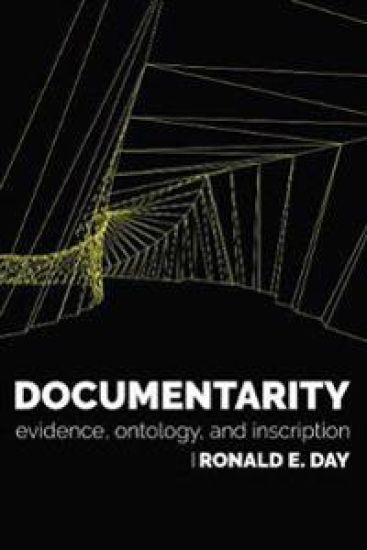
Documentarity

Documentarity

Ronald E. Day

MIT Press
2019
pokkari
A historical-conceptual account of the different genres, technologies, modes of inscription, and innate powers of expression by which something becomes evident.In this book, Ronald Day offers a historical-conceptual account of how something becomes evident. Crossing philosophical ontology with documentary ontology, Day investigates the different genres, technologies, modes of inscription, and innate powers of expression by which something comes into presence and makes itself evident. He calls this philosophy of evidence documentarity, and it is through this theoretical lens that he examines documentary evidence (and documentation) within the tradition of Western philosophy, largely understood as representational in its epistemology, ontology, aesthetics, and politics.Day discusses the expression of beings or entities as evidence of what exists through a range of categories and modes, from Plato's notion that ideas are universal types expressed in evidential particulars to the representation of powerful particulars in social media and machine learning algorithms. He considers, among other topics, the contrast between positivist and anthropological documentation traditions; the ontological and epistemological importance of the documentary index; the nineteenth-century French novel's documentary realism and the avant-garde's critique of representation; performative literary genres; expression as a form of self evidence; and the "post-documentation" technologies of social media and machine learning, described as a posteriori, real-time technologies of documentation. Ultimately, the representational means are not only information and knowledge technologies but technologies of judgment, judging entities both descriptively and prescriptively.
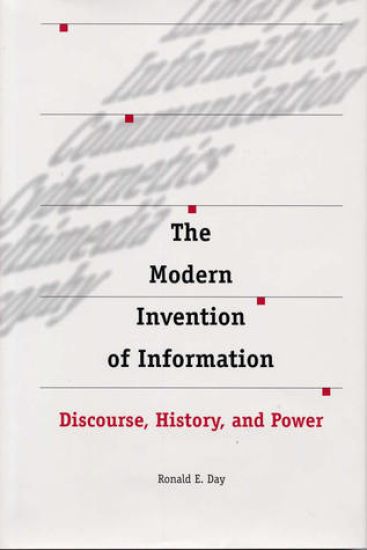
The Modern Invention of Information

The Modern Invention of Information

Ronald E Day

Southern Illinois University Press
2001
sidottu
Ronald E. Day provides a historically informed critical analysis of the concept and politics of information in the twentieth century. Analyzing texts in Europe and the United States, his critical reading method goes beyond traditional historiographical readings of communication and information by engaging specific historical texts in terms of their attempts to construct and reshape history. After laying the groundwork and justifying his method of close reading for this study, Day examines the texts of two pre-World War II documentalists, Paul Otlet and Suzanne Briet. Through the work of Otlet and Briet, Day shows how documentation and information were associated with concepts of cultural progress. Day also discusses the social expansion of the conduit metaphor in the works of Warren Weaver and Norbert Wiener. He then shows how the work of contemporary French multimedia theorist Pierre Levy refracts the earlier philosophical writings of Gilles Deleuze and Felix Guattari through the prism of the capitalist understanding of the "virtual society." Turning back to the pre-World War II period, Day examines two critics of the information society: Martin Heidegger and Walter Benjamin. He explains Heidegger's philosophical critique of the information culture's model of language and truth as well as Benjamin's aesthetic and historical critique of mass information and communication. Day concludes by contemplating the relation of critical theory and information, particularly in regard to the information culture's transformation of history, historiography, and historicity into positive categories of assumed and represented knowledge.