Kirjojen hintavertailu. Mukana 12 320 915 kirjaa ja 12 kauppaa.

Kirjailija

Ronald L. Lipsman

Kirjat ja teokset yhdessä paikassa: 6 kirjaa, julkaisuja vuosilta 1998-2018, suosituimpien joukossa The Mathematica ® Primer. Vertaile teosten hintoja ja tarkista saatavuus suomalaisista kirjakaupoista.

6 kirjaa

Kirjojen julkaisuhaarukka 1998-2018.

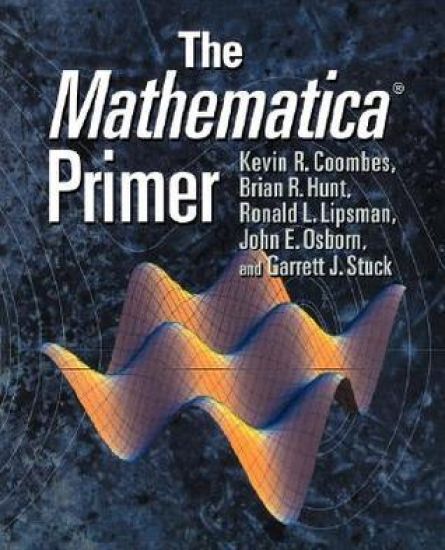
The Mathematica ® Primer

The Mathematica ® Primer

Kevin R. Coombes; Brian R. Hunt; Ronald L. Lipsman; John E. Osborn; Garrett J. Stuck

Cambridge University Press
1998
pokkari
This book is a short, focused introduction to Mathematica, the comprehensive software system for doing mathematics. Written for the beginning user, this engaging book contains an explanation of essential Mathematica commands, as well as the rich Mathematica interface for preparing polished technical documents. Mathematica can be used to graph functions, solve equations, perform statistics tests, and much more. In addition, it incorporates word processing and desktop publishing features for combining mathematical computations with text and graphics, and producing polished, integrated, interactive documents. You can even use it to create documents and graphics for the Web. This book explains everything you need to know to begin using Mathematica to do all these things and more. Written for Mathematica Version 3, this book can also be used with earlier versions of Mathematica, and even intermediate and advanced users may find useful information here, especially if they are making the switch to Version 3 from an earlier version.
Multivariable Calculus and Mathematica®

Multivariable Calculus and Mathematica®

Kevin R. Coombes; Ronald L. Lipsman; Jonathan M. Rosenberg

Springer-Verlag New York Inc.
1998
nidottu
One of the authors' stated goals for this publication is to "modernize" the course through the integration of Mathematica. Besides introducing students to the multivariable uses of Mathematica, and instructing them on how to use it as a tool in simplifying calculations, they also present intoductions to geometry, mathematical physics, and kinematics, topics of particular interest to engineering and physical science students. In using Mathematica as a tool, the authors take pains not to use it simply to define things as a whole bunch of new "gadgets" streamlined to the taste of the authors, but rather they exploit the tremendous resources built into the program. They also make it clear that Mathematica is not algorithms. At the same time, they clearly see the ways in which Mathematica can make things cleaner, clearer and simpler. The problem sets give students an opportunity to practice their newly learned skills, covering simple calculations with Mathematica, simple plots, a review of one-variable calculus using Mathematica for symbolic differentiation, integration and numberical integration. They also cover the practice of incorporating text and headings into a Mathematica notebook. A DOS-formatted diskette accompanies the printed work, containing both Mathematica 2.2 and 3.0 version notebooks, as well as sample examination problems for students. This supplementary work can be used with any standard multivariable calculus textbook. It is assumed that in most cases students will also have access to an introductory primer for Mathematica.
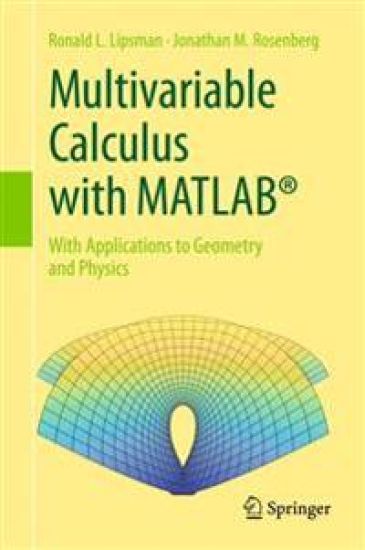
Multivariable Calculus with MATLAB®

Multivariable Calculus with MATLAB®

Ronald L. Lipsman; Jonathan M. Rosenberg

Springer International Publishing AG
2018
nidottu
This comprehensive treatment of multivariable calculus focuses on the numerous tools that MATLAB® brings to the subject, as it presents introductions to geometry, mathematical physics, and kinematics. Covering simple calculations with MATLAB®, relevant plots, integration, and optimization, the numerous problem sets encourage practice with newly learned skills that cultivate the reader’s understanding of the material. Significant examples illustrate each topic, and fundamental physical applications such as Kepler’s Law, electromagnetism, fluid flow, and energy estimation are brought to prominent position. Perfect for use as a supplement to any standard multivariable calculus text, a “mathematical methods in physics or engineering” class, for independent study, or even as the class text in an “honors” multivariable calculus course, this textbook will appeal to mathematics, engineering, and physical science students. MATLAB® is tightly integrated into every portion of this book, and its graphical capabilities are used to present vibrant pictures of curves and surfaces. Readers benefit from the deep connections made between mathematics and science while learning more about the intrinsic geometry of curves and surfaces. With serious yet elementary explanation of various numerical algorithms, this textbook enlivens the teaching of multivariable calculus and mathematical methods courses for scientists and engineers.
Multivariable Calculus with MATLAB®

Multivariable Calculus with MATLAB®

Ronald L. Lipsman; Jonathan M. Rosenberg

Springer International Publishing AG
2017
sidottu
This comprehensive treatment of multivariable calculus focuses on the numerous tools that MATLAB® brings to the subject, as it presents introductions to geometry, mathematical physics, and kinematics. Covering simple calculations with MATLAB®, relevant plots, integration, and optimization, the numerous problem sets encourage practice with newly learned skills that cultivate the reader’s understanding of the material. Significant examples illustrate each topic, and fundamental physical applications such as Kepler’s Law, electromagnetism, fluid flow, and energy estimation are brought to prominent position. Perfect for use as a supplement to any standard multivariable calculus text, a “mathematical methods in physics or engineering” class, for independent study, or even as the class text in an “honors” multivariable calculus course, this textbook will appeal to mathematics, engineering, and physical science students. MATLAB® is tightly integrated into every portion of this book, and its graphical capabilities are used to present vibrant pictures of curves and surfaces. Readers benefit from the deep connections made between mathematics and science while learning more about the intrinsic geometry of curves and surfaces. With serious yet elementary explanation of various numerical algorithms, this textbook enlivens the teaching of multivariable calculus and mathematical methods courses for scientists and engineers.
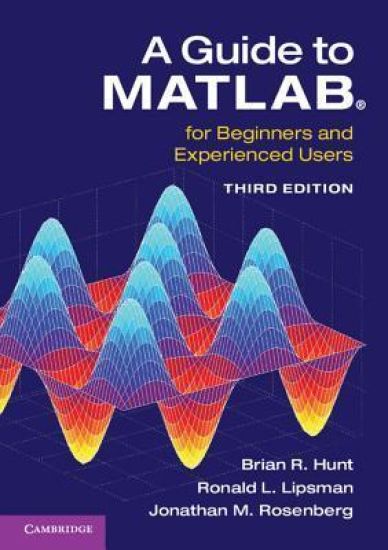
A Guide to MATLAB®

A Guide to MATLAB®

Brian R. Hunt; Ronald L. Lipsman; Jonathan M. Rosenberg

Cambridge University Press
2014
pokkari
Now in its third edition, this outstanding textbook explains everything you need to get started using MATLAB®. It contains concise explanations of essential MATLAB commands, as well as easily understood instructions for using MATLAB's programming features, graphical capabilities, simulation models, and rich desktop interface. MATLAB 8 and its new user interface is treated extensively in the book. New features in this edition include: a complete treatment of MATLAB's publish feature; new material on MATLAB graphics, enabling the user to master quickly the various symbolic and numerical plotting routines; and a robust presentation of MuPAD® and how to use it as a stand-alone platform. The authors have also updated the text throughout, reworking examples and exploring new applications. The book is essential reading for beginners, occasional users and experienced users wishing to brush up their skills. Further resources are available from the authors' website at www-math.umd.edu/schol/a-guide-to-matlab.html.
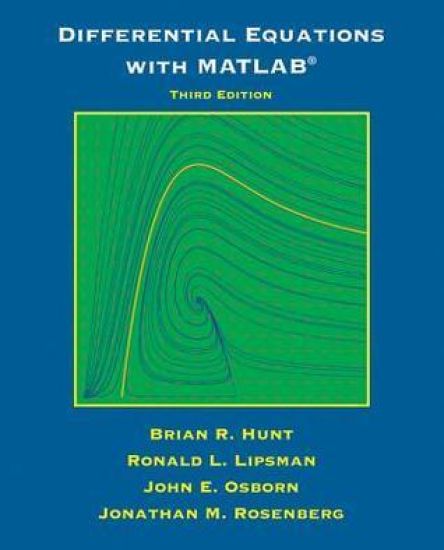
Differential Equations with Matlab

Differential Equations with Matlab

Brian R. Hunt; Ronald L. Lipsman; John E. Osborn; Jonathan M. Rosenberg

JOHN WILEY SONS INC
2012
nidottu
A supplemental text that can enrich and enhance any first course in ordinary differential equations This supplement helps instructors move towards an earlier use of numerical and geometric methods, place a greater emphasis on systems (including nonlinear ones), and increase discussions of both the benefits and possible pitfalls in numerical solution of ODEs. By providing an introduction to the software that is integrated with the relevant mathematics, Differential Equations with MATLAB can perfectly complement and enhance other texts from Wiley. Since the third edition of Differential Equations with MATLAB first appeared in 2012, there have been many changes and enhancements to MATLAB and Simulink. These include addition of live scripts, new plotting commands, and major changes to the Symbolic Math Toolbox. This revised version brings the text completely up to date with the 2019a release of MATLAB.