Kirjojen hintavertailu. Mukana 12 595 353 kirjaa ja 12 kauppaa.

Kirjailija

Ronald M. Glassman

Kirjat ja teokset yhdessä paikassa: 12 kirjaa, julkaisuja vuosilta 2000-2025, suosituimpien joukossa The Origins of Tyranny. Vertaile teosten hintoja ja tarkista saatavuus suomalaisista kirjakaupoista.

12 kirjaa

Kirjojen julkaisuhaarukka 2000-2025.

The Great Global Transformation

The Great Global Transformation

Ronald M. Glassman

Springer International Publishing AG
2025
sidottu
This book explores Karl Polanyi's concept of labor, land, and money as "fictional commodities" created by the market. Capitalism transformed these elements, shifting labor from artisanal crafts to factory wage work, land from communal ownership to private property, and money from a medium of exchange to capital for profit. The book extends Polanyi's vision to modern transformations, analyzing the impact of automation, Artificial Intelligence, and technological advancements on society. It examines the great changes in gender, sexuality, race, and religion, highlighting the ongoing evolution of social and cultural norms. Additionally, the book analyzes the complex relationship between free market capitalism and democracy, offering insights into the balance of power and the future of democratic governance in a rapidly changing world. This book critically analyzes the forces shaping contemporary society. It will appeal to students, scholars, and researchers in political science, economics, and the social sciences, interested in a better understanding of the great global transformation.
The Origins of Tyranny

The Origins of Tyranny

Ronald M. Glassman

Cognella, Inc
2023
pokkari
Featuring a uniquely philosophical lens, The Origins of Tyranny: War Chiefs, Divine Kings, Dictators, and Totalitarians provides readers with an exploration of the development of tyranny throughout history within tribes, great empires, city-states, and nations. The book points to the nature of the human species as a way of understanding the roots of tyranny, examining how our intelligent awareness of ourselves and the world around us paired with our innate instinct toward domination-submission have engendered both democratic and tyrannical tendencies. The book is organized into six distinct parts. Part I begins in hunter-gatherer times, exploring the rise of the alpha male and democracy in tribal societies, the transition from war chief to king, and the rise of the divine kingship. In Part II, students learn about oligarchy, democracy, and tyranny in Greek and Italian city-states and tyranny during the English and French revolutions. Part III discusses the progression of tyranny to totalitarianism in the 20th century, including material on Mussolini, Hitler, Stalin, and communist efforts in China and North Korea. Part IV introduces the concept of illiberal democracy, and Part V focuses on the causes of tyranny, including social crises, rapid social change, and political disorder. The final part speaks to the evolution of humanistic ethics and the question of whether women can save us from the alpha male. Developed to help students better understand how tyranny takes hold, as well as how it can be combated and prevented, The Origins of Tyranny is an ideal textbook for courses in world history, philosophy, sociology, and international relations.
Can Democracy Survive in the 21st Century?

Can Democracy Survive in the 21st Century?

Ronald M. Glassman

Springer Nature Switzerland AG
2022
nidottu
This book analyzes the many threats to democracy that exist in the 21st century and tries to understand how democracy can survive economic, social and political crises. It focuses on issues of oligarchy, tyranny, totalitarianism, and ochlocracy. It discusses how these forms of governance manifested themselves in ancient and medieval worlds, and how socio-economic transitions in the 21st century have created conditions that increasingly pose similar threats to modern democracy. The author discusses broad transitions in the contemporary world: economic transition to advanced, high technology capitalism; cultural transition from traditional religious and family values to norms focusing on racial equality, gender and transgender equality and liberation, and multiculturalism; also, transition from the traditional religious worldview to rational-scientific worldview, and from religious morality to secular humanist ethics. These taken together undergird the political transition from traditional authority, involving monarchy and aristocracy, to rational-legal authority, involving constitutional law and democratic participation. The book shows, through extensive country discussions, that whenever these transitions become difficult, undemocratic forms of governance may emerge and override democracy. Authored by an expert in the field, this book touches upon an especially topical theme in the contemporary world and is of interest to a wide readership across the social sciences, from researchers and students to discerning laypersons.
Can Democracy Survive in the 21st Century?

Can Democracy Survive in the 21st Century?

Ronald M. Glassman

Springer Nature Switzerland AG
2021
sidottu
This book analyzes the many threats to democracy that exist in the 21st century and tries to understand how democracy can survive economic, social and political crises. It focuses on issues of oligarchy, tyranny, totalitarianism, and ochlocracy. It discusses how these forms of governance manifested themselves in ancient and medieval worlds, and how socio-economic transitions in the 21st century have created conditions that increasingly pose similar threats to modern democracy. The author discusses broad transitions in the contemporary world: economic transition to advanced, high technology capitalism; cultural transition from traditional religious and family values to norms focusing on racial equality, gender and transgender equality and liberation, and multiculturalism; also, transition from the traditional religious worldview to rational-scientific worldview, and from religious morality to secular humanist ethics. These taken together undergird the political transition from traditional authority, involving monarchy and aristocracy, to rational-legal authority, involving constitutional law and democratic participation. The book shows, through extensive country discussions, that whenever these transitions become difficult, undemocratic forms of governance may emerge and override democracy. Authored by an expert in the field, this book touches upon an especially topical theme in the contemporary world and is of interest to a wide readership across the social sciences, from researchers and students to discerning laypersons.
The Future of Democracy

The Future of Democracy

Ronald M. Glassman

Springer Nature Switzerland AG
2020
nidottu
This book focuses on the processes that help stabilize democracy. It provides a socio-historical analysis of the future prospects of democracy.The link between advanced capitalism and democracy is emphasized, focusing on contract law and the separation of the economy from the state. The book also emphasizes the positive effects of the scientific world view on legal- rational authority. Aristotle’s theory of the majority middle class and its stabilizing effect on democracy is highlighted.This book describes the face to face democracies of the past in order to give us a better perspective on the high tech democracies of the future, making it appealing to students and academics in the political and social sciences.
The Future of Democracy

The Future of Democracy

Ronald M. Glassman

Springer Nature Switzerland AG
2019
sidottu
This book focuses on the processes that help stabilize democracy. It provides a socio-historical analysis of the future prospects of democracy.The link between advanced capitalism and democracy is emphasized, focusing on contract law and the separation of the economy from the state. The book also emphasizes the positive effects of the scientific world view on legal- rational authority. Aristotle’s theory of the majority middle class and its stabilizing effect on democracy is highlighted.This book describes the face to face democracies of the past in order to give us a better perspective on the high tech democracies of the future, making it appealing to students and academics in the political and social sciences.
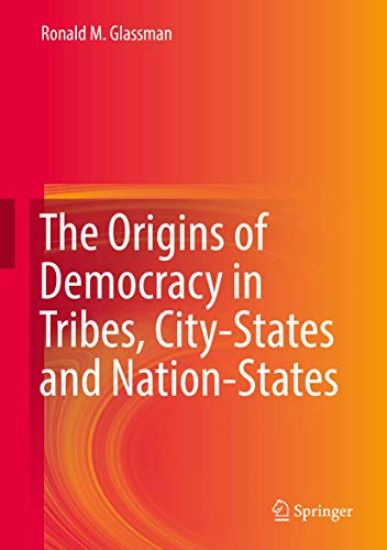
The Origins of Democracy in Tribes, City-States and Nation-States

The Origins of Democracy in Tribes, City-States and Nation-States

Ronald M. Glassman

Springer International Publishing AG
2018
nidottu
This four-part work describes and analyses democracy and despotism in tribes, city-states, and nation states. The theoretical framework used in this work combines Weberian, Aristotelian, evolutionary anthropological, and feminist theories in a comparative-historical context. The dual nature of humans, as both an animal and a consciously aware being, underpins the analysis presented. Part One covers tribes. It uses anthropological literature to describe the “campfire democracy” of the African Bushmen, the Pygmies, and other band societies. Its main focus is on the tribal democracy of the Cheyenne, Iroquois, Huron, and other tribes, and it pays special attention to the role of women in tribal democracies. Part Two describes the city-states of Mesopotamia, Syria, and Canaan-Phoenicia, and includes a section on the theocracy of the Jews. This part focuses on the transition from tribal democracy to city-state democracy in the ancient Middle East – from the Sumerian city-statesto the Phoenician. Part Three focuses on the origins of democracy and covers Greece—Mycenaean, Dorian, and the Golden Age. It presents a detailed description of the tribal democracy of Archaic Greece – emphasizing the causal effect of the hoplite-phalanx military formation in egalitarianizing Greek tribal society. Next, it analyses the transition from tribal to city-state democracy—with the new commercial classes engendering the oligarchic and democratic conflicts described by Plato and Aristotle. Part Four describes the Norse tribes as they contacted Rome, the rise of kingships, the renaissance of the city-states, and the parliamentary monarchies of the emerging nation-states. It provides details of the rise of commercial city states in Renaissance Italy, Hanseatic Germany and the Netherlands.
The Origins of Democracy in Tribes, City-States and Nation-States

The Origins of Democracy in Tribes, City-States and Nation-States

Ronald M. Glassman

Springer International Publishing AG
2017
sidottu
This four-part work describes and analyses democracy and despotism in tribes, city-states, and nation states. The theoretical framework used in this work combines Weberian, Aristotelian, evolutionary anthropological, and feminist theories in a comparative-historical context. The dual nature of humans, as both an animal and a consciously aware being, underpins the analysis presented. Part One covers tribes. It uses anthropological literature to describe the “campfire democracy” of the African Bushmen, the Pygmies, and other band societies. Its main focus is on the tribal democracy of the Cheyenne, Iroquois, Huron, and other tribes, and it pays special attention to the role of women in tribal democracies. Part Two describes the city-states of Mesopotamia, Syria, and Canaan-Phoenicia, and includes a section on the theocracy of the Jews. This part focuses on the transition from tribal democracy to city-state democracy in the ancient Middle East – from the Sumerian city-statesto the Phoenician. Part Three focuses on the origins of democracy and covers Greece—Mycenaean, Dorian, and the Golden Age. It presents a detailed description of the tribal democracy of Archaic Greece – emphasizing the causal effect of the hoplite-phalanx military formation in egalitarianizing Greek tribal society. Next, it analyses the transition from tribal to city-state democracy—with the new commercial classes engendering the oligarchic and democratic conflicts described by Plato and Aristotle. Part Four describes the Norse tribes as they contacted Rome, the rise of kingships, the renaissance of the city-states, and the parliamentary monarchies of the emerging nation-states. It provides details of the rise of commercial city states in Renaissance Italy, Hanseatic Germany and the Netherlands.
Social Problems in Global Perspective

Social Problems in Global Perspective

Ronald M. Glassman; Swatos; Barbara J. Denison

University Press of America
2004
nidottu
The global high-tech economy has generated a technological and scientific productive miracle. But along with the miracle has come problems. Social Problems in Global Perspective focuses on some of these problems, including family decline, divorce and single parenting; the gender war- with men and women distrustful and threatened by one another in the workplace, the home, and the bedroom- the moral malaise created by science and religion, the media, and morality. This book presents detailed chapters on the high-tech economy, religious fundamentalism, terrorism, and ethnic conflicts. It also includes chapters on homosexuality and AIDS, the world population explosion, and pop culture.
Caring Capitalism

Caring Capitalism

Ronald M. Glassman

Palgrave Macmillan
2000
sidottu
Everywhere one travels in the world, people are excited about the new high technology production system. But the global villagers are also perplexed about the new social service needs that seem to accompany the high-tech economy: child care needs for working couples, elder care facilities for infirm senior citizens, burgeoning health care costs accompanying high-tech medicine, nursery school and college tuition costs, and more. There has been a global response to these social service needs, and this book will present and analyse that response. For, a new phenomenon may be emerging, as contradictory as it may appear, a kind of 'caring capitalism' may arise, worldwide. This book explores the various attempts around the globe to create a system of 'caring capitalism' and why nations have been pressured by the 'new middle class' to do so.
Caring Capitalism

Caring Capitalism

Ronald M. Glassman

Palgrave Macmillan
2000
nidottu
Everywhere one travels in the world, people are excited about the new high technology production system. But the global villagers are also perplexed about the new social service needs that seem to accompany the high-tech economy: child care needs for working couples, elder care facilities for infirm senior citizens, burgeoning health care costs accompanying high-tech medicine, nursery school and college tuition costs, and more. There has been a global response to these social service needs, and this book will present and analyse that response. For, a new phenomenon may be emerging, as contradictory as it may appear, a kind of 'caring capitalism' may arise, worldwide. This book explores the various attempts around the globe to create a system of 'caring capitalism' and why nations have been pressured by the 'new middle class' to do so.
Caring Capitalism

Caring Capitalism

Ronald M. Glassman

Palgrave Macmillan
2000
sidottu
Everywhere one travels in the world, people are excited about the new high technology production system. But the global villagers are also perplexed about the new social service needs that seem to accompany the high-tech economy: child care needs for working couples, elder care facilities for infirm senior citizens, burgeoning health care costs accompanying high-tech medicine, nursery school and college tuition costs, and more. There has been a global response to these social service needs, and this book will present and analyse that response. For, a new phenomenon may be emerging, as contradictory as it may appear, a kind of 'caring capitalism' may arise, worldwide. This book explores the various attempts around the globe to create a system of 'caring capitalism' and why nations have been pressured by the 'new middle class' to do so.