Kirjojen hintavertailu. Mukana 12 273 452 kirjaa ja 12 kauppaa.

Kirjailija

Ronald W. Shonkwiler

Kirjat ja teokset yhdessä paikassa: 8 kirjaa, julkaisuja vuosilta 2009-2025, suosituimpien joukossa Explorations in Monte Carlo Methods. Vertaile teosten hintoja ja tarkista saatavuus suomalaisista kirjakaupoista.

8 kirjaa

Kirjojen julkaisuhaarukka 2009-2025.

Explorations in Monte Carlo Methods

Explorations in Monte Carlo Methods

Ronald W. Shonkwiler; Franklin Mendivil

Springer International Publishing AG
2025
nidottu
Monte Carlo Methods are among the most used, and useful, computational tools available today. They provide efficient and practical algorithms to solve a wide range of scientific and engineering problems in dozens of areas many of which are covered in this text. These include simulation, optimization, finance, statistical mechanics, birth and death processes, Bayesian inference, quadrature, gambling systems and more. This text is for students of engineering, science, economics and mathematics who want to learn about Monte Carlo methods but have only a passing acquaintance with probability theory. The probability needed to understand the material is developed within the text itself in a direct manner using Monte Carlo experiments for reinforcement. There is a prerequisite of at least one year of calculus and a semester of matrix algebra. Each new idea is carefully motivated by a realistic problem, thus leading to insights into probability theory via examples and numerical simulations. Programming exercises are integrated throughout the text as the primary vehicle for learning the material. All examples in the text are coded in Python as a representative language; the logic is sufficiently clear so as to be easily translated into any other language. Further, Python scripts for each worked example are freely accessible for each chapter. Along the way, most of the basic theory of probability is developed in order to illuminate the solutions to the questions posed. One of the strongest features of the book is the wealth of completely solved example problems. These provide the reader with a sourcebook to follow towards the solution of their own computational problems. Each chapter ends with a large collection of homework problems illustrating and directing the material. This book is suitable as a textbook for students of engineering, finance, and the sciences as well as mathematics. The problem-oriented approach makes it ideal for an applied course in basic probability as well as for a more specialized course in Monte Carlo Methods. Topics include probability distributions, probability calculations, sampling, counting combinatorial objects, Markov chains, random walks, simulated annealing, genetic algorithms, option pricing, gamblers ruin, statistical mechanics, random number generation, Bayesian Inference, Gibbs Sampling and Monte Carlo integration.
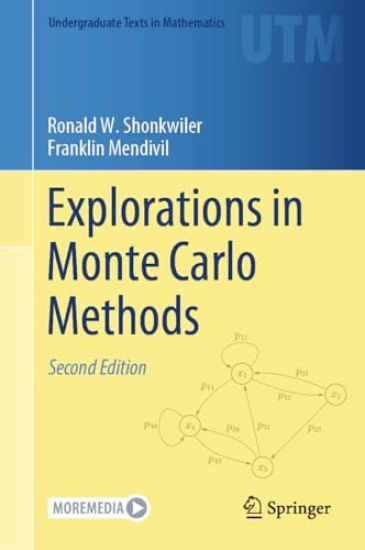
Explorations in Monte Carlo Methods

Explorations in Monte Carlo Methods

Ronald W. Shonkwiler; Franklin Mendivil

Springer International Publishing AG
2024
sidottu
Monte Carlo Methods are among the most used, and useful, computational tools available today. They provide efficient and practical algorithms to solve a wide range of scientific and engineering problems in dozens of areas many of which are covered in this text. These include simulation, optimization, finance, statistical mechanics, birth and death processes, Bayesian inference, quadrature, gambling systems and more.This text is for students of engineering, science, economics and mathematics who want to learn about Monte Carlo methods but have only a passing acquaintance with probability theory. The probability needed to understand the material is developed within the text itself in a direct manner using Monte Carlo experiments for reinforcement. There is a prerequisite of at least one year of calculus and a semester of matrix algebra.Each new idea is carefully motivated by a realistic problem, thus leading to insights into probability theory via examples and numerical simulations. Programming exercises are integrated throughout the text as the primary vehicle for learning the material. All examples in the text are coded in Python as a representative language; the logic is sufficiently clear so as to be easily translated into any other language. Further, Python scripts for each worked example are freely accessible for each chapter. Along the way, most of the basic theory of probability is developed in order to illuminate the solutions to the questions posed. One of the strongest features of the book is the wealth of completely solved example problems. These provide the reader with a sourcebook to follow towards the solution of their own computational problems. Each chapter ends with a large collection of homework problems illustrating and directing the material. This book is suitable as a textbook for students of engineering, finance, and the sciences as well as mathematics. The problem-oriented approach makes it ideal for an applied course in basic probability as well as for a more specialized course in Monte Carlo Methods. Topics include probability distributions, probability calculations, sampling, counting combinatorial objects, Markov chains, random walks, simulated annealing, genetic algorithms, option pricing, gamblers ruin, statistical mechanics, random number generation, Bayesian Inference, Gibbs Sampling and Monte Carlo integration.

Finance with Monte Carlo

Finance with Monte Carlo

Ronald W. Shonkwiler

Springer-Verlag New York Inc.
2016
nidottu
This text introduces upper division undergraduate/beginning graduate students in mathematics, finance, or economics, to the core topics of a beginning course in finance/financial engineering. Particular emphasis is placed on exploiting the power of the Monte Carlo method to illustrate and explore financial principles. Monte Carlo is the uniquely appropriate tool for modeling the random factors that drive financial markets and simulating their implications.The Monte Carlo method is introduced early and it is used in conjunction with the geometric Brownian motion model (GBM) to illustrate and analyze the topics covered in the remainder of the text. Placing focus on Monte Carlo methods allows for students to travel a short road from theory to practical applications. Coverage includes investment science, mean-variance portfolio theory, option pricing principles, exotic options, option trading strategies, jump diffusion and exponential Lévy alternative models, and the Kelly criterion for maximizing investment growth.Novel features:inclusion of both portfolio theory and contingent claim analysis in a single textpricing methodology for exotic optionsexpectation analysis of option trading strategiespricing models that transcend the Black–Scholes frameworkoptimizing investment allocationsconcepts thoroughly explored through numerous simulation exercisesnumerous worked examples and illustrationsThe mathematical background required is a year and one-half course in calculus, matrix algebra covering solutions of linear systems, and a knowledge of probability including expectation, densities and the normal distribution. A refresher for these topics is presented in the Appendices. The programming background needed is how to code branching, loops and subroutines in some mathematical or general purpose language. The mathematical background required is a year and one-half course in calculus, matrix algebra covering solutions of linear systems, and a knowledge of probability including expectation, densities and the normal distribution. A refresher for these topics is presented in the Appendices. The programming background needed is how to code branching, loops and subroutines in some mathematical or general purpose language. Also by the author: (with F. Mendivil) Explorations in Monte Carlo, ©2009, ISBN: 978-0-387-87836-2; (with J. Herod) Mathematical Biology: An Introduction with Maple and Matlab, Second edition, ©2009, ISBN: 978-0-387-70983-3.
Explorations in Monte Carlo Methods

Explorations in Monte Carlo Methods

Ronald W. Shonkwiler; Franklin Mendivil

Springer-Verlag New York Inc.
2014
nidottu
Monte Carlo methods are among the most used and useful computational tools available today, providing efficient and practical algorithims to solve a wide range of scientific and engineering problems. Explorations in Monte Carlo Methods provides a hands-on approach to learning this subject. Each new idea is carefully motivated by a realistic problem, thus leading from questions to theory via examples and numerical simulations. Programming exercises are integrated throughout the text as the primary vehicle for learning the material. Each chapter ends with a large collection of problems illustrating and directing the material. This book is suitable as a textbook for students of engineering and the sciences, as well as mathematics. The problem-oriented approach makes it ideal for an applied course in basic probability and for a more specialized course in Monte Carlo methods. Topics include probability distributions, counting combinatorial objects, simulated annealing, genetic algorithms, option pricing, gamblers ruin, statistical mechanics, sampling, and random number generation.
Mathematical Biology

Mathematical Biology

Ronald W. Shonkwiler; James Herod

Springer-Verlag New York Inc.
2014
nidottu
Biology is a source of fascination for most scientists, whether their training is in the life sciences or not. In particular, there is a special satisfaction in discovering an understanding of biology in the context of another science like mathematics. For- nately there are plenty of interesting problems (and fun) in biology, and virtually all scienti?c disciplines have become the richer for it. For example, two major journals, MathematicalBiosciences andJournalofMathematicalBiology, have tripled in size since their inceptions 20-25 years ago. More recently, the advent of genomics has spawned whole new ?elds of study in thebiosciences,?eldssuchasproteomics,comparativegenomics,genomicmedicine, pharmacogenomics, and structural genomics among them. These new disciplines are as much mathematical as biological. Thevariousscienceshaveagreatdealtogivetooneanother, buttherearestilltoo many fences separating them. In writing this book we have adopted the philosophy that mathematical biology is not merely the intrusion of one science into another, but that it has a unity of its own, in which both biology and mathematics should be equal, complete, and ?ow smoothly into and out of one another. There is a timeliness in calculating a protocol for administering a drug. Likewise, the signi?cance of bones being "sinks" for lead accumulation while bonemeal is being sold as a dietary c- cium supplement adds new meaning to mathematics as alifescience. The dynamics of a compartmentalized system are classical; applications to biology can be novel. Exponential and logistic population growths are standard studies; the delay in the increaseofAIDScasesbehindtheincreaseintheHIV-positivepopulationisprovo- tive.
Finance with Monte Carlo

Finance with Monte Carlo

Ronald W. Shonkwiler

Springer-Verlag New York Inc.
2013
sidottu
This text introduces upper division undergraduate/beginning graduate students in mathematics, finance, or economics, to the core topics of a beginning course in finance/financial engineering. Particular emphasis is placed on exploiting the power of the Monte Carlo method to illustrate and explore financial principles. Monte Carlo is the uniquely appropriate tool for modeling the random factors that drive financial markets and simulating their implications.The Monte Carlo method is introduced early and it is used in conjunction with the geometric Brownian motion model (GBM) to illustrate and analyze the topics covered in the remainder of the text. Placing focus on Monte Carlo methods allows for students to travel a short road from theory to practical applications. Coverage includes investment science, mean-variance portfolio theory, option pricing principles, exotic options, option trading strategies, jump diffusion and exponential Lévy alternative models, and the Kelly criterion for maximizing investment growth.Novel features:inclusion of both portfolio theory and contingent claim analysis in a single textpricing methodology for exotic optionsexpectation analysis of option trading strategiespricing models that transcend the Black–Scholes frameworkoptimizing investment allocationsconcepts thoroughly explored through numerous simulation exercisesnumerous worked examples and illustrationsThe mathematical background required is a year and one-half course in calculus, matrix algebra covering solutions of linear systems, and a knowledge of probability including expectation, densities and the normal distribution. A refresher for these topics is presented in the Appendices. The programming background needed is how to code branching, loops and subroutines in some mathematical or general purpose language. The mathematical background required is a year and one-half course in calculus, matrix algebra covering solutions of linear systems, and a knowledge of probability including expectation, densities and the normal distribution. A refresher for these topics is presented in the Appendices. The programming background needed is how to code branching, loops and subroutines in some mathematical or general purpose language. Also by the author: (with F. Mendivil) Explorations in Monte Carlo, ©2009, ISBN: 978-0-387-87836-2; (with J. Herod) Mathematical Biology: An Introduction with Maple and Matlab, Second edition, ©2009, ISBN: 978-0-387-70983-3.
Explorations in Monte Carlo Methods

Explorations in Monte Carlo Methods

Ronald W. Shonkwiler; Franklin Mendivil

Springer-Verlag New York Inc.
2009
sidottu
Monte Carlo methods are among the most used and useful computational tools available today, providing efficient and practical algorithims to solve a wide range of scientific and engineering problems. Explorations in Monte Carlo Methods provides a hands-on approach to learning this subject. Each new idea is carefully motivated by a realistic problem, thus leading from questions to theory via examples and numerical simulations. Programming exercises are integrated throughout the text as the primary vehicle for learning the material. Each chapter ends with a large collection of problems illustrating and directing the material. This book is suitable as a textbook for students of engineering and the sciences, as well as mathematics. The problem-oriented approach makes it ideal for an applied course in basic probability and for a more specialized course in Monte Carlo methods. Topics include probability distributions, counting combinatorial objects, simulated annealing, genetic algorithms, option pricing, gamblers ruin, statistical mechanics, sampling, and random number generation.
Mathematical Biology

Mathematical Biology

Ronald W. Shonkwiler; James Herod

Springer-Verlag New York Inc.
2009
sidottu
Biology is a source of fascination for most scientists, whether their training is in the life sciences or not. In particular, there is a special satisfaction in discovering an understanding of biology in the context of another science like mathematics. For- nately there are plenty of interesting problems (and fun) in biology, and virtually all scienti?c disciplines have become the richer for it. For example, two major journals, MathematicalBiosciences andJournalofMathematicalBiology, have tripled in size since their inceptions 20-25 years ago. More recently, the advent of genomics has spawned whole new ?elds of study in thebiosciences,?eldssuchasproteomics,comparativegenomics,genomicmedicine, pharmacogenomics, and structural genomics among them. These new disciplines are as much mathematical as biological. Thevariousscienceshaveagreatdealtogivetooneanother, buttherearestilltoo many fences separating them. In writing this book we have adopted the philosophy that mathematical biology is not merely the intrusion of one science into another, but that it has a unity of its own, in which both biology and mathematics should be equal, complete, and ?ow smoothly into and out of one another. There is a timeliness in calculating a protocol for administering a drug. Likewise, the signi?cance of bones being "sinks" for lead accumulation while bonemeal is being sold as a dietary c- cium supplement adds new meaning to mathematics as alifescience. The dynamics of a compartmentalized system are classical; applications to biology can be novel. Exponential and logistic population growths are standard studies; the delay in the increaseofAIDScasesbehindtheincreaseintheHIV-positivepopulationisprovo- tive.