Kirjojen hintavertailu. Mukana 12 595 353 kirjaa ja 12 kauppaa.

Kirjailija

Ronaldo C. Prati

Kirjat ja teokset yhdessä paikassa: 2 kirjaa, julkaisuja vuosilta 2018-2019, suosituimpien joukossa Learning from Imbalanced Data Sets. Vertaile teosten hintoja ja tarkista saatavuus suomalaisista kirjakaupoista.

2 kirjaa

Kirjojen julkaisuhaarukka 2018-2019.

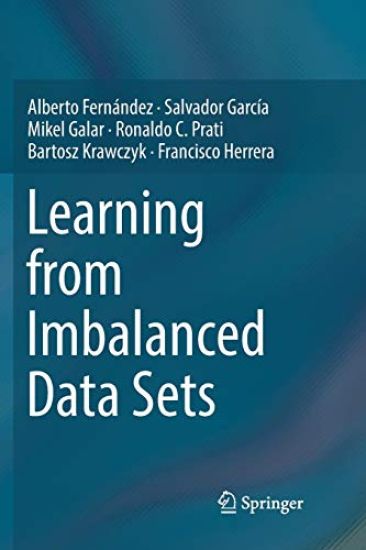
Learning from Imbalanced Data Sets

Learning from Imbalanced Data Sets

Alberto Fernández; Salvador García; Mikel Galar; Ronaldo C. Prati; Bartosz Krawczyk; Francisco Herrera

Springer Nature Switzerland AG
2019
nidottu
This book provides a general and comprehensible overview of imbalanced learning. It contains a formal description of a problem, and focuses on its main features, and the most relevant proposed solutions. Additionally, it considers the different scenarios in Data Science for which the imbalanced classification can create a real challenge. This book stresses the gap with standard classification tasks by reviewing the case studies and ad-hoc performance metrics that are applied in this area. It also covers the different approaches that have been traditionally applied to address the binary skewed class distribution. Specifically, it reviews cost-sensitive learning, data-level preprocessing methods and algorithm-level solutions, taking also into account those ensemble-learning solutions that embed any of the former alternatives. Furthermore, it focuses on the extension of the problem for multi-class problems, where the former classical methods are no longer to be applied in a straightforward way.This book also focuses on the data intrinsic characteristics that are the main causes which, added to the uneven class distribution, truly hinders the performance of classification algorithms in this scenario. Then, some notes on data reduction are provided in order to understand the advantages related to the use of this type of approaches.Finally this book introduces some novel areas of study that are gathering a deeper attention on the imbalanced data issue. Specifically, it considers the classification of data streams, non-classical classification problems, and the scalability related to Big Data. Examples of software libraries and modules to address imbalanced classification are provided.This book is highly suitable for technical professionals, senior undergraduate and graduate students in the areas of data science, computer science and engineering. It will also be useful for scientists and researchers to gain insight on the current developments in this area of study, as well as future research directions.
Learning from Imbalanced Data Sets

Learning from Imbalanced Data Sets

Alberto Fernández; Salvador García; Mikel Galar; Ronaldo C. Prati; Bartosz Krawczyk; Francisco Herrera

Springer International Publishing AG
2018
sidottu
This book provides a general and comprehensible overview of imbalanced learning. It contains a formal description of a problem, and focuses on its main features, and the most relevant proposed solutions. Additionally, it considers the different scenarios in Data Science for which the imbalanced classification can create a real challenge. This book stresses the gap with standard classification tasks by reviewing the case studies and ad-hoc performance metrics that are applied in this area. It also covers the different approaches that have been traditionally applied to address the binary skewed class distribution. Specifically, it reviews cost-sensitive learning, data-level preprocessing methods and algorithm-level solutions, taking also into account those ensemble-learning solutions that embed any of the former alternatives. Furthermore, it focuses on the extension of the problem for multi-class problems, where the former classical methods are no longer to be applied in a straightforward way.This book also focuses on the data intrinsic characteristics that are the main causes which, added to the uneven class distribution, truly hinders the performance of classification algorithms in this scenario. Then, some notes on data reduction are provided in order to understand the advantages related to the use of this type of approaches.Finally this book introduces some novel areas of study that are gathering a deeper attention on the imbalanced data issue. Specifically, it considers the classification of data streams, non-classical classification problems, and the scalability related to Big Data. Examples of software libraries and modules to address imbalanced classification are provided.This book is highly suitable for technical professionals, senior undergraduate and graduate students in the areas of data science, computer science and engineering. It will also be useful for scientists and researchers to gain insight on the current developments in this area of study, as well as future research directions.