Kirjojen hintavertailu. Mukana 12 595 353 kirjaa ja 12 kauppaa.

Kirjailija

Ronnie Lessem

Kirjat ja teokset yhdessä paikassa: 22 kirjaa, julkaisuja vuosilta 1994-2024, suosituimpien joukossa Beyond Leadership. Vertaile teosten hintoja ja tarkista saatavuus suomalaisista kirjakaupoista.

22 kirjaa

Kirjojen julkaisuhaarukka 1994-2024.

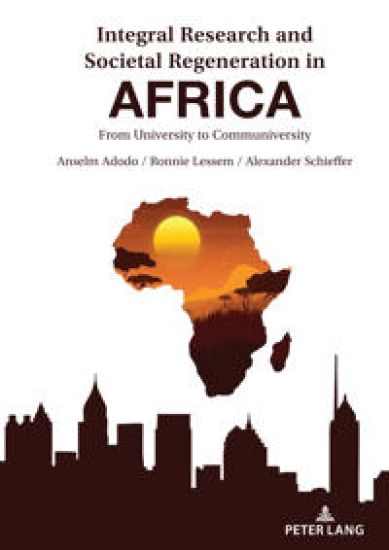
Integral Research and Societal Regeneration in Africa

Integral Research and Societal Regeneration in Africa

Anselm Adodo; Ronnie Lessem; Alexander Schieffer

PETER LANG AG
2024
sidottu
Embark on a journey through Africa’s social innovation landscape with this groundbreaking book, which presents a comprehensive framework for transformative change. Across its five captivating parts, it intricately weaves together cultural heritage, participatory research methods, and authentic storytelling to mitigate the adverse effects of globalization. Probe into the concepts of “Communitalism” and “Communiversity”, explore African phenomenology, and embrace critical realism as avenues for understanding and catalyzing positive change. This is a vital resource for researchers, policymakers, and individuals committed to shaping Africa’s trajectory towards a more equitable and sustainable future.
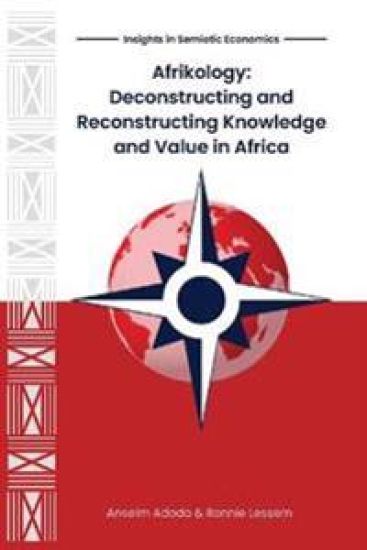
Afrikology

Afrikology

Anselm Adodo; Ronnie Lessem

Beacon Academic
2021
pokkari
During the twentieth century, global politics and economics have been marked by two politically, economically, and intellectually divi - sive rather than culturally and psychologically integrative forces. This has been reflected in the "East/West" mutually antagonistic divide of communism/capitalism and the North/South chasm of wealth and poverty. The result, worldwide, has been, to a considerable degree, stasis and disintegration. In this book, the authors argue that both capitalism and communism were born out of narrow views of our hu - manity, ignoring the cultural richness of the rest of the world. The evidence is everywhere: climate change, terrorism, rising poverty, political tension, social chaos and food insecurity. But this is not a book of lamentations. The authors present real case studies to dem - onstrate that there is an alternative to the current chaos: Afrikology. It is "Afri-" because it is inspired by ideas initially produced in Africa, the cradle of humankind; it is "ko (logy)" because it is based on logos, the word from which the world was originated, but at the same time, an episteme, a worldly-wise eco-logical knowledge, and consciousness. It stands for a plurality of epistemic directions. Knowledge, therefore, is an interpretation that is always situated within a living communal tradition, co-created by individuals, communities, and enterprises, specifically out of Africa's genius, alongside others.
Embodying Integral Development

Embodying Integral Development

Ronnie Lessem

Routledge
2020
nidottu
In this fourth and final volume of the CARE-ing for Integral Development series, Ronnie Lessem integrates all that has come before in terms of: Community activation; Awakening integral consciousness; and institutionalized Research. Here he focuses on individual and community development alongside that of the organization or society, and sets it in the context of an integral economy. The four critical success factors identified in recognizing and releasing integral development aligned with CARE are: GROUNDING – linking up with and building upon existing local and global movements for socio-economic development; EMERGENCE – maintaining interconnected focus; NAVIGATING – locating and developing GENE-ius in a particular community/society; EFFECTING – committing to resolving an issue and identifying the most fertile development path. Embodying Integral Development offers a comprehensive system of accreditation. Supported by examples and illustrations of CARE, this book makes a case for Integral Development as a whole. It argues that it is a qualitative means of self-assessment rather than a quantitative one, focused on engagement, immersion and interpretation, as well as evaluation, rather than empirical verification.
Evolving Work

Evolving Work

Ronnie Lessem; Tony Bradley

Routledge
2020
nidottu
The idea of Self and the authenticity of particular identities have been rapidly dissolving in the acids of post-modern globalising capitalism. The hegemony of patterns of work, wage-labor and the operation of labour markets in the American West (and European North) has ridden rough-shod over distinctive ways of enabling communities to flourish in many parts of the Southern and Eastern worlds (Global South). But, this is not inevitable. Indeed, as this book indicates, there are many practical examples across the globe – that connect with some of the most significant theoretical challenges to the operation of dehumanising work – which reveal that a profound reversal is taking place. As such, the core theme of this book is to show that a movement is occurring whereby self-employment can be transformed into communal work that employs the Self in ways that release the authentic vocations of people, individually and collectively.The approach taken in these chapters traverses the globe, utilising the original ‘integral worlds’ model that will be familiar to students of the Trans4M/Routledge Transformation and Innovation series, developed over more than a decade. Such a standpoint points the way to the release of particular social and economic cultures in each of what we term the four "realities" or "worldviews" of South, East, North and Western worlds. In this book we use the methodology of GENEalogy – identifying the realms associated with each world – to show how the rhythms, that is Grounding, Emergence, Navigation and Effect, of each is leading to greater economic, social and spiritual freedom for individuals, organisations, communities and, indeed, entire societies.
Nhakanomics

Nhakanomics

Ronnie Lessem; Munyaradzi Mawere; Daud Taranhike

Africa Talent Publishers
2019
pokkari
Nhakanomics: Harvesting Knowledge and Value for Re-generation Through Social Innovation is a radical departure from the commonly held belief that neo-liberal economics from the US and the West is universal, and is the only solution to underdevelopment and poverty throughout the world. Instead, the book teases out and theorises the intellectually rutted terrain of development studies, and neo-liberal economics from a decolonial Pan-Africanist perspective. Following a path of social innovation, with perspectives drawn from social anthropology, economics, and business and management studies Nhakanomics is a unique socio-economic approach applicable in the Global South and in Southern Africa in particular. The study argues that the process and substance of nhakanomics with its pre-emphasis on the relational South provides a robust and holistic approach to social innovation and social transformation grounded in relational networks and 'meshworks'. The central idea is a call to re-GENE-rate society, through local Grounding and Origination, and tapping into local-global Emergent Foundations via a newly global Emancipatory Navigation, while ultimately culminating in global-local transformative Effects in four recursive cycles of re-GENE-rating C(K)umusha, Culture, Communication, and Capital after re-Constituting Africa-the 5Cs. With a novel and radical approach the book is an interrogation of neo-liberal economics in the Global South. As such, this book is remarkably handy to students and practitioners in the fields of economics, development studies, political science, science and technology studies, business management, sociology, transformation studies, and development related non-Governmental Organisations working with grassroots communities.
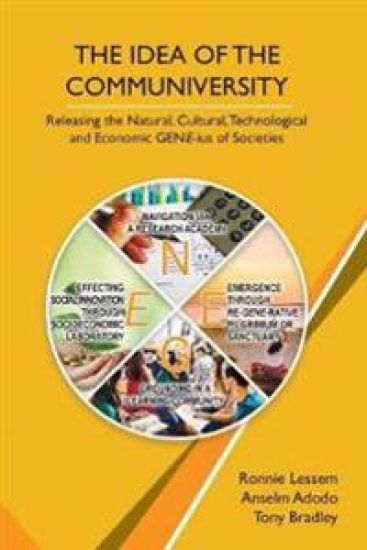
The Idea of the Communiversity

The Idea of the Communiversity

Ronnie Lessem; Anselm Adodo; Tony Bradley

Beacon Books and Media Ltd
2019
pokkari
This book takes an integral world's approach to societal transformation, by pointing to ways in which we can reform our modes of knowledge creation. Through the fourfold model of community, pilgrimium, academy and co-laboratory, the authors have re-conceptualised a university for every people and culture.
Evolving Work

Evolving Work

Ronnie Lessem; Tony Bradley

CRC Press Inc
2018
sidottu
The idea of Self and the authenticity of particular identities have been rapidly dissolving in the acids of post-modern globalising capitalism. The hegemony of patterns of work, wage-labor and the operation of labour markets in the American West (and European North) has ridden rough-shod over distinctive ways of enabling communities to flourish in many parts of the Southern and Eastern worlds (Global South). But, this is not inevitable. Indeed, as this book indicates, there are many practical examples across the globe – that connect with some of the most significant theoretical challenges to the operation of dehumanising work – which reveal that a profound reversal is taking place. As such, the core theme of this book is to show that a movement is occurring whereby self-employment can be transformed into communal work that employs the Self in ways that release the authentic vocations of people, individually and collectively.The approach taken in these chapters traverses the globe, utilising the original ‘integral worlds’ model that will be familiar to students of the Trans4M/Routledge Transformation and Innovation series, developed over more than a decade. Such a standpoint points the way to the release of particular social and economic cultures in each of what we term the four "realities" or "worldviews" of South, East, North and Western worlds. In this book we use the methodology of GENEalogy – identifying the realms associated with each world – to show how the rhythms, that is Grounding, Emergence, Navigation and Effect, of each is leading to greater economic, social and spiritual freedom for individuals, organisations, communities and, indeed, entire societies.
Embodying Integral Development

Embodying Integral Development

Ronnie Lessem

Routledge
2017
sidottu
In this fourth and final volume of the CARE-ing for Integral Development series, Ronnie Lessem integrates all that has come before in terms of: Community activation; Awakening integral consciousness; and institutionalized Research. Here he focuses on individual and community development alongside that of the organization or society, and sets it in the context of an integral economy. The four critical success factors identified in recognizing and releasing integral development aligned with CARE are: GROUNDING – linking up with and building upon existing local and global movements for socio-economic development; EMERGENCE – maintaining interconnected focus; NAVIGATING – locating and developing GENE-ius in a particular community/society; EFFECTING – committing to resolving an issue and identifying the most fertile development path.Embodying Integral Development offers a comprehensive system of accreditation. Supported by examples and illustrations of CARE, this book makes a case for Integral Development as a whole. It argues that it is a qualitative means of self-assessment rather than a quantitative one, focused on engagement, immersion and interpretation, as well as evaluation, rather than empirical verification.
Innovation Driven Institutional Research
This is the third volume in the CARE-ing for Integral Development series. It continues to build on the previous two works, Community Activation and Awakening Integral Consciousness, as well as preceding the fourth and final book, Embodying Integral Development. This book serves as a follow-up to the author's approach to integral research and development, economics and enterprise, contained within the Innovation and Transformation series, and as a focus for how put all of this "CARE-fully" to work. This third volume, in the CARE quartet is perhaps the most crucial one, building on the organizational systems (see Awakening Integral Consciousness) that came before and turning from trans-cultural and transformational to trans-disciplinary, from integral reality and integral rhythm to integral realms, with a view ultimately to transpersonal, integral rounds. The author turns his attention to research and innovation, and then focuses in on enterprise and economics, management and leadership. As such, he introduces his Inter-Institutional Genealogy in place of an "integral", yet still inhibiting, university. In the process this book paves the way for a new kind of institutionalized, innovation driven social research, which, while rooted in a particular place, speaks to the world as a whole. Moreover, such a research-and-innovation institution has a fundamental role to play in the evolution of a specific community, building on what has come CARE-wise before.
Community Activation for Integral Development
As mass global and social media communications spread across the globe, we are seeing a need for a change in the way we approach issues of political and economic development. The effects of these growing communications are that, on the one hand, we see the significance of place rising, while on the other, marginalized people clamour to be heard and identities become increasingly threatened. We are quickly realizing that a ‘one-size fits all’ approach is not going to work.Despite more than half a century of attempts to address issues of development, we have seen fairly bleak results. In fact, the rising of economic stars, such as Japan and the Pacific Tigers hitherto, and China and India of late, have little to do with such programs of development or cultural studies, notwithstanding their accomplishment. Typically, such successes have developed top-down, with theories born and bred in the ‘West’ affecting,or maligning, practices in the ‘rest’. The approach taken in this book looks at these developments by turning them on their head: instead, starting bottom-up with an emphasis on what the author terms ‘community activation’. With a selection of case studies, this volume looks at where community activation can be found and explores how it could evolve and be of use in developing societies at large. In the process, he addresses such topics as how to embed development in a particular society, how to generate social and economic solidarity, and how to generate wealth from pre-industrial and post-industrial networks.This book provides a guide for readers on how to build community within their organization-and-society from the ground up.
Integral Renewal

Integral Renewal

Ronnie Lessem; Alexander Schieffer

Routledge
2016
nidottu
In 2010 Ronnie Lessem and Alexander Schieffer published their seminal work on Integral Research and Innovation, whereby they identified the four R’s; relational and renewal, reason and realization based research paths that altogether encompass the major qualitative research methods and methodologies. Within each path they identified a trajectory from origination to transformation via foundation and emancipation. However these paths, underlying the research process, conventionally termed 'method', were disconnected from the integral economic and enterprise content, conventionally termed 'literature', with which they were concerned. In this book, Integral Renewal they seek to remedy such, in two major respects. As transformative masters and PhD programs are focused on the 'Global South', where the vast majority of the world’s population is based, as well as those developmental agencies focused on such, the great majority of the people with whom the authors deal select the relational research path, and the path of renewal, over and above the paths of reason and realization. The focus of this book will be on these two paths of integral research, now interconnected with integral enterprise and economics. Uniquely, the authors pursue research and innovation in a systematic way. In that respect, while their prior Integral Research book still provides the research foundation for the four southern and eastern, northern and western paths, this book will focus on the former two relational (southern) and renewal (eastern) from the combined perspectives of research process and economic and enterprise content.
Integral Development

Integral Development

Alexander Schieffer; Ronnie Lessem

Routledge
2016
nidottu
Alexander Schieffer and Ronnie Lessem introduce a groundbreaking development framework and process to address the most burning issues that humanity faces. While conventional top-down, outside-in development has reached a cul-de-sac, a new, integral form of development is emerging around the world. Integral Development uniquely articulates this emergent approach, and invites us to fully participate in this process. The integral approach has been researched and framed over decades of in-depth experience in transformative development education and practice all over the world. It uniquely combines four mutually reinforcing perspectives: nature and community; culture and spirituality; science, systems and technology; and enterprise and economics. Conventional development theory and practice has prioritized the latter two perspectives, neglecting the former two. This has caused massive imbalances in today’s world. The four interconnected perspectives allow for a transformative and integrated engagement with core development issues in a way that is locally relevant and globally resonant. Throughout, the practical impact of Integral Development is brought to life through highly innovative cases from around the globe, drawing on the authors` first-hand experience. This makes the book a living demonstration of the power of this pioneering approach. Integral Development shows how individual, organizational and societal developments need to be interconnected to release a society’s full potential. It shifts the responsibility for large-scale development from often-distant experts and organizations to each individual, community, enterprise and institution within the society. It is essential reading - and a call to action - for everyone concerned with the current state of local and global development.
Integral Advantage

Integral Advantage

Ronnie Lessem

Routledge
2015
sidottu
The BRICS countries are heralded for their double digit economic growth rates and while this has indeed been impressive, particularly in India and China, it is clear that significant social and environmental fault-lines have developed in these regions. Building on the integral heritage of Ronnie Lessem’s previous work through Trans4m’s Centre for Integral Development, here he makes the case for ’integral advantage’, a philosophy inclusive of nature and culture, technology and economy, altogether accommodated by an integral polity. Moreover, and as will be illustrated in each of the cases of the five BRICS countries, each one is an integral entity in its own particular right, and needs to be viewed, and duly evolved, as such. In the final analysis, he argues, then, that around the world, the failure of a society to develop is not due to its economic limitations, in isolation, but to the failure of nature and culture, technology and economy, to co-evolve in unison, under the rubric of an integral polity, altogether aligned with that particular society. Drawing on the approach he has developed towards the release of a society’s genius, in each case, he demonstrates how the pursuit of integral advantage may actually arise. Most specifically, he indicates how a balance between the spiritual and the material, on the one hand, and the natural and the social, on the other, needs to be achieved.
Integral Renewal

Integral Renewal

Ronnie Lessem; Alexander Schieffer

Routledge
2015
sidottu
In 2010 Ronnie Lessem and Alexander Schieffer published their seminal work on Integral Research and Innovation, whereby they identified the four R’s; relational and renewal, reason and realization based research paths that altogether encompass the major qualitative research methods and methodologies. Within each path they identified a trajectory from origination to transformation via foundation and emancipation. However these paths, underlying the research process, conventionally termed 'method', were disconnected from the integral economic and enterprise content, conventionally termed 'literature', with which they were concerned. In this book, Integral Renewal they seek to remedy such, in two major respects. As transformative masters and PhD programs are focused on the 'Global South', where the vast majority of the world’s population is based, as well as those developmental agencies focused on such, the great majority of the people with whom the authors deal select the relational research path, and the path of renewal, over and above the paths of reason and realization. The focus of this book will be on these two paths of integral research, now interconnected with integral enterprise and economics. Uniquely, the authors pursue research and innovation in a systematic way. In that respect, while their prior Integral Research book still provides the research foundation for the four southern and eastern, northern and western paths, this book will focus on the former two relational (southern) and renewal (eastern) from the combined perspectives of research process and economic and enterprise content.
Integral Polity

Integral Polity

Ronnie Lessem; Ibrahim Abouleish; Louis Herman

Routledge
2014
sidottu
Releasing the genius of an individual, an enterprise and a society is a central pre-occupation of the contemporary business environment. A fascinating approach to how we can begin to tackle this challenge is presented by the authors of Integral Polity. Integral spirituality, integral philosophy and the integral age, at an overall or holistic level of consciousness, has therefore become a strong enough idea to form the genesis of a movement over the course of the last half century. Taking as a starting point the ground-breaking work of the Trans4m Centre for Integral Development this book applies such an ’integral’ notion to the realms of business, economics and enterprise. To be successful, an integral approach must recognise the nuances of its environment - an integral approach in India is different from that in Indonesia, or Iceland, and they may in fact complement rather than conflict. Therefore this book also provides a fascinating alignment of such ’integrality’ with, and between different ’southern’ and ’eastern’, ’northern’ and ’western’ worlds. Using case studies ranging across the globe this review of a newly integral theory and practice provides a new lease of life to what may increasingly be perceived as the self-seeking, insulated and occasionally violent and corrupt, realm of the political.
Integral Development

Integral Development

Alexander Schieffer; Ronnie Lessem

Ashgate Publishing Limited
2014
sidottu
Alexander Schieffer and Ronnie Lessem introduce a groundbreaking development framework and process to address the most burning issues that humanity faces. While conventional top-down, outside-in development has reached a cul-de-sac, a new, integral form of development is emerging around the world. Integral Development uniquely articulates this emergent approach, and invites us to fully participate in this process. The integral approach has been researched and framed over decades of in-depth experience in transformative development education and practice all over the world. It uniquely combines four mutually reinforcing perspectives: nature and community; culture and spirituality; science, systems and technology; and enterprise and economics. Conventional development theory and practice has prioritized the latter two perspectives, neglecting the former two. This has caused massive imbalances in today’s world. The four interconnected perspectives allow for a transformative and integrated engagement with core development issues in a way that is locally relevant and globally resonant. Throughout, the practical impact of Integral Development is brought to life through highly innovative cases from around the globe, drawing on the authors` first-hand experience. This makes the book a living demonstration of the power of this pioneering approach. Integral Development shows how individual, organizational and societal developments need to be interconnected to release a society’s full potential. It shifts the responsibility for large-scale development from often-distant experts and organizations to each individual, community, enterprise and institution within the society. It is essential reading - and a call to action - for everyone concerned with the current state of local and global development.
Integral Dynamics

Integral Dynamics

Ronnie Lessem; Alexander Schieffer; Samuel D. Rima

Ashgate Publishing Limited
2013
sidottu
The theory of integral dynamics is based on the view that the development of individual leaders or entrepreneurs requires the simultaneous development of institutions and societies. It seeks a specific way forward for each society, fundamentally different from, but drawing on, its past. Nearly every natural science has been transformed from an analytically-based approach to a dynamic one: now it is time for society and culture to follow suit locally and globally. Each culture, discipline and person is incomplete and is in need of others in order to develop and evolve. This book sets out a curriculum for a new integral, trans-cultural and trans-disciplinary area of study, inclusive of, but extending beyond, economics and enterprise. It embraces a trans-personal perspective, linking self with community, enterprise and society, and focusing on the vital relationship between local identity and global integrity. For the government policy maker, the enlightened business practitioner, and the student and researcher into economics and enterprise, the new discipline is set out here in complete detail by a multi-national team of Gower's Transformation and Innovation Series authors. Illuminated with examples relating the conceptual to the practical, this is a text, not for a pre-modern, modern, or even post-modern era, but for what has been called our trans-modern age.
Management Development Through Cultural Diversity
This stimulating, clearly written and well-structured text is a comprehensive introduction to the principles of management and organisational behaviour, as well as a corrective to the eurocentric bias of most management texts. It develops a trans-cultural perspective which draws on insights from across the world to examine different management styles, cultures and stages of business development. Contents include: * Orientation * Primal Management - Western including America * Rational Management - Northern including Scandinavia * Developmental Management - Eastern including Japan * Metaphysical Management - Southern including South Africa * Developing yourself as a manager Each section examines core management theory and literature, cultural orientation and related prominent theories. The numerous case studies use appropriate examples from a wide range of international organisations. The uniquely wide-ranging perspective make this a valuable text for all those interested in general management, international business, organisational behaviour and corporate strategy.
Management Development Through Cultural Diversity
This stimulating, clearly written and well-structured text is a comprehensive introduction to the principles of management and organisational behaviour, as well as a corrective to the eurocentric bias of most management texts. It develops a trans-cultural perspective which draws on insights from across the world to examine different management styles, cultures and stages of business development. Contents include: * Orientation * Primal Management - Western including America * Rational Management - Northern including Scandinavia * Developmental Management - Eastern including Japan * Metaphysical Management - Southern including South Africa * Developing yourself as a manager Each section examines core management theory and literature, cultural orientation and related prominent theories. The numerous case studies use appropriate examples from a wide range of international organisations. The uniquely wide-ranging perspective make this a valuable text for all those interested in general management, international business, organisational behaviour and corporate strategy.
Managing in Four Worlds

Managing in Four Worlds

Ronnie Lessem; Sudhanshu Palsule

Blackwell Publishers
1997
sidottu
Managing in Four Worlds Managing in Four Worlds is the first business book to focus simultaneously on physical and human nature, as embodied in culture, as a basis of sustainable business development internationally. The authors combine key concepts from the new physics, developmental psychology and ecology to develop a theory and practice of business that can be applied anywhere in the world.The book draws upon the four main major cultures from around the globe — pragmatism, rationalism, holism and humanism — and combines threads from each to create a new, commercially effective and psychologically fulfilling a proach to enterprise and work. In doing so, tke approach that Lessem and Palsule take straddles the culture and approaches of the North, South, East and West. They have created an entirely original overarching theory of business that applies simultaneously to organizational learning, business innovation, and managing across cultures.