Kirjailija
Rosabeth Moss Kanter
Kirjat ja teokset yhdessä paikassa: 13 kirjaa, julkaisuja vuosilta 1972-2022, suosituimpien joukossa Men and Women of the Corporation. Vertaile teosten hintoja ja tarkista saatavuus suomalaisista kirjakaupoista.
13 kirjaa
Kirjojen julkaisuhaarukka 1972-2022.
One of the leading business thinkers in the world offers a bold, new theory of advanced leadership for tackling the world's complex, messy, and recalcitrant social and environmental problems.
Over a decade ago, renowned innovation expert Rosabeth Moss Kanter co-founded and then directed Harvard's Advanced Leadership Initiative. Her breakthrough work with hundreds of successful professionals and executives, as well as aspiring young entrepreneurs, identifies the leadership paradigm of the future: the ability to "think outside the building" to overcome establishment paralysis and produce significant innovation for a better world.Kanter provides extraordinary accounts of the successes and near-stumbles of purpose-driven men and women from diverse backgrounds united in their conviction that positive change is possible.A former Trader Joe's executive, for example, navigated across business, government, and community sectors to deal with poor nutrition in inner cities while reducing food waste. A concerned European banker used the power of persuasion, not position, to find novel financing for improving the health of the oceans. A Washington couple enticed global partners to join an Uber-like platform to match skilled refugees with talent-hungry companies. A visionary journalist-turned-entrepreneur closed social divides by giving fifty million social media users access to free local education and culture.When traditional approaches are inadequate or resisted, advanced leadership skills are essential. In this book, Kanter shows how people everywhere can unleash their creativity and entrepreneurial adroitness to mobilize partners across challenging cultural, social, and political situations and innovate for a brighter future.
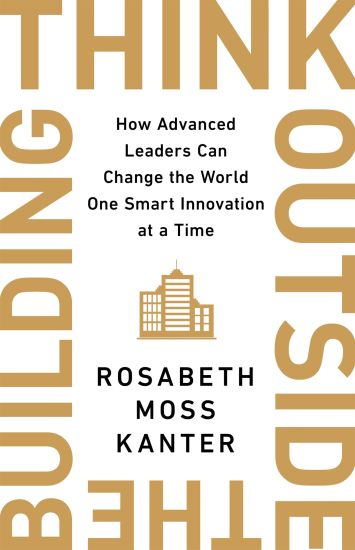
Think Outside the Building: How Advanced Leaders Can Change the World One Smart Innovation at a Time
Rosabeth Moss Kanter
PublicAffairs
2020
sidottu
One of the leading business thinkers in the world offers a bold, new theory of advanced leadership for tackling the world's complex, messy, and recalcitrant social and environmental problems. Over a decade ago, renowned innovation expert Rosabeth Moss Kanter co-founded and then directed Harvard's Advanced Leadership Initiative. Her breakthrough work with hundreds of successful professionals and executives, as well as aspiring young entrepreneurs, identifies the leadership paradigm of the future: the ability to "think outside the building" to overcome establishment paralysis and produce significant innovation for a better world. Kanter provides extraordinary accounts of the successes and near-stumbles of purpose-driven men and women from diverse backgrounds united in their conviction that positive change is possible. A former Trader Joe's executive, for example, navigated across business, government, and community sectors to deal with poor nutrition in inner cities while reducing food waste. A concerned European banker used the power of persuasion, not position, to find novel financing for improving the health of the oceans. A Washington couple enticed global partners to join an Uber-like platform to match skilled refugees with talent-hungry companies. A visionary journalist-turned-entrepreneur closed social divides by giving fifty million social media users access to free local education and culture. When traditional approaches are inadequate or resisted, advanced leadership skills are essential. In this book, Kanter shows how people everywhere can unleash their creativity and entrepreneurial adroitness to mobilize partners across challenging cultural, social, and political situations and innovate for a brighter future.
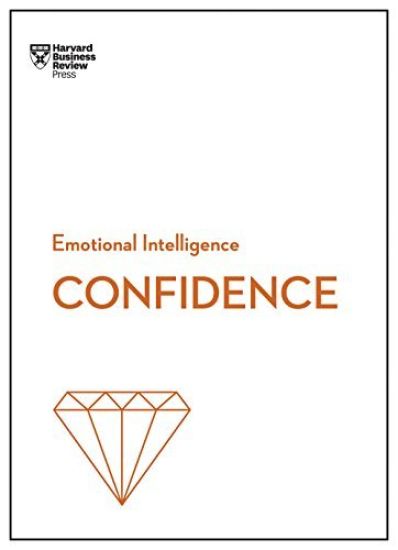
Confidence (HBR Emotional Intelligence Series)
Harvard Business Review; Tomas Chamorro-Premuzic; Rosabeth Moss Kanter; Amy Jen Su; Peter Bregman
Harvard Business Review Press
2019
pokkari
Become more confident at work.You need confidence to inspire trust, communicate effectively, and succeed in your organization. But self-doubt and nerves can undermine your ability to act decisively and persuade others. What can you do to push past these insecurities?This book explains how you can use emotional intelligence to become more confident at work. You'll learn how to correct what is holding you back, how to overcome imposter syndrome, and when feeling too self-assured can actually backfire.This volume includes the work of:Tomas Chamorro-PremuzicRosabeth Moss KanterAmy Jen SuPeter BregmanHow to be human at work. The HBR Emotional Intelligence Series features smart, essential reading on the human side of professional life from the pages of Harvard Business Review. Each book in the series offers proven research showing how our emotions impact our work lives, practical advice for managing difficult people and situations, and inspiring essays on what it means to tend to our emotional well-being at work. Uplifting and practical, these books describe the social skills that are critical for ambitious professionals to master.
Confidence (HBR Emotional Intelligence Series)
Harvard Business Review; Tomas Chamorro-Premuzic; Rosabeth Moss Kanter; Amy Jen Su; Peter Bregman
Harvard Business Review Press
2019
sidottu
Become more confident at work.You need confidence to inspire trust, communicate effectively, and succeed in your organization. But self-doubt and nerves can undermine your ability to act decisively and persuade others. What can you do to push past these insecurities?This book explains how you can use emotional intelligence to become more confident at work. You'll learn how to correct what is holding you back, how to overcome imposter syndrome, and when feeling too self-assured can actually backfire.This volume includes the work of:Tomas Chamorro-PremuzicRosabeth Moss KanterAmy Jen SuPeter BregmanHow to be human at work. The HBR Emotional Intelligence Series features smart, essential reading on the human side of professional life from the pages of Harvard Business Review. Each book in the series offers proven research showing how our emotions impact our work lives, practical advice for managing difficult people and situations, and inspiring essays on what it means to tend to our emotional well-being at work. Uplifting and practical, these books describe the social skills that are critical for ambitious professionals to master.
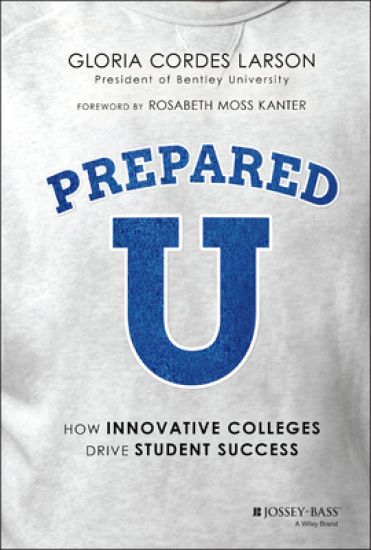
How can we as parents, educators, and members of the business community prepare students to be successful leaders in today's global environment? It's a critically important question. Gloria Cordes Larson, president of Bentley University, explains why today's practices in higher education are inadequate preparation for our rapidly evolving innovation economy. Instead, she passionately advocates for a hybrid-learning model that integrates business education with traditional liberal arts courses. Today's businesses demand a new kind of hybrid graduate, possessed of both hard and soft skills, with the courage to take risks, the creativity to innovate, and the savvy to excel in a turbulent competitive climate. This book is a valuable resource for participants in every learning community: our homes, schools, and businesses. It will change the way you think about what excellence in education means in today's business environment as you develop strategies that will move our children, students, and future employees forward in a rapidly changing and very challenging world. Prepared with that training and knowledge, they will find greater fulfillment and make their own mark on the future.
America is stuck: just look at the crumbling roads and bridges, mismanaged railways, old-fashioned and easily overloaded air traffic control system, and perpetual lack of political will to do anything about it all. In contrast, take a trip around the world. Whiz through the "Chunnel", get high-speed Internet and phone signal on a remote mountain in Turkey or travel in a driverless Mercedes in Germany and see a future of possibilities that the US is barely glimpsing. Rosabeth Moss Kanter’s bold solutions will motivate Americans to move their transportation infrastructure into a cleaner, faster and more prosperous future.
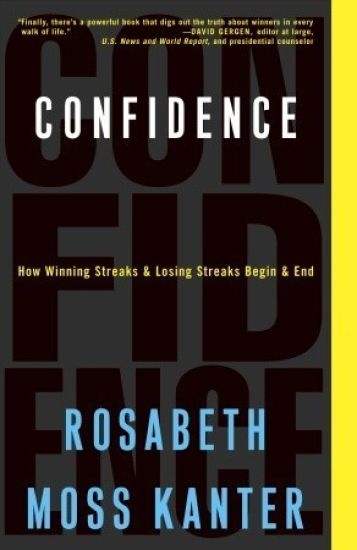
Confidence: How Winning Streaks and Losing Streaks Begin and End
Rosabeth Moss Kanter
Crown Publishing Group (NY)
2006
nidottu
From the locker room to the living room to the boardroom--how winners become winners . . . and stay that way. Is success simply a matter of money and talent? Or is there another reason why some people and organizations always land on their feet, while others, equally talented, stumble again and again? There's a fundamental principle at work-confidence-that makes the difference between winning and losing in any competition, be it a high school basketball game or a high-stakes business situation. In Confidence, Harvard Business School professor Rosabeth Moss Kanter shows why organizations of all types may be brimming with talent but not be winners. Based on her extraordinary investigation of success and failure in companies such as Continental Airlines and Verizon and sports teams such as the New England Patriots and Philadelphia Eagles, as well as the arenas of education, health care, and politics, Kanter explores a new theory and practice of success and provides people in leadership positions with a prescriptive program for maintaining a winning streak or turning around a downward spiral. Packed with brilliant, practical ideas, Confidence provides fresh thinking about success in all facets of life--from the factors that can make or break corporations and governments to the keys for successful relationships in the workplace or at home.
In an era of increased global competition, of takeovers, downsizing, restructuring, and even outright failure, managing intelligent organizational change is the most difficult challenge facing business. Kanter, Stein, and Jick present here a comprehensive overview and an authoritative model for how to and, in some cases how not to, institute change in organizations.Building upon their "Big Three" model of change, the authors focus on internal and external forces that set events in motion; the major kinds of change that correspond to external and internal change pressures; and the principal tasks involved in managing the change process. Several "portraits" of companies undergoing different types of change, coupled with the authors' own expert analyses, prove that no one person or group can make change "happen" alone. Instead, the authors assert that it is the delicate balance among key players that makes organizational change a success.The authors analyze the forces for change by examining Banc One, Apple Computer, and Lehman Brothers, among others, to illustrate environmental and cyclical change as businesses grow. Then they turn to forms of change, drawing on the Western-Delta merger, strategy change at Bell Atlantic, and takeover turmoil at Lucky Stores, to show how companies change their structures and cultures. The section on execution of change shows "change masters," to use Kanter's own famous term, at work at Motorola, General Electric, and other leading firms, as well as the difficulties of implementing change at General Motors and Microswitch.Fundamental organizational change, they argue, is exemplified by identity change, involving much more than the transfer of tangible assets. Managing the feelings, fears, and hopes of people must be the central strategy during such transitions. In this essential volume for managers and analysts of change, Kanter, Stein, and Jick offer powerful insights, practical new directions for action, prospects for the future of deliberate organizational change, and advice on where to begin the change process, and when: NOW!
In this landmark work on corporate power, especially as it relates to women, Rosabeth Moss Kanter, the distinguished Harvard management thinker and consultant, shows how the careers and self-images of the managers, professionals, and executives, and also those of the secretaries, wives of managers, and women looking for a way up, are determined by the distribution of power and powerlessness within the corporation. This new edition of her award-winning book has a major new afterward in which the author reviews and analyzes how attitudes and practices within the corporate power structure have changed in the 1990s.
WHEN GIANTS LEARN TO DANCE is the first comprehensive business strategy book to address the pressing challenges facing companies and careers today - an award-winning work that has become a business classic. Rosabeth Moss Kanter has already helped inject entrepreneurial dynamism into the corporate world with her bestselling THE CHANGE MASTERS. In WHEN GIANTS LEARN TO DANCE, she reveals how to avoid the dangers of both hierarchical stagnation and go-for-broke innovation and tells you how to keep your career in step with the corporate world's new and increasingly complex rhythms. The new key to a fast-track career is a flexible package of skills and services that Kanter details with authority and vision. Comprehensive and challenging, her blueprint for success is a must read for anyone in business who wants to stay competitive in the new millennium.
What makes some communes work, while others fail? Why is it so difficult to put utopian ideals into practice? In this exciting study of the success or failure of nineteenth-century American Utopias and twentieth-century communes, Rosabeth Moss Kanter combines the results of her first-hand experiences in a variety of contemporary groups with her thorough research on earlier Utopian communities. Convinced that the Utopias of the past offer important models for social organization today, the author also stresses the need for a historical perspective in viewing contemporary movements. Kanter analyzes the ideas and values expressed and developed in communal living, she explores the methods of organization that led to commitment and success or failure in the nineteenth-century, and she deals with the dilemmas and problems that contemporary communities present. The final chapters of this brilliant study, a discussion of contemporary communes, allows the reader to see the similarities as well as the differences between nineteenth and twentieth-century communities.