Kirjojen hintavertailu. Mukana 12 595 353 kirjaa ja 12 kauppaa.

Kirjailija

Roshdi Rashed

Kirjat ja teokset yhdessä paikassa: 24 kirjaa, julkaisuja vuosilta 1996-2026, suosituimpien joukossa Ibn al-Haytham and Analytical Mathematics. Vertaile teosten hintoja ja tarkista saatavuus suomalaisista kirjakaupoista.

24 kirjaa

Kirjojen julkaisuhaarukka 1996-2026.

Ibn al-Haytham and Analytical Mathematics
This volume provides a unique primary source on the history and philosophy of mathematics and the exact sciences in the mediaeval Arab world. The second of five comprehensive volumes, this book offers a detailed exploration of Arabic mathematics in the eleventh century as embodied in the legacy of the celebrated polymath al-Hasan ibn al-Haytham. Extensive analyses and annotations from the eminent scholar, Roshdi Rashed, support a number of key Arabic texts from Ibn al-Haytham’s treatises in infinitesimal mathematics, translated here into English for the first time. Rashed shows how Ibn al-Haytham’s works demonstrate a remarkable mathematical competence in mathematical subjects like the quadrature of the circle and of lunes, the calculation of the volumes of paraboloids, the problem of isoperimetric plane figures and solid figures with equal surface areas, along with the extraction of square and cubic roots. The present text is complemented by the first volume of A History of Arabic Sciences and Mathematics, which focused on founding figures and commentators in the ninth and tenth centuries Archimedean-Apollonian mathematical ‘School of Baghdad’. This constellation of works illustrates the historical and epistemological development of ‘infinitesimal mathematics’ as it became clearly articulated in the oeuvre of Ibn al-Haytham.Contributing to a more informed and balanced understanding of the internal currents of the history of mathematics and the exact sciences in Islam, and of its adaptive interpretation and assimilation in the European context, this fundamental text will appeal to historians of ideas, epistemologists and mathematicians at the most advanced levels of research.
Ibn al-Haytham

Ibn al-Haytham

Roshdi Rashed

TAYLOR FRANCIS LTD
2026
sidottu
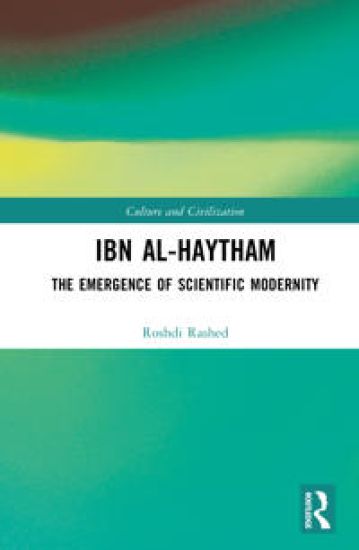
Ibn al-Haytham: The Emergence of Scientific Modernity offers the first comprehensive monograph on one of the most brilliant figures of the medieval intellectual world. Spanning his groundbreaking contributions in mathematics, optics, astronomy, and natural philosophy, this book portrays Ibn al-Haytham as he was seen in his own time: a man of universal learning whose methods, sources, and intellectual reputation resonated far beyond his era. Moving beyond the familiar terrain of his Kitab al-Mana?ir (Book of Optics), it places his achievements in a much wider context, examining his lesser-studied writings on geometry, mechanics, and scientific method. Through a systematic analysis of these works, the book demonstrates how Ibn al-Haytham’s experimental rigor, mathematical formalism, and critical engagement with earlier Greek and Arabic sources foreshadowed core principles of the European Scientific Revolution. It shows how his insistence on verification through observation and reasoning forged a distinctive approach that inspired thinkers from medieval Cairo to Renaissance Europe. An essential resource for historians of science, Islamic studies scholars, and anyone interested in the intellectual foundations of modernity, this volume restores Ibn al-Haytham to his rightful place as a pioneering figure in the history of ideas and a bridge between classical learning and the birth of modern science.
L'Optique Dans l'Inde Islamique Au Xviie Siècle: Ibn Ṣāliḥ, >Sur Les Miroirs Ardents Paraboliques
Le trait d'Ibn Ṣāliḥ Sur les miroirs ardents paraboliques repr sente une contribution majeure l'histoire de l'optique g om trique. Le pr sent ouvrage contient la premi re dition de ce texte, accompagn e d'une traduction fran aise et d'un commentaire historique et math matique. L'int r t principal du texte d'Ibn Ṣāliḥ consiste dans la mani re originale dont il construit sa d marche catoptrique partir des oeuvres optiques et g om triques de la tradition. Partant des recherches d'Ibn al-Haytham (XIe si cle) sur les miroirs paraboliques, il infl chit le traitement de ces objets dans deux directions nouvelles: tout d'abord, Ibn Ṣāliḥ traduit dans les termes de la g om trie d'Euclide des propri t s des coniques trait es par ses pr d cesseurs arabes dans le style d'Apollonius; en second lieu, il montre un int r t technique pour la construction des miroirs, dont il fournit un v ritable manuel l'attention des architectes et des ing nieurs de l'entourage de Shāh Jahān. Le pr sent ouvrage contient en outre la premi re dition d'un trait catoptrique anonyme conserv en Inde. Ces nouveaux mat riaux permettent de documenter pour la premi re fois les d veloppements remarquables de la catoptrique arabe au XVIIe si cle, ainsi que les avanc es de la science islamique dans l'Inde moghole l' poque de Shāh Jahān.
Arithmétique, Algèbre et Théorie des Nombres
The texts in these four volumes deal with the history and philosophy of mathematics and its applications. The first three volumes are devoted to the history of mathematics (arithmetic, algebra, geometry), optics and astronomy, from Antiquity to the Classical Age. Over the last fifty years, the numerous studies contained in this volume have renewed the study of the main Greek mathematicians - Euclid, Archimedes, Apollonius, Diophantus, Menelaus - and have shown the nature and scope of their reception and transformations, both in classical Islam and in early European modernity. The fourth volume establishes and explores various fields of research between philosophy and mathematics, from the polymorphous interactions specific to Greek, Arab and Latin science to the mathematisation of the social sciences in the eighteenth century. Both in terms of the novelty of the material discovered and published for the first time and the power and finesse that continue to guide its epistemological analysis, the dozens of contributions collected here represent a major work that has changed the history of science in our time.
Géométries

Géométries

Roshdi Rashed

De Gruyter
2023
sidottu
The texts in these four volumes deal with the history and philosophy of mathematics and its applications. The first three volumes are devoted to the history of mathematics (arithmetic, algebra, geometry), optics and astronomy, from Antiquity to the Classical Age. Over the last fifty years, the numerous studies contained in this volume have renewed the study of the main Greek mathematicians - Euclid, Archimedes, Apollonius, Diophantus, Menelaus - and have shown the nature and scope of their reception and transformations, both in classical Islam and in early European modernity. The fourth volume establishes and explores various fields of research between philosophy and mathematics, from the polymorphous interactions specific to Greek, Arab and Latin science to the mathematisation of the social sciences in the eighteenth century. Both in terms of the novelty of the material discovered and published for the first time and the power and finesse that continue to guide its epistemological analysis, the dozens of contributions collected here represent a major work that has changed the history of science in our time.
Optique et Astronomie

Optique et Astronomie

Roshdi Rashed

De Gruyter
2023
sidottu
The texts in these four volumes deal with the history and philosophy of mathematics and its applications. The first three volumes are devoted to the history of mathematics (arithmetic, algebra, geometry), optics and astronomy, from Antiquity to the Classical Age. Over the last fifty years, the numerous studies contained in this volume have renewed the study of the main Greek mathematicians - Euclid, Archimedes, Apollonius, Diophantus, Menelaus - and have shown the nature and scope of their reception and transformations, both in classical Islam and in early European modernity. The fourth volume establishes and explores various fields of research between philosophy and mathematics, from the polymorphous interactions specific to Greek, Arab and Latin science to the mathematisation of the social sciences in the eighteenth century. Both in terms of the novelty of the material discovered and published for the first time and the power and finesse that continue to guide its epistemological analysis, the dozens of contributions collected here represent a major work that has changed the history of science in our time.
Mathématiques et Philosophie

Mathématiques et Philosophie

Roshdi Rashed

De Gruyter
2023
sidottu
The texts in these four volumes deal with the history and philosophy of mathematics and its applications. The first three volumes are devoted to the history of mathematics (arithmetic, algebra, geometry), optics and astronomy, from Antiquity to the Classical Age. Over the last fifty years, the numerous studies contained in this volume have renewed the study of the main Greek mathematicians - Euclid, Archimedes, Apollonius, Diophantus, Menelaus - and have shown the nature and scope of their reception and transformations, both in classical Islam and in early European modernity. The fourth volume establishes and explores various fields of research between philosophy and mathematics, from the polymorphous interactions specific to Greek, Arab and Latin science to the mathematisation of the social sciences in the eighteenth century. Both in terms of the novelty of the material discovered and published for the first time and the power and finesse that continue to guide its epistemological analysis, the dozens of contributions collected here represent a major work that has changed the history of science in our time.
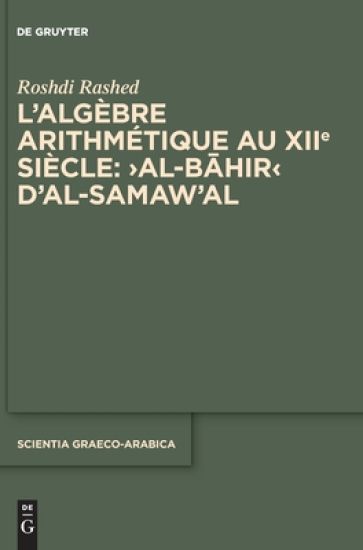
L'algèbre arithmétique au XIIe siècle: ›Al-Bahir‹ d'al-Samaw'al
Après qu'al-Khwarizmi eut rédigé son livre fondateur de l'algèbre au début du IXe siècle, les recherches algébriques se sont rapidement développées et enrichies, avant de se scinder et de se concentrer en deux principaux courants: l'algèbre arithmétique, l'analyse indéterminée et la théorie des nombres d'une part, la géométrie algébrique élémentaire d'autre part. C'est à partir des travaux du premier courant qu'al-Samaw'al (mort en 1175) rédige le premier traité en algèbre arithmétique: "Le Brillant en Algèbre", al-Bahir fi al-Jabr. On trouvera ici l'édition critique de cet ouvrage fondamental, sa traduction en français, ainsi que son commentaire mathématique et historique. Le présent livre est important non seulement pour comprendre l'histoire de l'algèbre en arabe, mais aussi celle de l'algèbre latine à partir de Leonardo Pisano et, plus généralement, l'histoire des mathématiques classiques .
L’hydrostatique de Ménélaüs

L’hydrostatique de Ménélaüs

Roshdi Rashed

De Gruyter
2020
sidottu
Menelaus of Alexandria (1st century CE) is the author of the treatise Sphaerica and as of a treatise on fluid statics. Both of these works only survive in Arabic translations. This book provides an editio princeps of Menelaus’s second text as well as the recently discovered commentary thereon, written by the philosopher and scholar Muhammad ibn al-Haytham (10th–11th century).
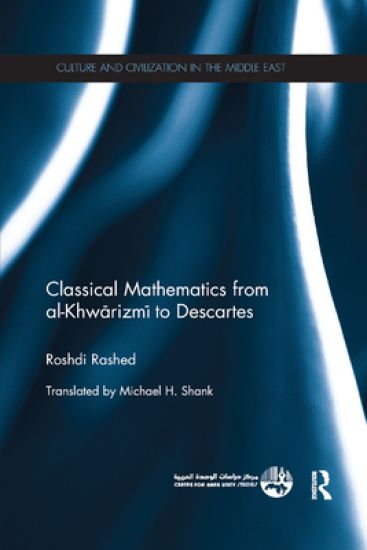
Classical Mathematics from Al-Khwarizmi to Descartes
This book follows the development of classical mathematics and the relation between work done in the Arab and Islamic worlds and that undertaken by the likes of Descartes and Fermat.‘Early modern,’ mathematics is a term widely used to refer to the mathematics which developed in the West during the sixteenth and seventeenth century. For many historians and philosophers this is the watershed which marks a radical departure from ‘classical mathematics,’ to more modern mathematics; heralding the arrival of algebra, geometrical algebra, and the mathematics of the continuous. In this book, Roshdi Rashed demonstrates that ‘early modern,’ mathematics is actually far more composite than previously assumed, with each branch having different traceable origins which span the millennium. Going back to the beginning of these parts, the aim of this book is to identify the concepts and practices of key figures in their development, thereby presenting a fuller reality of these mathematics.This book will be of interest to students and scholars specialising in Islamic science and mathematics, as well as to those with an interest in the more general history of science and mathematics and the transmission of ideas and culture.
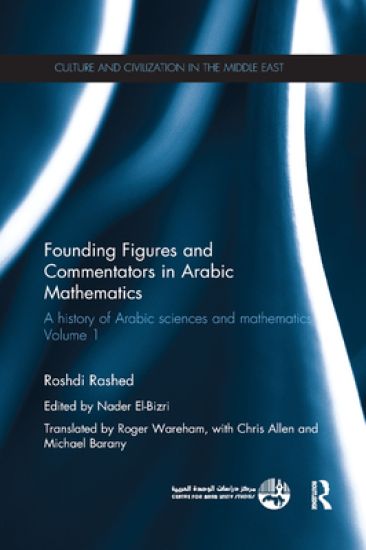
Founding Figures and Commentators in Arabic Mathematics
In this unique insight into the history and philosophy of mathematics and science in the mediaeval Arab world, the eminent scholar Roshdi Rashed illuminates the various historical, textual and epistemic threads that underpinned the history of Arabic mathematical and scientific knowledge up to the seventeenth century. The first of five wide-ranging and comprehensive volumes, this book provides a detailed exploration of Arabic mathematics and sciences in the ninth and tenth centuries.Extensive and detailed analyses and annotations support a number of key Arabic texts, which are translated here into English for the first time. In this volume Rashed focuses on the traditions of celebrated polymaths from the ninth and tenth centuries ‘School of Baghdad’ - such as the Banu Musa, Thabit ibn Qurra, Ibrahim ibn Sinan, Abu Ja´far al-Khazin, Abu Sahl Wayjan ibn Rustam al-Quhi - and eleventh-century Andalusian mathematicians like Abu al-Qasim ibn al-Samh, and al-Mu’taman ibn Hud. The Archimedean-Apollonian traditions of these polymaths are thematically explored to illustrate the historical and epistemological development of ‘infinitesimal mathematics’ as it became more clearly articulated in the eleventh-century influential legacy of al-Hasan ibn al-Haytham (‘Alhazen’). Contributing to a more informed and balanced understanding of the internal currents of the history of mathematics and the exact sciences in Islam, and of its adaptive interpretation and assimilation in the European context, this fundamental text will appeal to historians of ideas, epistemologists, mathematicians at the most advanced levels of research.
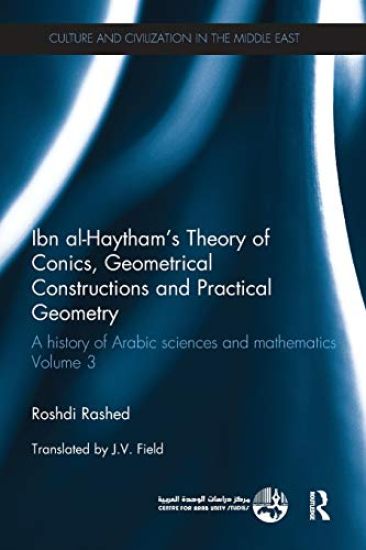
Ibn al-Haytham's Theory of Conics, Geometrical Constructions and Practical Geometry
Theory of Conics, Geometrical Constructions and Practical Geometry: A History of Arabic Sciences and Mathematics Volume 3, provides a unique primary source on the history and philosophy of mathematics and science from the mediaeval Arab world. The present text is complemented by two preceding volumes of A History of Arabic Sciences and Mathematics, which focused on founding figures and commentators in the ninth and tenth centuries, and the historical and epistemological development of ‘infinitesimal mathematics’ as it became clearly articulated in the oeuvre of Ibn al-Haytham. This volume examines the increasing tendency, after the ninth century, to explain mathematical problems inherited from Greek times using the theory of conics. Roshdi Rashed argues that Ibn al-Haytham completes the transformation of this ‘area of activity,’ into a part of geometry concerned with geometrical constructions, dealing not only with the metrical properties of conic sections but with ways of drawing them and properties of their position and shape.Including extensive commentary from one of world’s foremost authorities on the subject, this book contributes a more informed and balanced understanding of the internal currents of the history of mathematics and the exact sciences in Islam, and of its adaptive interpretation and assimilation in the European context. This fundamental text will appeal to historians of ideas, epistemologists and mathematicians at the most advanced levels of research.
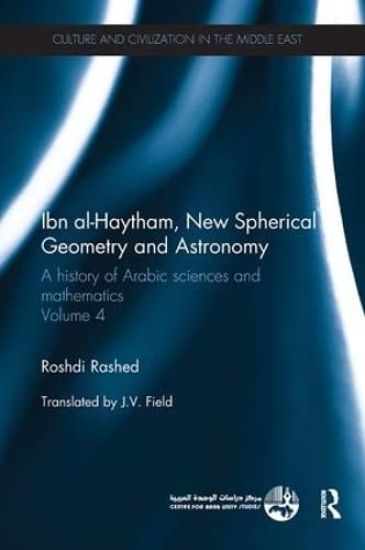
Ibn al-Haytham, New Astronomy and Spherical Geometry
This volume provides a unique primary source on the history and philosophy of mathematics and science from the mediaeval Arab world. The fourth volume of A History of Arabic Sciences and Mathematics is complemented by three preceding volumes which focused on infinitesimal determinations and other chapters of classical mathematics.This book includes five main works of the polymath Ibn al-Haytham (Alhazen) on astronomy, spherical geometry and trigonometry, plane trigonometry and studies of astronomical instruments on hour lines, horizontal sundials and compasses for great circles.In particular, volume four examines: the increasing tendency to mathematize the inherited astronomy from Greek sources, namely Ptolemy's Almagest; the development of celestial kinematics; new research in spherical geometry and trigonometry required by the new kinematical theory; the study on astronomical instruments and its impact on mathematical research. These new historical materials and their mathematical and historical commentaries contribute to rewriting the history of mathematical astronomy and mathematics from the 11th century on.Including extensive commentary from one of the world’s foremost authorities on the subject, this fundamental text is essential reading for historians and mathematicians at the most advanced levels of research.
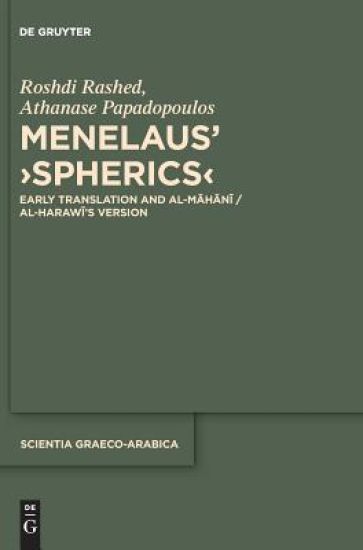
Menelaus' ›Spherics‹

Menelaus' ›Spherics‹

Roshdi Rashed; Athanase Papadopoulos

De Gruyter
2017
sidottu
Despite its importance in the history of Ancient science, Menelaus’ Spherics is still by and large unknown. This treatise, which lies at the foundation of spherical geometry, is lost in Greek but has been preserved in its Arabic versions. The reader will find here, for the first time edited and translated into English, the essentials of this tradition, namely: a fragment of an early Arabic translation and the first Arabic redaction of the Spherics composed by al-Mahani /al-Harawi, together with a historical and mathematical study of Menelaus’ treatise. With this book, a new and important part of the Greek and Arabic legacy to the history of mathematics comes to light. This book will be an indispensable acquisition for any reader interested in the history of Ancient geometry and science and, more generally, in Greek and Arabic science and culture.
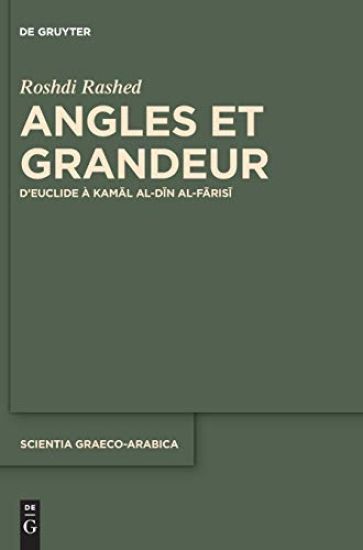
Angles et Grandeur

Angles et Grandeur

Roshdi Rashed

de Gruyter
2015
sidottu
From Antiquity until recently, philosophers and mathematicians have continually discussed the concept of angle and its relation to archimedean and non-archimedean theories of measurement. For the first time, this book traces the history of these discussions in Greek and Arabic, from Euclid to Kamāl al-Dīn al-Fārisī, after whom the discussion was not resumed until Newton and Euler. The volume presents first editions of over twenty texts, either in Arabic or Greek and translated into Arabic, of the greatest mathematicians and philosophers of the time. The texts are here translated into French and supplemented with extensive commentary. The book begins with the definitions and propositions of Euclid on angles and measurement, followed by the Greek commentary tradition represented by Proclus and Simplicius (only extant in Arabic) and the writings of the Arabic mathematicians and philosophers from the 9th through 14th century, placing the fundamental contributions by Avicenna and Ibn al-Haytham into their historical context and showing how numerous successors produced new syntheses of their work.
Classical Mathematics from Al-Khwarizmi to Descartes
This book follows the development of classical mathematics and the relation between work done in the Arab and Islamic worlds and that undertaken by the likes of Descartes and Fermat.‘Early modern,’ mathematics is a term widely used to refer to the mathematics which developed in the West during the sixteenth and seventeenth century. For many historians and philosophers this is the watershed which marks a radical departure from ‘classical mathematics,’ to more modern mathematics; heralding the arrival of algebra, geometrical algebra, and the mathematics of the continuous. In this book, Roshdi Rashed demonstrates that ‘early modern,’ mathematics is actually far more composite than previously assumed, with each branch having different traceable origins which span the millennium. Going back to the beginning of these parts, the aim of this book is to identify the concepts and practices of key figures in their development, thereby presenting a fuller reality of these mathematics.This book will be of interest to students and scholars specialising in Islamic science and mathematics, as well as to those with an interest in the more general history of science and mathematics and the transmission of ideas and culture.
Ibn al-Haytham, New Astronomy and Spherical Geometry
This volume provides a unique primary source on the history and philosophy of mathematics and science from the mediaeval Arab world. The fourth volume of A History of Arabic Sciences and Mathematics is complemented by three preceding volumes which focused on infinitesimal determinations and other chapters of classical mathematics.This book includes five main works of the polymath Ibn al-Haytham (Alhazen) on astronomy, spherical geometry and trigonometry, plane trigonometry and studies of astronomical instruments on hour lines, horizontal sundials and compasses for great circles.In particular, volume four examines: the increasing tendency to mathematize the inherited astronomy from Greek sources, namely Ptolemy's Almagest; the development of celestial kinematics; new research in spherical geometry and trigonometry required by the new kinematical theory; the study on astronomical instruments and its impact on mathematical research. These new historical materials and their mathematical and historical commentaries contribute to rewriting the history of mathematical astronomy and mathematics from the 11th century on.Including extensive commentary from one of the world’s foremost authorities on the subject, this fundamental text is essential reading for historians and mathematicians at the most advanced levels of research.
Les "Arithmétiques" de Diophante

Les "Arithmétiques" de Diophante

Roshdi Rashed; Christian Houzel

de Gruyter
2013
sidottu
Until recently, only six of thirteen books comprising Diophantus’ Arithmetica were known to us. Four other books in an Arabic translation have been discovered recently. We can now understand the organization of this work and its long-lasting impact on mathematics. The present book offers the first historical and mathematical study of the work as it has survived in ten books.
Histoire de l'analyse diophantienne classique
This is the first study of the history of Diophantine analysis and the theory of numbers from Abu Kamil to Fermat (9th-17th century). It thus offers an elaborate and detailed overview on a fundamental chapter on classical mathematical thought and its relation to algebra and Diophantus’ Arithmetica.
Ibn al-Haytham's Theory of Conics, Geometrical Constructions and Practical Geometry
Theory of Conics, Geometrical Constructions and Practical Geometry: A History of Arabic Sciences and Mathematics Volume 3, provides a unique primary source on the history and philosophy of mathematics and science from the mediaeval Arab world. The present text is complemented by two preceding volumes of A History of Arabic Sciences and Mathematics, which focused on founding figures and commentators in the ninth and tenth centuries, and the historical and epistemological development of ‘infinitesimal mathematics’ as it became clearly articulated in the oeuvre of Ibn al-Haytham. This volume examines the increasing tendency, after the ninth century, to explain mathematical problems inherited from Greek times using the theory of conics. Roshdi Rashed argues that Ibn al-Haytham completes the transformation of this ‘area of activity,’ into a part of geometry concerned with geometrical constructions, dealing not only with the metrical properties of conic sections but with ways of drawing them and properties of their position and shape.Including extensive commentary from one of world’s foremost authorities on the subject, this book contributes a more informed and balanced understanding of the internal currents of the history of mathematics and the exact sciences in Islam, and of its adaptive interpretation and assimilation in the European context. This fundamental text will appeal to historians of ideas, epistemologists and mathematicians at the most advanced levels of research.