Kirjojen hintavertailu. Mukana 12 390 323 kirjaa ja 12 kauppaa.

Kirjailija

Ross McKibbin

Kirjat ja teokset yhdessä paikassa: 8 kirjaa, julkaisuja vuosilta 1990-2019, suosituimpien joukossa Consensus or Coercion?. Vertaile teosten hintoja ja tarkista saatavuus suomalaisista kirjakaupoista.

8 kirjaa

Kirjojen julkaisuhaarukka 1990-2019.

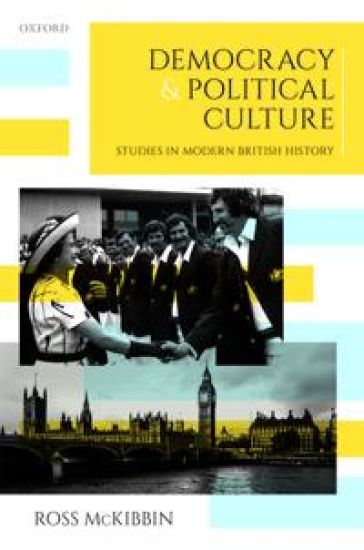
Democracy and Political Culture

Democracy and Political Culture

Ross McKibbin

Oxford University Press
2019
sidottu
Democracy and Political Culture: Studies in Modern British History attempts to give a total picture of the political-social culture of Great Britain in the twentieth century. To do so it chooses a number of particular subjects which nonetheless stand for this culture as a whole, and which together allow us to reach a number general conclusions about modern British history. In this sense it is a successor to McKibbin's previous collection of essays, The Ideologies of Class (1991), while it also takes up a number of the themes of his Classes and Cultures (1998). Above all, it is a study of British democracy and asks the questions: what does it mean to describe Britain as a democratic society and how might we measure it against other comparable societies? To do so, McKibbin has chosen not only more 'global' subjects - Britain's social structure and the sources of political authority; the social and political effects of the first world war; Britain's electoral and party system; its literary culture; its sporting culture, and the relation of that culture to the rest of the world, as well as to Britain itself; and a comparison of Britain's political culture with one of the closest comparable societies, Australia, and what that tells us about Britain - but also individual studies of three men, very prominent in British life, who, in different ways, both contributed to Britain's political culture and were also students of it: J.M. Keynes, an economist, Harold Nicolson, a politician and writer, and A.J. Cronin, a novelist. All three represented British political culture in its broadest spectrum.
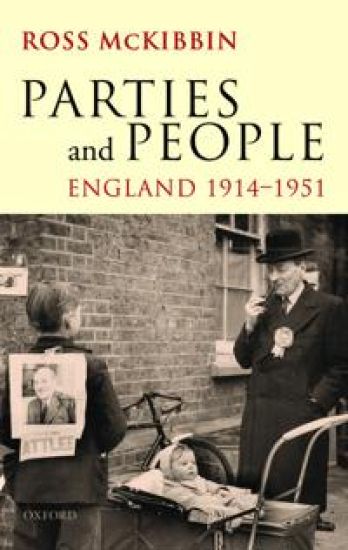
Parties and People

Parties and People

Ross McKibbin

Oxford University Press
2011
nidottu
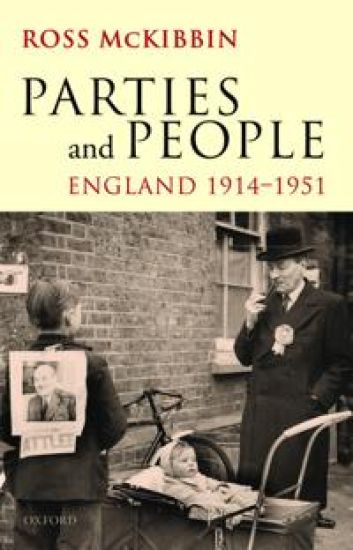
The 'sequel' to his best-selling Classes and Cultures, Ross McKibbin's latest book is a powerful reinterpretation of British politics in the first decades of universal suffrage. What did it mean to be a 'democratic society'? To what extent did voters make up their own minds on politics or allow elites to do it for them? Exploring the political culture of these extraordinary years, Parties and People shows that class became one of the principal determinants of political behaviour, although its influence was often surprisingly weak. McKibbin argues that the kind of democracy that emerged in Britain was far from inevitable-as much historical accident as design-and was in many ways highly flawed.
Parties and People

Parties and People

Ross McKibbin

Oxford University Press
2010
sidottu
The 'sequel' to his best-selling Classes and Cultures, Ross McKibbin's latest book is a powerful reinterpretation of British politics in the first decades of universal suffrage. What did it mean to be a 'democratic society'? To what extent did voters make up their own minds on politics or allow elites to do it for them? Exploring the political culture of these extraordinary years, Parties and People shows that class became one of the principal determinants of political behaviour, although its influence was often surprisingly weak. McKibbin argues that the kind of democracy that emerged in Britain was far from inevitable-as much historical accident as design-and was in many ways highly flawed.
Classes and Cultures

Classes and Cultures

Ross McKibbin

Oxford University Press
2000
nidottu
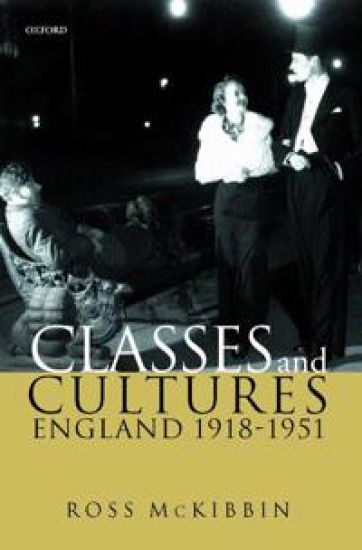
Ross McKibbin investigates the ways in which class culture characterized English society and intruded on every aspect of life, during the period 1918-1951. He also shows the increasing effects of Americanization on this culture.
Classes and Cultures

Classes and Cultures

Ross McKibbin

Oxford University Press
1998
sidottu
Taking the period from the end of World War I until the mid-1950s, Ross McKibbin investigates the ways in which "class culture" characterized English society, and intruded into every aspect of life. The study also explores the social and ideological foundations of English politics.
The Ideologies of Class

The Ideologies of Class

Ross McKibbin

Clarendon Press
1994
nidottu
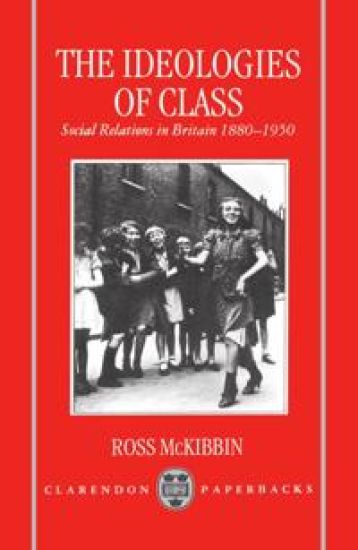
The recent history of the working class is essential to any account of modern Britain: between 1880 and 1950 manual workers and their dependents made up three-quarters of the British population. In this fascinating collection of essays, Ross McKibbin examines the social and political character of the working class, as well as its relationship with the rest of society and the State. He focuses on such subjects as the relationship of work and hobbies, working-class gambling, class and poverty, and unemployment in inter-war Britain. What emerges is a coherent picture of the world in Britain's social classes. 'uniformly excellent, and should be read by anybody who is interested in the history, sociology or politics of Britain in the 20th century', London Review of Books 'splendid volume of essays . . . McKibbin has written an illuminating work which takes the vitally important step from labour to working-class history', Times Literary Supplement
The Ideologies of Class

The Ideologies of Class

Ross McKibbin

Clarendon Press
1990
sidottu
This is a study of the social character of the British working class in the period from the 1880s to the early 1950s, when about seventy-five per cent of the population were manual workers, or their dependents. It has three central themes: the nature of working-class culture and working-class organization; the relationships between the working class and other classes; and the role of both World Wars and the state in shaping class relations. Ross McKibbin examines different aspects of British political, social, and economic history to give an integrated explanation of the development of modern British society, and the ideological assumptions on which it is based. Attitudes to work and leisure are also explored, to build a coherent picture of the ideological world of Britain's social classes.