Kirjailija
Rowan Wilken
Kirjat ja teokset yhdessä paikassa: 15 kirjaa, julkaisuja vuosilta 2011-2023, suosituimpien joukossa Everyday Data Cultures. Vertaile teosten hintoja ja tarkista saatavuus suomalaisista kirjakaupoista.
15 kirjaa
Kirjojen julkaisuhaarukka 2011-2023.
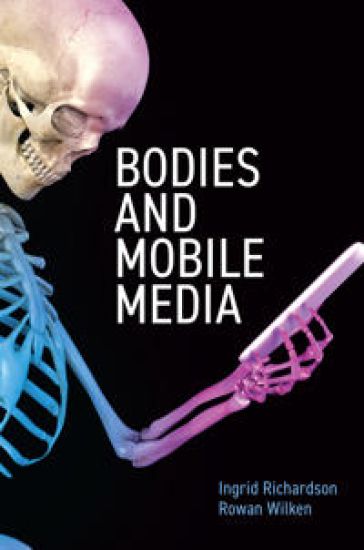
Have you ever considered how mobile media change what we see, hear and pay attention to, or how they alter our movement through the city? Over the last decade, mobile media and communication technologies have become deeply integral to our perception and bodily experience of the world. In Bodies and Mobile Media, Ingrid Richardson and Rowan Wilken explore mobile media as a lens through which to understand how embodiment both shapes, and is shaped by, media experience. It offers a unique approach by focusing on specific sensory affordances and body parts – including the eyes, ears, face, hands and feet – to consider the uneven ratios of sensory perception at work in our engagement with mobile devices. Each chapter provides rich and accessible narratives of mobile media practices interwoven with current scholarship in media studies and phenomenology, with a concluding chapter that reflects on mobile media use as a synesthetic experience. By interpreting theoretical insights about the relationship between the body and technology, the book serves as an important work of knowledge translation. This work is crucial, the authors argue, if we are to critically understand how our perception and experience of the world are mediated by technology. This book will be of interest to students and scholars in media, communication and cultural studies.
Everyday Data Cultures
Jean Burgess; Kath Albury; Anthony McCosker; Rowan Wilken
JOHN WILEY AND SONS LTD
2022
nidottu
The AI revolution can seem powerful and unstoppable, extracting data from every aspect of our lives and subjecting us to unprecedented surveillance and control. But at ground level, even the most advanced ‘smart’ technologies are not as all-powerful as either the tech companies or their critics would have us believe.From gig worker activism to wellness tracking with sex toys and TikTokers' manipulation of the algorithm, this book shows how ordinary people are negotiating the datafication of society. The book establishes a new theoretical framework for understanding everyday experiences of data and automation, and offers guidance on the ethical responsibilities we share as we learn to live together with data-driven machines.Everyday Data Cultures is essential reading for students and researchers in digital media and communication, as well as for anyone interested in the role of data and AI in society.
Have you ever considered how mobile media change what we see, hear and pay attention to, or how they alter our movement through the city? Over the last decade, mobile media and communication technologies have become deeply integral to our perception and bodily experience of the world. In Bodies and Mobile Media, Ingrid Richardson and Rowan Wilken explore mobile media as a lens through which to understand how embodiment both shapes, and is shaped by, media experience. It offers a unique approach by focusing on specific sensory affordances and body parts – including the eyes, ears, face, hands and feet – to consider the uneven ratios of sensory perception at work in our engagement with mobile devices. Each chapter provides rich and accessible narratives of mobile media practices interwoven with current scholarship in media studies and phenomenology, with a concluding chapter that reflects on mobile media use as a synesthetic experience. By interpreting theoretical insights about the relationship between the body and technology, the book serves as an important work of knowledge translation. This work is crucial, the authors argue, if we are to critically understand how our perception and experience of the world are mediated by technology. This book will be of interest to students and scholars in media, communication and cultural studies.
Everyday Data Cultures
Jean Burgess; Kath Albury; Anthony McCosker; Rowan Wilken
JOHN WILEY AND SONS LTD
2022
sidottu
The AI revolution can seem powerful and unstoppable, extracting data from every aspect of our lives and subjecting us to unprecedented surveillance and control. But at ground level, even the most advanced ‘smart’ technologies are not as all-powerful as either the tech companies or their critics would have us believe.From gig worker activism to wellness tracking with sex toys and TikTokers' manipulation of the algorithm, this book shows how ordinary people are negotiating the datafication of society. The book establishes a new theoretical framework for understanding everyday experiences of data and automation, and offers guidance on the ethical responsibilities we share as we learn to live together with data-driven machines.Everyday Data Cultures is essential reading for students and researchers in digital media and communication, as well as for anyone interested in the role of data and AI in society.
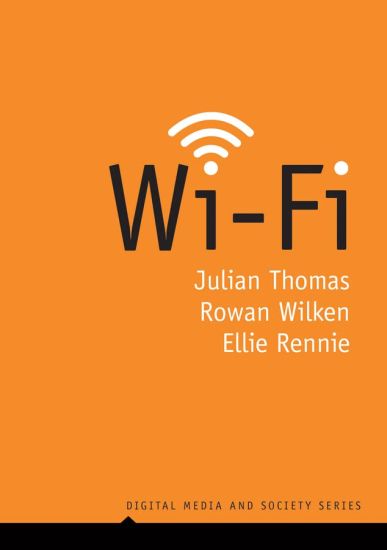
From café culture to home schooling, remote community networks, and smart cities, Wi-Fi is an invisible but fundamental element of contemporary life. Loosely regulated, low-cost, and largely overlooked by researchers, this technology has driven the rise of the smartphone and broadband internet, and is a vital element in the next wave of automation. Thomas, Wilken, and Rennie provide the first comprehensive account of the social and cultural consequences of Wi-Fi, highlighting the ways in which it has changed our homes, communities, and cities. They discuss its origins as an experimental technology, the conflicts generated around its ownership and control, and the ideas and expectations attached to it by technologists, activists, and entrepreneurs. The authors reveal the ways in which Wi-Fi is an inherently social and political technology, animated by conflicting aspirations for local, public, and community control, and defined by private and corporate interests. As this book shows, Wi-Fi has extended and intensified our online lives while also promising a more inclusive internet. Wi-Fi is essential reading for students and scholars of media and communication, as well as anyone who wants a better understanding of this ubiquitous and influential technology.
Digital Domesticity
Jenny Kennedy; Michael Arnold; Martin Gibbs; Bjorn Nansen; Rowan Wilken
Oxford University Press Inc
2020
sidottu
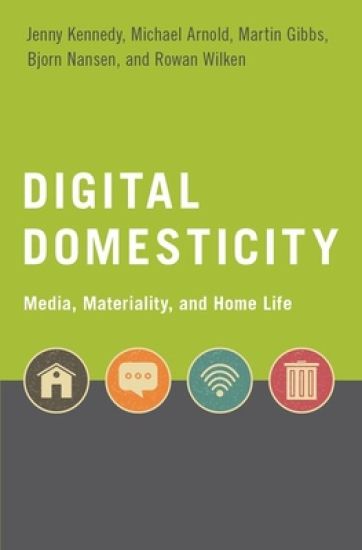
At the turn of the twenty-first century, typical households were equipped with a landline telephone, a desktop computer connected to a dial-up modem, and a shared television set. Television, radio and newspapers were the dominant mass media. Today, homes are now network hubs for all manner of digital technologies, from mobile devices littering lounge rooms to Bluetooth toothbrushes in bathrooms--and tomorrow, these too will be replaced with objects once inconceivable. Tracing the origins of these digital developments, Jenny Kennedy, Michael Arnold, Martin Gibbs, Bjorn Nansen, and Rowan Wilken advance media domestication research through an ecology-based approach to the abundance and materiality of media in the home. The book locates digital domesticity through phases of adoption and dwelling, to management and housekeeping, to obsolescence and disposal. The authors synthesize household interviews, technology tours, remote data collection via mobile applications, and more to offer readers groundbreaking insight into domestic media consumption. Chapters use original case studies to empirically trace the adoption, use, and disposal of technology by individuals and families within their homes. The book unearths social and material accounts of media technologies, offering insight into family negotiations regarding technology usage in such a way that puts technology in the context of recent developments of digital infrastructure, devices, and software--all of which are now woven into the domestic fabric of the modern household.
Digital Domesticity
Jenny Kennedy; Michael Arnold; Martin Gibbs; Bjorn Nansen; Rowan Wilken
Oxford University Press Inc
2020
nidottu
At the turn of the twenty-first century, typical households were equipped with a landline telephone, a desktop computer connected to a dial-up modem, and a shared television set. Television, radio and newspapers were the dominant mass media. Today, homes are now network hubs for all manner of digital technologies, from mobile devices littering lounge rooms to Bluetooth toothbrushes in bathrooms--and tomorrow, these too will be replaced with objects once inconceivable. Tracing the origins of these digital developments, Jenny Kennedy, Michael Arnold, Martin Gibbs, Bjorn Nansen, and Rowan Wilken advance media domestication research through an ecology-based approach to the abundance and materiality of media in the home. The book locates digital domesticity through phases of adoption and dwelling, to management and housekeeping, to obsolescence and disposal. The authors synthesize household interviews, technology tours, remote data collection via mobile applications, and more to offer readers groundbreaking insight into domestic media consumption. Chapters use original case studies to empirically trace the adoption, use, and disposal of technology by individuals and families within their homes. The book unearths social and material accounts of media technologies, offering insight into family negotiations regarding technology usage in such a way that puts technology in the context of recent developments of digital infrastructure, devices, and software--all of which are now woven into the domestic fabric of the modern household.
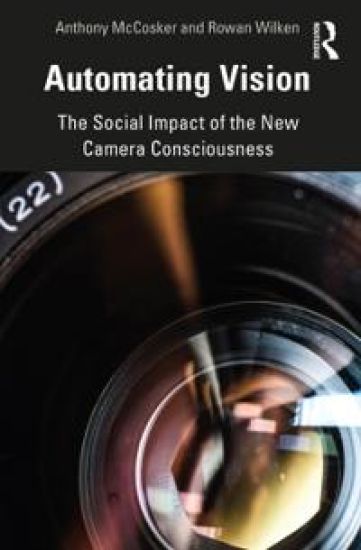
Automating Vision explores the rise of seeing machines through four case studies: facial recognition, drone vision, mobile and locative media and driverless cars. Proposing a conceptual lens of camera consciousness, which is drawn from the early visual anthropology of Gregory Bateson and Margaret Mead, Automating Vision accounts for the growing power and value of camera technologies and digital image processing. Behind the smart camera devices examined throughout the book lies a set of increasingly integrated and automated technologies underpinned by artificial intelligence, machine learning and image processing. Seeing machines are now implicated in growing visual data markets and are supported by emerging layers of infrastructure that they coproduce. In this book, Anthony McCosker and Rowan Wilken address the social impacts, the disruptions and reconfigurations to existing digital media ecosystems, to urban environments and to mobility and social relations that result from the increasing automation of vision and explore how it might be possible to ensure a safe and equitable future as we learn to see with and negotiate the interventions of seeing machines.This book will appeal to students and scholars in media, communication, cultural studies, sociology of media and science and technology studies.More resources for the book can be found at https://www.anthonymccosker.com/automating-vision.
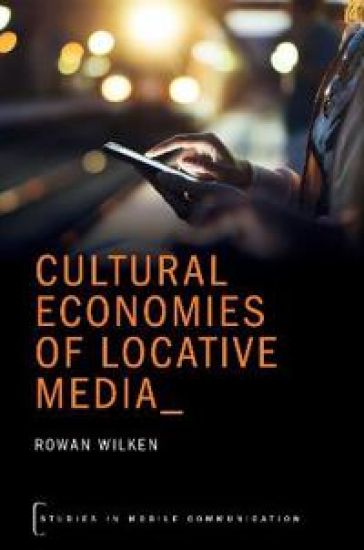
Location, location-awareness, and location data have all become familiar and increasingly significant parts of our everyday mobile-mediated experiences. Cultural Economies of Locative Media examines the ways in which location-based services, such as GPS-enabled mobile smartphones, are socially, culturally, economically, and politically produced just as much as they are technically designed and manufactured. Rowan Wilken explores the complex interrelationships that mutually define new business models and the economic factors that emerge around, and structure, locative media services. Further, he offers readers insight into the diverse social uses, cultures of consumption, and policy implications of location, providing a detailed, critical account of contemporary location-sensitive mobile data. Cultural Economies of Locative Media delves into the ideas, technologies, contexts, and power relationships that define this scholarship, resulting in a rich portrait of locative media in all of its cultural and economic complexity.
These 14 essays examine Georges Perec's impact on architecture, art, design, media, electronic communications, computing and the everyday. What do Perec's descriptions of the minutiae of everyday life reveal about our use of information and communications technologies? What happens if we read Life: A User's Manual as a toolbox of ideas for games studies? What light does the concept of the 'infra-ordinary' shed on social media? What insights does algorithmic writing generate for the digital humanities? What lessons can architects, artists, game-designers and writers draw from Perec's fascination with creative constraints? Through an examination of such questions, this collection takes Perec scholarship beyond its existing limits to offer new ways of rethinking our present.
Teletechnologies, or technologies of distance, cannot be ignored. Indeed, the present electronic age is said to have wrought profound changes to how we think about and experience who we are, where we are, and how we relate with one another. Place and community have traditionally formed key concepts for thinking about these issues, but what relevance do these concepts now hold for us? In this wide-ranging study, Wilken re-evaluates how ideas of place and community intersect with and help us make sense of a world transformed by information and communication technologies. This interdisciplinary investigation ranges across diverse textual and contextual terrain, exploring approaches from media and communications, architectural history and theory, philosophy, sociology, geography, literature, and urban design. The rich analysis of these myriad texts reveals the complex and at times contradictory ways in which notions of place and community circulate in relation to these technologies of distance. Wilken’s examination underscores both the enduring importance of ideas of place and community in the present age, and the urgent need to continue to engage with, think about and reconfigure these twin ideas.