Kirjojen hintavertailu. Mukana 12 595 353 kirjaa ja 12 kauppaa.

Kirjailija

Rowland Stout

Kirjat ja teokset yhdessä paikassa: 6 kirjaa, julkaisuja vuosilta 1996-2025, suosituimpien joukossa Action. Vertaile teosten hintoja ja tarkista saatavuus suomalaisista kirjakaupoista.

6 kirjaa

Kirjojen julkaisuhaarukka 1996-2025.

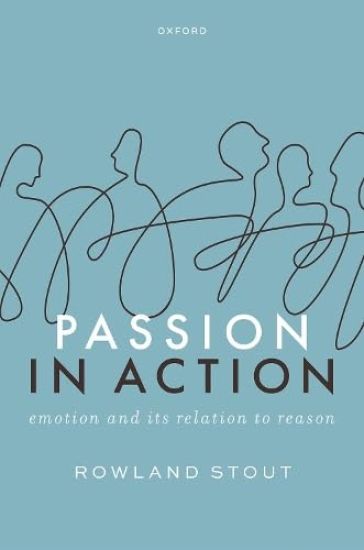
Passion in Action

Passion in Action

Rowland Stout

Oxford University Press
2025
sidottu
Developing a sophisticated and original approach to the nature of emotion, this volume demonstrates that the way we feel about things is simultaneously a product of our reason and a force on it-an aspect both of our agency and of our passivity. As a force on the way we think about things, emotions are passions and felt as such. As a product of the way we think about things, having emotions means we find values in our world. Starting from a conception of what it is to be sensitive to reason, Stout develops an account of emotional dispositions as manifested in forming and maintaining goals. When these dispositions are active we feel like behaving in certain ways, and this feeling characterizes the phenomenological aspect of emotional states. Each type of emotion corresponds to a characteristic behavioural pattern. Since emotional states are rational responses to features of our environment, having an emotion means that we are treating our environment as meriting that emotional state - i.e. as having value. It follows that every emotion corresponds to a rational perspective - a way of thinking about things. The familiar problem of emotional recalcitrance - where you know your emotional state is not rational but cannot stop feeling that way - is resolved by showing how we may have rational perspectives on our rational perspectives.
The Inner Life of a Rational Agent

The Inner Life of a Rational Agent

Rowland Stout

Edinburgh University Press
2006
sidottu
A radical approach to the philosophy of mind, in which states of mind are identified with dispositions to behave in certain ways. The approach taken by Rowland Stout is a thoroughly up-to-date version of behaviourism, although not a form of behaviourism that denies the existence of consciousness, free will, rationality, etc., nor aims to reduce these to other sorts of things. Properly understood, the idea of being disposed to behave in a certain way is seen to be exactly as rich and interesting as the idea of being in a certain state of mind. The fact that our ways of behaving are sensitive to practical rationality is taken to be an essential aspect of our nature as conscious agents. And in describing such a version of practical rationality Stout claims we are describing the mental state of someone whose behaviour is sensitive to it. His account of behaviourism rests on two central notions - that of a causal disposition to behave and that of sensitivity to practical rationality. He explains and develops these notions in some detail, and then uses them to construct powerful and original accounts of belief, intention, knowledge, perception and consciousness. Key Features * A systematic and completely original theoretical approach to the philosophy of mind * A re-evaluation of the history of the philosophy of mind based on a rejection of the generally accepted arguments in the 1960s and 1970s used by functionalists against behaviourists * A serious engagement with the intuitively compelling issues concerning behaviourism.
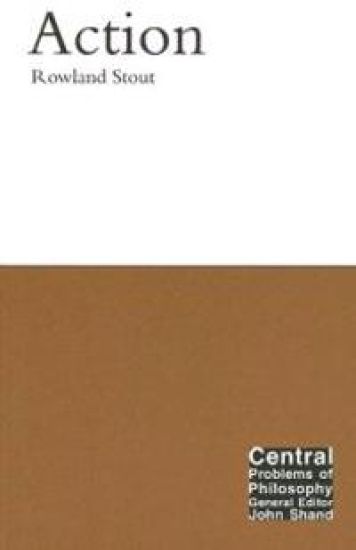
Action

Action

Rowland Stout

Acumen Publishing Ltd
2005
sidottu
The traditional focus of debate in philosophy of action has been the causal theory of action and metaphysical questions about the nature of actions as events. In this lucid and lively introduction to philosophy of action, Rowland Stout shows how these issues are subsidiary to more central ones that concern the freedom of the will, practical rationality and moral psychology. When seen in these terms, agency becomes one of the most exciting areas in philosophy and one of the most useful ways into the philosophy of mind. If one can understand what it is to be a free and rational agent, then one is some way to understanding what it is to be a conscious subject of experience. Although the book places the traditional Davidsonian agenda centre stage, it locates it historically by considering in particular Aristotle and Kant. It also takes the debate beyond Davidson by considering one of the most recent issues of interest in the philosophy of action, externalism. By focusing on the central issues of freedom and rationality as well as on the ontological structure of human action, Stout is able to offer readers a fresh and engaging treatment.
Action

Action

Rowland Stout

Acumen Publishing Ltd
2005
nidottu
The traditional focus of debate in philosophy of action has been the causal theory of action and metaphysical questions about the nature of actions as events. In this lucid and lively introduction to philosophy of action, Rowland Stout shows how these issues are subsidiary to more central ones that concern the freedom of the will, practical rationality and moral psychology. When seen in these terms, agency becomes one of the most exciting areas in philosophy and one of the most useful ways into the philosophy of mind. If one can understand what it is to be a free and rational agent, then one is some way to understanding what it is to be a conscious subject of experience. Although the book places the traditional Davidsonian agenda centre stage, it locates it historically by considering in particular Aristotle and Kant. It also takes the debate beyond Davidson by considering one of the most recent issues of interest in the philosophy of action, externalism. By focusing on the central issues of freedom and rationality as well as on the ontological structure of human action, Stout is able to offer readers a fresh and engaging treatment.
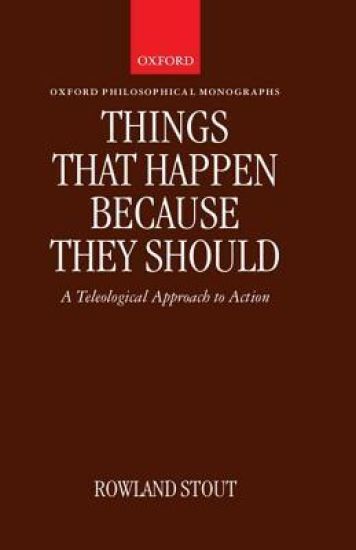
Things That Happen Because They Should

Things That Happen Because They Should

Rowland Stout

Oxford University Press
1996
sidottu
Philosophers have usually argued that the right way to explain people's actions is in terms of their beliefs and intentions rather than in terms of objective facts. Rowland Stout takes the opposite line in his account of action. Appeal to teleology is widely regarded with suspicion, but Dr Stout argues that there are things in nature, namely actions, which can be teleologically explained: they happen because they serve some end. Moreover, this teleological explanation is externalist: it cites facts about the world, not beliefs and intentions which only represent the world. Such externalism about the explanation of action is a natural partner to externalism about knowledge and about reference, but has hardly ever been considered seriously before. One dramatic consequence of such a position is that it opens up the possibility of a behaviourist account of beliefs and intentions.