Kirjojen hintavertailu. Mukana 12 657 676 kirjaa ja 12 kauppaa.

Kirjailija

Roy Bhaskar

Kirjat ja teokset yhdessä paikassa: 41 kirjaa, julkaisuja vuosilta 1986-2026, suosituimpien joukossa Scientific Realism and Human Emancipation. Vertaile teosten hintoja ja tarkista saatavuus suomalaisista kirjakaupoista.

41 kirjaa

Kirjojen julkaisuhaarukka 1986-2026.

From Science to Emancipation

From Science to Emancipation

Roy Bhaskar

Routledge
2011
sidottu
From Science to Emancipation: Alienation and the Actuality of Enlightenment is the second of three books elaborating Roy Bhaskar’s new philosophy of metaReality, which appeared in rapid succession in 2002. With a new introduction from Mervyn Hartwig, this book contains some of the original transcripts and the questions and answers they provoked, from a variety of lecture and workshop tours Roy Bhaskar presented for Indian audiences before this book was first published. Because of the spontaneous and informal nature of these talks and discussions, this book continues to provide the most immediate and accessible introduction to Roy Bhaskar's philosophy as it charts his intellectual journey.The talks recorded here have retained an immediate local but also deeply universal interest. From Science to Emancipation provides an indispensible resource for all students of philosophy and the human sciences.
From Science to Emancipation

From Science to Emancipation

Roy Bhaskar

Routledge
2011
nidottu
From Science to Emancipation: Alienation and the Actuality of Enlightenment is the second of three books elaborating Roy Bhaskar’s new philosophy of metaReality, which appeared in rapid succession in 2002. With a new introduction from Mervyn Hartwig, this book contains some of the original transcripts and the questions and answers they provoked, from a variety of lecture and workshop tours Roy Bhaskar presented for Indian audiences before this book was first published. Because of the spontaneous and informal nature of these talks and discussions, this book continues to provide the most immediate and accessible introduction to Roy Bhaskar's philosophy as it charts his intellectual journey.The talks recorded here have retained an immediate local but also deeply universal interest. From Science to Emancipation provides an indispensible resource for all students of philosophy and the human sciences.
Reflections on metaReality

Reflections on metaReality

Roy Bhaskar

Routledge
2011
sidottu
Reflections on meta-Reality is now widely regarded as a landmark in contemporary philosophy. It initiates the philosophy of meta-Reality, the third main phase of Roy Bhaskar’s philosophical thoughts, after original or basic critical realism and dialectical critical realism. Originally published in 2002 and based on talks given in India, Europe and America, Roy Bhaskar presents his new philosophy of meta-Reality as a radical extension, systematic development and proleptic completion of critical realism. This brilliant series of studies contains seminal and far-reaching discussions of critical realism and the nature of being; an incisive and limpid account of modernity, modernism and post-modernism; a sublime discourse on the nature of the self and compelling considerations on the relationship between social science and self-realization. Together, they demonstrate the ubiquity of transcendental phenomena in everyday life and the orientation of enlightenment towards collective human emancipation and universal self-realization.A new introduction to this edition by Mervyn Hartwig, founding editor of The Journal of Critical Realism and editor of A Dictionary of Critical Realism (Routledge, 2007), describes the context, significance and impact of Reflections on meta-Reality, and supplies an expert guide to its content. This book is essential reading for students and practitioners in both philosophy and the human sciences.
Reflections on metaReality

Reflections on metaReality

Roy Bhaskar

Routledge
2011
nidottu
Reflections on meta-Reality is now widely regarded as a landmark in contemporary philosophy. It initiates the philosophy of meta-Reality, the third main phase of Roy Bhaskar’s philosophical thoughts, after original or basic critical realism and dialectical critical realism. Originally published in 2002 and based on talks given in India, Europe and America, Roy Bhaskar presents his new philosophy of meta-Reality as a radical extension, systematic development and proleptic completion of critical realism. This brilliant series of studies contains seminal and far-reaching discussions of critical realism and the nature of being; an incisive and limpid account of modernity, modernism and post-modernism; a sublime discourse on the nature of the self and compelling considerations on the relationship between social science and self-realization. Together, they demonstrate the ubiquity of transcendental phenomena in everyday life and the orientation of enlightenment towards collective human emancipation and universal self-realization.A new introduction to this edition by Mervyn Hartwig, founding editor of The Journal of Critical Realism and editor of A Dictionary of Critical Realism (Routledge, 2007), describes the context, significance and impact of Reflections on meta-Reality, and supplies an expert guide to its content. This book is essential reading for students and practitioners in both philosophy and the human sciences.
Philosophy and the Idea of Freedom
First published in 2011. In Philosophy and the Idea of Freedom Roy Bhaskar sets out to develop a critique of the work of Richard Rorty, who must be one of the most in?uential authors of recent decades. In a brilliant tour de force, Bhaskar shows how Rorty falls victim to the very epistemological problematic Rorty himself describes. Roy Bhaskar argues that Rorty’s account of science and knowledge is based on a half-truth. He sees the historicity of knowledge but cannot sustain its rationality or the reality of the objects it describes. The author further argues that Rorty’s problem-?eld replicates the Kantian resolution of the third antinomy: we are determined as material bodies, but free as discursive (speaking and writing) subjects. Rorty’s actualism (like Kant’s) makes human agency impossible. Developing his own critical realism, Bhaskar shows just where Rorty’s system comes unstuck, and how the philosophical problems to which it gives rise can be rationally resolved and explained. In this process Bhaskar utilizes his critique of Rorty to begin to elaborate his own alternative interpretation and critique of the philosophical conversation of the West.
Philosophy and the Idea of Freedom
First published in 2011. In Philosophy and the Idea of Freedom Roy Bhaskar sets out to develop a critique of the work of Richard Rorty, who must be one of the most in?uential authors of recent decades. In a brilliant tour de force, Bhaskar shows how Rorty falls victim to the very epistemological problematic Rorty himself describes. Roy Bhaskar argues that Rorty’s account of science and knowledge is based on a half-truth. He sees the historicity of knowledge but cannot sustain its rationality or the reality of the objects it describes. The author further argues that Rorty’s problem-?eld replicates the Kantian resolution of the third antinomy: we are determined as material bodies, but free as discursive (speaking and writing) subjects. Rorty’s actualism (like Kant’s) makes human agency impossible. Developing his own critical realism, Bhaskar shows just where Rorty’s system comes unstuck, and how the philosophical problems to which it gives rise can be rationally resolved and explained. In this process Bhaskar utilizes his critique of Rorty to begin to elaborate his own alternative interpretation and critique of the philosophical conversation of the West.
Reclaiming Reality

Reclaiming Reality

Roy Bhaskar

Routledge
2010
nidottu
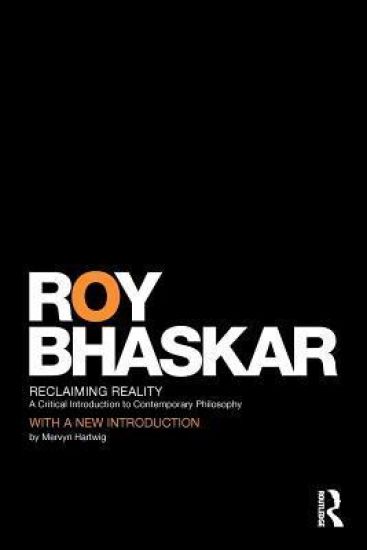
Originally published in 1989, Reclaiming Reality still provides the most accessible introduction to the increasingly influential multi-disciplinary and international body of thought, known as critical realism. It is designed to "underlabour" both for the sciences, especially the human sciences, and for the projects of human emancipation which such sciences may come to inform; and provides an enlightening intervention in current debates about realism and relativism, positivism and poststucturalism, modernism and postmodernism, etc. Elaborating his critical realist perspective on society, nature, science and philosophy itself, Roy Bhaskar shows how this perspective can be used to undermine currently fashionable ideologies of the Right, and at the same time, to clear the ground for a reinvigorated Left. Reclaiming Reality contains powerful critiques of some of the most important schools of thought and thinkers of recent years—from Bachelard and Feyerabend to Rorty and Habermas; and it advances novel and convincing resolutions of many traditional philosophical problems. Now with a new introduction from Mervyn Hartwig, this book continues to provide a straightforward and stimulating introduction to current debates in philosophy and social theory for the interested lay reader and student alike. Reclaiming Reality will be of particular value not only for critical realists but for all those concerned with the revitalization of the socialist emancipatory project and the renaissance of the Marxist theoretical tradition.
Reclaiming Reality

Reclaiming Reality

Roy Bhaskar

Routledge
2010
sidottu
Originally published in 1989, Reclaiming Reality still provides the most accessible introduction to the increasingly influential multi-disciplinary and international body of thought, known as critical realism. It is designed to "underlabour" both for the sciences, especially the human sciences, and for the projects of human emancipation which such sciences may come to inform; and provides an enlightening intervention in current debates about realism and relativism, positivism and poststucturalism, modernism and postmodernism, etc. Elaborating his critical realist perspective on society, nature, science and philosophy itself, Roy Bhaskar shows how this perspective can be used to undermine currently fashionable ideologies of the Right, and at the same time, to clear the ground for a reinvigorated Left. Reclaiming Reality contains powerful critiques of some of the most important schools of thought and thinkers of recent years—from Bachelard and Feyerabend to Rorty and Habermas; and it advances novel and convincing resolutions of many traditional philosophical problems. Now with a new introduction from Mervyn Hartwig, this book continues to provide a straightforward and stimulating introduction to current debates in philosophy and social theory for the interested lay reader and student alike. Reclaiming Reality will be of particular value not only for critical realists but for all those concerned with the revitalization of the socialist emancipatory project and the renaissance of the Marxist theoretical tradition.Roy Bhaskar is the originator of the philosophy of critical realism, and the author of many acclaimed and influential works including A Realist Theory of Science, The Possibility of Naturalism, Scientific Realism and Human Emancipation and Dialectic: The Pulse of Freedom. He is an editor of the recently published Critical Realism: Essential Readings and is currently chair of the Centre for Critical Realism.
The Formation of Critical Realism

The Formation of Critical Realism

Roy Bhaskar; Mervyn Hartwig

Routledge
2010
nidottu
This series of interviews, conducted in the form of exchanges between Roy Bhaskar and Mervyn Hartwig, tells a riveting story of the formation and development of critical realism.Three intersecting and interweaving narratives unfold in the course of this unfinished story: the personal narrative of Roy Bhaskar, born of an Indian father and English mother, a child of post-war Britain and Indian partition and independence; the intellectual narrative of the emergence and growth of critical realism; and a world-historical story, itself theorized by critical realism in its discussion of the development of modernity.This book gives an invaluable account of the development of critical realism, and its consolidation as a leading philosophy of our times. It takes us through the major moments of its formation, the principal objections to and controversies within critical realism, the establishment of its institutions, and considers its limits and future development. Special features of the book include discussion of the genesis of critical realism, and the origins and nature of the so-called dialectical and spiritual turns.The informal dialogical style of The Formation of Critical Realism makes it compelling reading and an invaluable source for students of critical realism as well as all those interested in the intellectual story of our times.
The Formation of Critical Realism

The Formation of Critical Realism

Roy Bhaskar; Mervyn Hartwig

Routledge
2010
sidottu
This series of interviews, conducted in the form of exchanges between Roy Bhaskar and Mervyn Hartwig, tells a riveting story of the formation and development of critical realism.Three intersecting and interweaving narratives unfold in the course of this unfinished story: the personal narrative of Roy Bhaskar, born of an Indian father and English mother, a child of post-war Britain and Indian partition and independence; the intellectual narrative of the emergence and growth of critical realism; and a world-historical story, itself theorized by critical realism in its discussion of the development of modernity.This book gives an invaluable account of the development of critical realism, and its consolidation as a leading philosophy of our times. It takes us through the major moments of its formation, the principal objections to and controversies within critical realism, the establishment of its institutions, and considers its limits and future development. Special features of the book include discussion of the genesis of critical realism, and the origins and nature of the so-called dialectical and spiritual turns.The informal dialogical style of The Formation of Critical Realism makes it compelling reading and an invaluable source for students of critical realism as well as all those interested in the intellectual story of our times.
Plato Etc

Plato Etc

Roy Bhaskar

Routledge
2009
sidottu
In this concise text, Roy Bhaskar sets out to diagnose, explain and resolve the "problems of philosophy". Plato Etc. reviews all the main areas of the subject: the theory of knowledge and philosophy of science; the philosophy of logic and language; the philosophies of space, time and causality; the philosophy of the social and life sciences and of dialectic; ethics, politics and aesthetics; and the history and sociology of philosophy.Among the issues discussed are the problems of induction and universals, the question of relativism, Heidegger’s "scandal of philosophy" (the search for a proof of the reality of the external world), the nature of moral truth and the conundrum of free will and determinism. The last two chapters consist of a synoptic account of the development of Western philosophy from the pre-Socratics to poststructuralism.Plato Etc. seeks to revindicate the philosophical project, and to demonstrate that the author’s "dialectical critical realism" has the categorical power to remedy the problem fields of philosophy. The book serves both as a critical introduction to philosophy and as an invaluable resource for the scholar.
Plato Etc

Plato Etc

Roy Bhaskar

Routledge
2009
nidottu
In this concise text, Roy Bhaskar sets out to diagnose, explain and resolve the "problems of philosophy". Plato Etc. reviews all the main areas of the subject: the theory of knowledge and philosophy of science; the philosophy of logic and language; the philosophies of space, time and causality; the philosophy of the social and life sciences and of dialectic; ethics, politics and aesthetics; and the history and sociology of philosophy.Among the issues discussed are the problems of induction and universals, the question of relativism, Heidegger’s "scandal of philosophy" (the search for a proof of the reality of the external world), the nature of moral truth and the conundrum of free will and determinism. The last two chapters consist of a synoptic account of the development of Western philosophy from the pre-Socratics to poststructuralism.Plato Etc. seeks to revindicate the philosophical project, and to demonstrate that the author’s "dialectical critical realism" has the categorical power to remedy the problem fields of philosophy. The book serves both as a critical introduction to philosophy and as an invaluable resource for the scholar.
Scientific Realism and Human Emancipation
Following on from Roy Bhaskar’s first two books, A Realist Theory of Science and The Possibility of Naturalism, Scientific Realism and Human Emancipation, establishes the conception of social science as explanatory—and thence emancipatory—critique. Scientific Realism and Human Emancipation starts from an assessment of the impasse of contemporary accounts of science as stemming from an incomplete critique of positivism. It then proceeds to a systematic exposition of scientific realism in the form of transcendental realism, highlighting a conception of science as explanatory of a structured, differentiated and changing world. Turning to the social domain, the book argues for a view of the social order as conditioned by, and emergent from, nature. Advocating a critical naturalism, the author shows how the transformational model of social activity together with the conception of social science as explanatory critique which it entails, resolves the divisions and dualisms besetting orthodox social and normative theory: between society and the individual, structure and agency, meaning and behavior, mind and body, reason and cause, fact and value, and theory and practice. The book then goes on to discuss the emancipatory implications of social science and sketches the nature of the depth investigation characteristically entailed.In the highly innovative third part of the book Roy Bhaskar completes his critique of positivism by developing a theory of philosophical discourse and ideology, on the basis of the transcendental realism and critical naturalism already developed, showing how positivism functions as a restrictive ideology of and for science and other social practices.
Scientific Realism and Human Emancipation
Following on from Roy Bhaskar’s first two books, A Realist Theory of Science and The Possibility of Naturalism, Scientific Realism and Human Emancipation, establishes the conception of social science as explanatory—and thence emancipatory—critique. Scientific Realism and Human Emancipation starts from an assessment of the impasse of contemporary accounts of science as stemming from an incomplete critique of positivism. It then proceeds to a systematic exposition of scientific realism in the form of transcendental realism, highlighting a conception of science as explanatory of a structured, differentiated and changing world. Turning to the social domain, the book argues for a view of the social order as conditioned by, and emergent from, nature. Advocating a critical naturalism, the author shows how the transformational model of social activity together with the conception of social science as explanatory critique which it entails, resolves the divisions and dualisms besetting orthodox social and normative theory: between society and the individual, structure and agency, meaning and behavior, mind and body, reason and cause, fact and value, and theory and practice. The book then goes on to discuss the emancipatory implications of social science and sketches the nature of the depth investigation characteristically entailed.In the highly innovative third part of the book Roy Bhaskar completes his critique of positivism by developing a theory of philosophical discourse and ideology, on the basis of the transcendental realism and critical naturalism already developed, showing how positivism functions as a restrictive ideology of and for science and other social practices.
A Realist Theory of Science

A Realist Theory of Science

Roy Bhaskar

Routledge
2008
nidottu
First Published in 2008. Now acknowledged as a classic in the philosophy of science, A Realist Theory of Science is one of the very few books which has transformed not only our understanding of science, but that of the nature of the world it studies. Since its original publication in 1975, the book has inspired the multi-disciplinary and international movement of thought known as critical realism; and its ideas have been influential across the whole spectrum of the sciences, arts and humanities and in a diverse array of social practices and professions. In this book, Roy Bhaskar sets out to revindicate ontology, critiquing the reduction of being in favor of knowledge, which he calls the epistemic fallacy. Employing a transcendental argument from the nature of experimental activity, he establishes a critique of the dominant positivist and neo-Kantian traditions in the philosophy of science, developing a new ontology in which concepts of structure, difference and change come to the fore. Then, analyzing the nature of scientific discovery and development, he shows how, against both the empiricist and rationalist traditions, science can come to have a posteriori knowledge of natural necessity. The resultant position, which the author characterizes as transcendental realism, has the power to resolve many traditional philosophical problems, such as the problem of induction. At the same time it lays the basis for radically new accounts of social science, ethics and the project of human emancipation.A new introduction to this edition by Mervyn Hartwig decribes the significance of A Realist Theory of Science throughout the humanities world, and offers an expert critique of its content.
Dialectic

Dialectic

Roy Bhaskar

Routledge
2008
nidottu
Dialectic is now widely regarded as a classic of contemporary philosophy. This book, first published in 1993, sets itself three main aims: the development of a general theory of dialectic, of which Hegelian dialectic can be seen to be a special case; the dialectical enrichment and deepening of critical realism, viz. into the system of dialectical critical realism; and the outline of the elements of a totalizing critique of Western philosophy.The first chapter clarifies the rational core of Hegelian dialectic. Chapter two then proceeds to develop a general theory of dialectic. Isolating the fallacy of 'ontological monovalence', Roy Bhaskar then shows how absence and other negating concepts such as contradiction have a legitimate and necessary ontological employment. He then goes on to give a synoptic account of key dialectical concepts such as the concrete universal; to sketch the further dialectical development of critical naturalism through an account of what he calls four-planar social being; and following consideration of the dialectical critique of analytical reason, he moves on to the real definition of dialectic as absenting absence and in the human sphere, the axiology of freedom.Chapter three extends and deepens critical realism’s characteristic concerns with ontology, science, social science and emancipation not only into the realms of negativity and totality, but also into the fields of reference and truth, spatio-temporality, tense and process, the logic of dialectical universalizability and on to the plane of ethics, where it articulates a combination of moral realism and ethical naturalism, whereby consideration of elemental desire involves commitment to the eudaimonistic society. This is then followed by a sublime discussion of key moments in the trajectory of Western philosophy, the tradition of which can now be seen to be based on what the author calls the unholy trinity of the epistemic fallacy or the reduction of being to knowledge, primal squeeze or the collapse of structure and alethic truth, and ontological monovalence.
A Realist Theory of Science

A Realist Theory of Science

Roy Bhaskar

Verso Books
2008
nidottu
A Realist Theory of Science is one of the few books that have changed our understanding of the philosophy of science. In this analysis of the natural sciences, with a particular focus on the experimental process itself, Roy Bhaskar provides a definitive critique of the traditional, positivist conception of science and stakes out an alternative, realist position. Since it original publication in 1975, a movement known as 'Critical Realism', which is both intellectually diverse and international in scope, has developed on the basis of key concepts outlined in the text. The book has been hailed in many quarters as a 'Copernican Revolution' in the study of the nature of science, and the implications of its account have been far-reaching for many fields of the humanities and social sciences.
Dialectic

Dialectic

Roy Bhaskar

Verso Books
1994
nidottu
This book attacks purely analytical modes of thinking. Bhaskar develops a critical realist philosophy, which isolates the definition of being in terms of knowledge as the characteristic flaw of traditional philosophy. He conceives a "transformational" model of society and sees social science as explanatory, and therefore of assistance to political projects of emancipation. Concerned to bridge the gap between philosophy and politics, Dialectic argues that critical realism provides the basis of a completely new and general methodology for the human sciences. This book also contains an account of the history of Western philosophy, from its pre-Socratic origins to its contemporary post-modernist forms.
Plato, Etc.

Plato, Etc.

Roy Bhaskar

Verso Books
1994
nidottu
In his most accessible book to date, Roy Bhaskar sets out to diagnose, explain and resolve the 'problems of philosophy'. Plato Etc. reviews all the main areas of the subject: the theory of knowledge and the philosophy of science; the philosophy of logic and language; the philosophies of space, time and causality; the philosophy of the social and life sciences and of dialectic; ethics, politics and aesthetics; and the history and sociology of philosophy.Among the issues discussed are the problems of induction and universals, the question of relativism, Heidegger's 'scandal of philosophy' (the search for a proof of the reality of the external world), the nature of moral truth, and the conundrum of free will and determinism. The last two chapters consist of a synoptic account of the development of Western philosophy from the pre-Socratics to poststructuralism.Plato Etc. seeks to revindicate the idea of the philosophical project, and to demonstrate that Bhaskar's 'dialectical critical realism' has the categorial power to remedy the problem fields of philosophy. The book serves both as an introduction to philosophy and as an invaluable resource for the scholar.
Reclaiming Reality

Reclaiming Reality

Roy Bhaskar

Verso Books
1989
nidottu
This series of linked essays is an accessible intervention in the current debates about realism which are of increasing significance on both sides of the Atlantic. It is designed to underlabour both for the sciences, especially the human sciences, and for the projects of human emancipation which such sciences may come to inform.Elaborating his own highly original critical realist perspective on society, nature, science and philosophy itself. Roy Bhaskar shows how this new perspective can be used to undermine currently fashionable ideologies of the right and, at the same time, to clear the ground for a reinvigorated left. Reclaiming Reality contains powerful critiques of some of the most important schools of thought and thinkers of our time - from Bachelard and Feyerabend to Rorty and Habermas. It advances novel and convincing resolutions of many traditional philosophical problems.Providing a straightforward and stimulating introduction to current debates in the philosophy of science and of social theory, for the interested lay reader and student alike, this book will be of particular value for all those concerned with the socialist emancipatory project and the renaissance of the Marxist theoretical tradition.