
Kirjailija
Rudolf Carnap
Kirjat ja teokset yhdessä paikassa: 34 kirjaa, julkaisuja vuosilta 1934-2026, suosituimpien joukossa Les Fondements Philosophiques de la Physique. Une Introduction a la Philosophie Des Sciences. Vertaile teosten hintoja ja tarkista saatavuus suomalaisista kirjakaupoista.
34 kirjaa
Kirjojen julkaisuhaarukka 1934-2026.

Scheinprobleme in der Philosophie und andere metaphysikkritische Schriften
Rudolf Carnap
Meiner Felix Verlag GmbH
2005
nidottu
The Logical Structure of the World and Pseudoproblems in Philosophy
Rudolf Carnap
Open Court Publishing Co ,U.S.
2003
pokkari
In this text, Rudolf Carnap analyzes the fundamental elements of experience, the derivation of qualities, the construction of sensory classes and the construction of the special and temporal orders.
Introduction to Symbolic Logic and its Applications
Rudolf Carnap
Dover Publications Inc.
2003
nidottu
A clear, comprehensive, and rigorous treatment develops the subject from elementary concepts to the construction and analysis of relatively complex logical languages. It then considers the application of symbolic logic to the clarification and axiomatization of theories in mathematics, physics, and biology. Hundreds of problems, examples, and exercises. 1958 edition.
Rudolf Carnap's entire theory of Language structure "came to me," he reports, "like a vision during a sleepless night in January 1931, when I was ill." This theory appeared in The Logical Syntax of Language (1934). Carnap argued that many philosophical controversies really depend upon whether a particular language form should be used. This leads him to his famous "Principle of tolerance" by which everyone is free to mix and match the rules of his language and therefore his logic in any way he wishes. In this way, philosophical issues become reduced to a discussion of syntactical properties, plus reasons of practical convenience for preferring one form of language to another. In a tour de force of precise reasoning, Carnap also indicated how two model languages could be constructed. This is one of three books which Open Court is making available in paperback reprint in its Open Court Classics series. The other two are Carnap's The Logical Structure of the World and Schlick's General Theory of Knowledge.
This is IV volume of eight in a series on Philosophy of the Mind and Language. For nearly a century mathematicians and logicians have been striving hard to make logic an exact science. But a book on logic must contain, in addition to the formulae, an expository context which, with the assistance of the words of ordinary language, explains the formulae and the relations between them; and this context often leaves much to be desired in the matter of clarity and exactitude. Originally published in 1937, the purpose of the present work is to give a systematic exposition of such a method, namely, of the method of logical syntax.
In seinem 1928 erschienenen Hauptwerk Der logische Aufbau der Welt unternahm Rudolf Carnap den Versuch, die erkenntnistheoretische These des englischen Empirismus, nach der die Basis aller unserer Wirklichkeitserkenntnis in Wahrnehmungserlebnissen bestehe, durch die methodische und zugleich logisch einsichtige Konstruktion der Gegenstandswelt aus solcherart bestimmten Elementarerlebnissen zu untermauern. Neu und richtungweisend an diesem Ansatz war der Gebrauch, den Carnap - er war Schüler Freges - "von den Hilfmitteln der modernen Logik, besonders der von Russell entwickelten Relationenlogik, machte, und die Rücksicht auf die psychologische Erkenntnis, daß die einfachen Sinnesdaten nicht Erlebnisse sind, sondern erst rückwärts aus den Erlebnissen erschlossen werden müssen" (Günter Patzig).
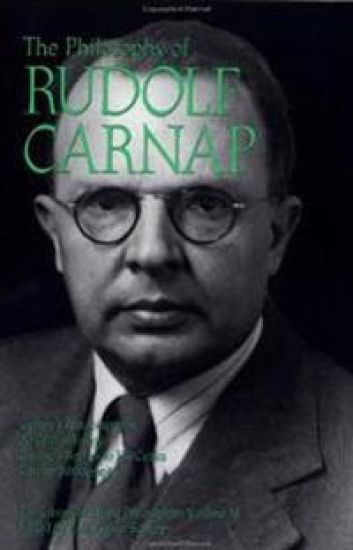
The Philosophy of Rudolf Carnap, Volume 11
Rudolf Carnap; Paul Arthur Schilpp
Open Court Publishing Co ,U.S.
1999
pokkari
The first volume of the Library of Living Philosophers (LLP) appeared in 1939, the brainchild of the late Professor Paul A. Schilpp. Schilpp saw that it would help to eliminate confusion and endless sterile disputes over interpretation if great philosophers could be confronted by their capable philosophical peers and asked to reply. As well as a number of critical essays with the chosen philosopher's replies to each essay, each volume would include an intellectual autobiography and an up-to-date bibliography The LLP series has exceeded even Schilpp's expectations, enabling great philosophers to do more than clarify by extending and elaborating their thoughts. A volume in the Library of Living Philosophers is not merely a commentary on a philosopher's work; it is a critical part of that work.

Logical Empiricism at Its Peak
Maria Neurath; Moritz Schlick; Rudolf Carnap
CRC Press Inc
1996
sidottu
A new direction in philosophy Between 1920 and 1940 logical empiricism reset the direction of philosophy of science and much of the rest of Anglo-American philosophy. It began as a relatively organized movement centered on the Vienna Circle, and like-minded philosophers elsewhere, especially in Berlin. As Europe drifted into the Nazi era, several important figures, especially Carnap and Neurath, also found common ground in their liberal politics and radical social agenda. Together, the logical empiricists set out to reform traditional philosophy with a new set of doctrines more firmly grounded in logic and science. Criticism and decline Because of Nazi persecution, most of the European adherents of logical empiricism moved to the United States in the late 1930s. During the 1940s, many of their most cherished tenets became targets of criticism from outsiders as well as from within their own ranks. Philosophers of science in the late 1950s and 1960s rejected logical empiricism and, starting in the 1970s, presented such alternative programs such as scientific realism with evolutionary epistemology. A resurgence of interest During the early 1980s, philosophers and historians of philosophy began to study logical empiricism as an important movement. Unlike their predecessors in the 1960s-for whom the debate over logical empiricism now seems to have been largely motivated by professional politics-these philosopher no longer have to take positions for or against logical empiricism. The result has been a more balanced view of that movement, its achievements, its failures, and its influence. Hard-to-find core writings now available This collection makes available a selection of the most influential and representative writings of the logical empiricists, important contemporary criticisms of their doctrines, their responses, as well as the recent reappraisals. Introductions to each volume examine the articles in historical context and provide important background information that is vital to a full understanding of the issues discussed. They outline prevalent trends, identifying leading figures and summarize their positions and reasoning, as well as those of opposing thinkers.
Rudolf Carnap and W. V. Quine, two of the twentieth century's most important philosophers, corresponded at length - and over a long period of time - on matters personal, professional, and philosophical. Their friendship encompassed issues and disagreements that go to the heart of contemporary philosophic discussions. Carnap (1891-1970) was a founder and leader of the logical positivist school. The younger Quine (1908) began as his staunch admirer but diverged from him increasingly over questions in the analysis of meaning and the justification of belief. That they remained close, relishing their differences through years of correspondence, shows their stature both as thinkers and as friends.The letters are presented here, in full, for the first time. The substantial introduction by Richard Creath offers a lively overview of Carnap's and Quine's careers and backgrounds, allowing the nonspecialist to see their writings in historical and intellectual perspective. Creath also provides a judicious analysis of the philosophical divide between them, showing how deep the issues cut into the discipline, and how to a large extent they remain unresolved.
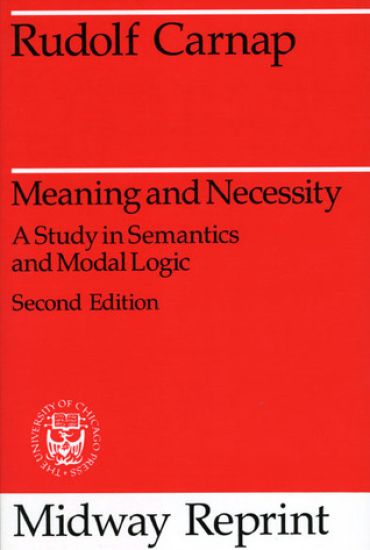
"This book is valuable as expounding in full a theory of meaning that has its roots in the work of Frege and has been of the widest influence. . . . The chief virtue of the book is its systematic character. From Frege to Quine most philosophical logicians have restricted themselves by piecemeal and local assaults on the problems involved. The book is marked by a genial tolerance. Carnap sees himself as proposing conventions rather than asserting truths. However he provides plenty of matter for argument."—Anthony Quinton, Hibbert Journal
Logische Syntax der Sprache
Rudolf Carnap
Springer-Verlag Berlin and Heidelberg GmbH Co. K
1968
nidottu
Seit beinahe einem Jahrhundert sind Mathematiker und Logiker mit Erfolg bemiiht, aus der Logik eine strenge Wissen- schaft zu machen. Dieses Ziel ist in einem gewissen Sinn erreicht worden: man hat gelemt, in der Logistik mit Symbolen und Formeln ii. hnlich denen der Mathematik in strenger Weise zu operieren. Aber ein logisches Buch muB auBer den Formeln auch Zwischentext enthalten, der mit Hilfe der gewohnlichen Wort- sprache iiber die Formeln spricht und ihren Zusammenhang kIar macht. Dieser Zwischentext laBt oft an Klarheit und Exakt- heit manches zu wiinschen ubrig. In den letzten Jahren nun hat sich bei den Logikem verschiedener Richtungen immer mehr die Einsicht entwickelt, daB dieser Zwischentext das Wesentliche an der Logik ist und daB as darauf ankommt, fUr diese Satze uber Satze eine exakte Methode zu entwickeln. Dieses Buch will die systematische Darstellung einer solchen Methode, der "logischen Syntax", geben (nahere Erlauterungen in der Einleitung, 1, 2). In unserem "Wiener Kreis" und in manchen ahnlich gerich- teten Gruppen (in Polen, Frankreich, England, USA. und ver- einzelt sogar in Deutschland) hat sich gegenwartig die Auffassung immer deutlicher herausgebildet, daB die traditionelle meta- physische Philosophie keinen Anspruch auf Wissenschaftlichkeit machen kann. Was an der Arbeit des Philosophen wissenschaft- lich haltbar ist, besteht - soweit es nicht empirische Fragen betrifft, die der Realwissenschaft zuzuweisen sind - in logischer Analyse. Die logische Syntax will nun ein Begriffsgeb8. ude, eine Sprache liefem, mit deren Hilfe die Ergebnisse logischer Analyse exakt formulierbar sind.
Introduction to Semantics and Formalization of Logic
Rudolf Carnap
Harvard University Press
1959
sidottu
Logische Syntax der Sprache
Rudolf Carnap; Philipp Frank; Moritz Schlick
Springer-Verlag Berlin and Heidelberg GmbH Co. K
1934
nidottu
Dieser Buchtitel ist Teil des Digitalisierungsprojekts Springer Book Archives mit Publikationen, die seit den Anfängen des Verlags von 1842 erschienen sind. Der Verlag stellt mit diesem Archiv Quellen für die historische wie auch die disziplingeschichtliche Forschung zur Verfügung, die jeweils im historischen Kontext betrachtet werden müssen. Dieser Titel erschien in der Zeit vor 1945 und wird daher in seiner zeittypischen politisch-ideologischen Ausrichtung vom Verlag nicht beworben.