Kirjojen hintavertailu. Mukana 12 390 323 kirjaa ja 12 kauppaa.

Kirjailija

Rudolf Kippenhahn

Kirjat ja teokset yhdessä paikassa: 5 kirjaa, julkaisuja vuosilta 1986-2014, suosituimpien joukossa Stellar Structure and Evolution. Vertaile teosten hintoja ja tarkista saatavuus suomalaisista kirjakaupoista.

5 kirjaa

Kirjojen julkaisuhaarukka 1986-2014.

Stellar Structure and Evolution

Stellar Structure and Evolution

Rudolf Kippenhahn; Alfred Weigert; Achim Weiss

Springer-Verlag Berlin and Heidelberg GmbH Co. K
2014
nidottu
This long-awaited second edition of the classical textbook on Stellar Structure and Evolution by Kippenhahn and Weigert is a thoroughly revised version of the original text. Taking into account modern observational constraints as well as additional physical effects such as mass loss and diffusion, Achim Weiss and Rudolf Kippenhahn have succeeded in bringing the book up to the state-of-the-art with respect to both the presentation of stellar physics and the presentation and interpretation of current sophisticated stellar models. The well-received and proven pedagogical approach of the first edition has been retained.The book provides a comprehensive treatment of the physics of the stellar interior and the underlying fundamental processes and parameters. The models developed to explain the stability, dynamics and evolution of the stars are presented and great care is taken to detail the various stages in a star’s life. Just as the first edition, which remained astandard work for more than 20 years after its first publication, the second edition will be of lasting value not only for students but also for active researchers in astronomy and astrophysics.
Stellar Structure and Evolution

Stellar Structure and Evolution

Rudolf Kippenhahn; Alfred Weigert; Achim Weiss

Springer-Verlag Berlin and Heidelberg GmbH Co. K
2012
sidottu
This long-awaited second edition of the classical textbook on Stellar Structure and Evolution by Kippenhahn and Weigert is a thoroughly revised version of the original text. Taking into account modern observational constraints as well as additional physical effects such as mass loss and diffusion, Achim Weiss and Rudolf Kippenhahn have succeeded in bringing the book up to the state-of-the-art with respect to both the presentation of stellar physics and the presentation and interpretation of current sophisticated stellar models. The well-received and proven pedagogical approach of the first edition has been retained.The book provides a comprehensive treatment of the physics of the stellar interior and the underlying fundamental processes and parameters. The models developed to explain the stability, dynamics and evolution of the stars are presented and great care is taken to detail the various stages in a star’s life. Just as the first edition, which remained astandard work for more than 20 years after its first publication, the second edition will be of lasting value not only for students but also for active researchers in astronomy and astrophysics.
Stellar Structure and Evolution

Stellar Structure and Evolution

Rudolf Kippenhahn; Alfred Weigert

Springer-Verlag Berlin and Heidelberg GmbH Co. K
1994
nidottu
The attempt to understand the physics of the structure of stars and their change in time - their evolution - has been bothering many physicists and astronomers ever since the last century. This long chain of successful research is well documented not only by numerous papers in the corresponding journals but also by a series of books. Some of them are so excellently written that despite their age they can still be recommended, and not only as documents of the state of the art at that time. A few outstanding examples are the books of R. Emden (1907), A. S. Eddington (1926), S. Chandrasekhar (1939), and M. Schwarzschild (1958). But our science has rapidly expanded in the last few decades, and new aspects have emerged which could not even be anticipated, say, 30 years ago and which today have to be carefully explored. This does not mean, however, that our ambition is to present a complete account of the latest and most refined numerical results. This can well be left to the large and growing number of excellent review articles. The present book is intended rather to be a textbook that will help students and teachers to understand these results as far as possible and present them in a simple and clear manner. We know how difficult this is since we ourselves have tried for the largest part of our scientific career to understand "how the stars work" - and then to make others believe it.
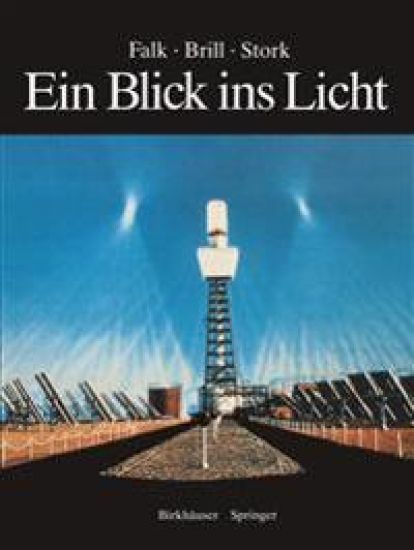
Ein Blick ins Licht

Ein Blick ins Licht

David S. Falk; Rudolf Kippenhahn; Dieter R. Brill; David G. Stork

Springer-Verlag Berlin and Heidelberg GmbH Co. K
1990
nidottu
Erst wurde es dunkel. Schwarz stand Es ist schon etwas Merkwiirdiges Doch Licht ist nicht nur ein Hilfs- dann die Scheibe des Mondes vor der mit unseren Augen. Wir denken nicht mittel zum Sehen. Die elektromagne- Sonne. An der Seite ragten Pro tube- oft dariiber nach, was es mit dem tische Strahlung ist ein wichtiger Be- ranzen in die silbrig leuchtende Koro- Licht auf sich hat, das uns durch das standteil der Welt. Licht entsteht in na, himbeerfarben, kitschig rosa. Ich Leben fiihrt. Die Augen zeigen uns Atomen und wird in Atomen wieder sehe das Bild noch heute vor meinen nur ein oberfliichliches Bild von ihm. gefangen. An ihm hat der Mensch zu- Augen. Ebenso unvergeBlich wie diese Wer zwei Polarisationsfilter in die erst gelernt, daB die Welt von Quan- totale Sonnenfinsternis sind mir die Hand bekommt, merkt, wieviel mehr tengesetzen regiert wird. Es kann sich Tierbilder, die ich Jahre danach in den im Licht steckt. Wer eine Haushalts- in Materieteilchen verwandeln, und es Hohlen von Altamira im Fackellicht folie hinzunimmt, wundert sich iiber entsteht, wenn sich Materie und Anti- sah, vor 20000 Jahren von einem die Farbenpracht, die in den farblosen materie begegnen. Kiinstler an die Felswand gezeichnet. Filtern und Folien steckt. Die mo- Wenn der Mond die Sonne verfin- Wieder war es ein optischer Eindruck, derne Optik mit Lasern und Holo- stert, treten Protuberanzen und Koro- von dem ich so ergriffen wurde, daB er grammen gar eroffnet eine noch wun- na hervor.
Light from the Depths of Time

Light from the Depths of Time

Rudolf Kippenhahn

Springer-Verlag Berlin and Heidelberg GmbH Co. K
1986
nidottu
Although this book has been available for some time, it is only now appearing in an English edition. This gives me the opportunity of adding a few explanations. I have not struggled to include the very latest, tentative results. I have, instead, concentrated on presenting cosmological ideas to interested non­ experts. They often encounter considerable difficulties when attempts are made to explain even long-established results in this field, so the aim of this book is to provide them with help. Naturally, I have also tried to include modern findings. To help with the explanation I have made use of the fictitious inhabi­ tants of Flatland, occasional historical digressions, and the dreams of Herr Meyer. Incidentally, I chose this name, which is very common in German­ speaking countries, to suggest an average citizen, just like the man next door. I should like to thank Springer-Verlag for deciding to publish this book in the language in which many of the discoveries described here were first formulated. I also thank my translator, Mr Storm Dunlop. Finally I thank Hanna Tettenborn for compiling the index.