Kirjojen hintavertailu. Mukana 12 390 323 kirjaa ja 12 kauppaa.

Kirjailija

Rui P. Chaves

Kirjat ja teokset yhdessä paikassa: 4 kirjaa, julkaisuja vuosilta 2020-2025, suosituimpien joukossa Unbounded Dependency Constructions. Vertaile teosten hintoja ja tarkista saatavuus suomalaisista kirjakaupoista.

4 kirjaa

Kirjojen julkaisuhaarukka 2020-2025.

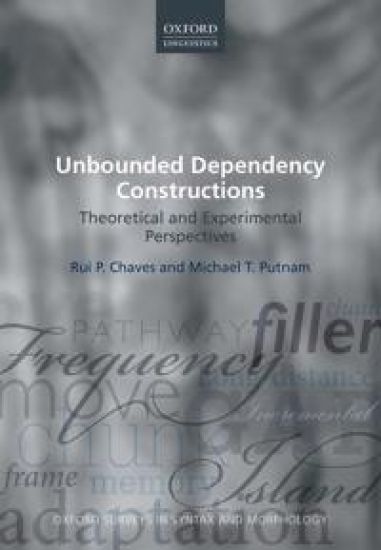
Unbounded Dependency Constructions

Unbounded Dependency Constructions

Rui P. Chaves; Michael T. Putnam

Oxford University Press
2020
nidottu
This book is about one of the most intriguing features of human communication systems: the fact that words that go together in meaning can occur arbitrarily far away from each other. In the sentence This is technology that most people think about, but rarely consider the implications of, the word 'technology' is interpreted as if it were simultaneously next to the words 'about' and 'of'. This kind of long-distance dependency has been the subject of intense linguistic and psycholinguistic research for the last half century, and offers a unique insight into the nature of grammatical structures and their interaction with cognition. The constructions in which these unbounded dependencies arise are remarkably difficult to model and come with a rather puzzling array of constraints that have often defied characterization or proper explanation. This work provides a detailed survey of these constructions and the factors responsible for their creation and comprehension, describes new experimental evidence that sheds light on the nature of the phenomenon, and suggests new avenues for future research. The volume will be of interest to graduate students and researchers in the fields of morphosyntax, psycholinguistics, and cognitive science.
Unbounded Dependency Constructions

Unbounded Dependency Constructions

Rui P. Chaves; Michael T. Putnam

Oxford University Press
2020
sidottu
This book is about one of the most intriguing features of human communication systems: the fact that words that go together in meaning can occur arbitrarily far away from each other. In the sentence This is technology that most people think about, but rarely consider the implications of, the word 'technology' is interpreted as if it were simultaneously next to the words 'about' and 'of'. This kind of long-distance dependency has been the subject of intense linguistic and psycholinguistic research for the last half century, and offers a unique insight into the nature of grammatical structures and their interaction with cognition. The constructions in which these unbounded dependencies arise are remarkably difficult to model and come with a rather puzzling array of constraints that have often defied characterization or proper explanation. This work provides a detailed survey of these constructions and the factors responsible for their creation and comprehension, describes new experimental evidence that sheds light on the nature of the phenomenon, and suggests new avenues for future research. The volume will be of interest to graduate students and researchers in the fields of morphosyntax, psycholinguistics, and cognitive science.
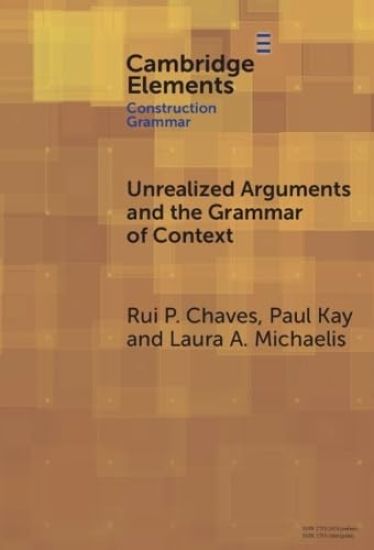
Unrealized Arguments and the Grammar of Context

Unrealized Arguments and the Grammar of Context

Rui P. Chaves; Paul Kay; Laura A. Michaelis

Cambridge University Press
2025
sidottu
In null instantiation (NI) an optionally unexpressed argument receives either anaphoric or existential interpretation. One cannot accurately predict a predicator's NI potential based either on semantic factors (e.g., Aktionsart class of the verb) or pragmatic factors (e.g., relative discourse prominence of arguments), but NI potential, while highly constrained, is not simply lexical idiosyncrasy. It is instead the product of both lexical and constructional licensing. In the latter case, a construction can endow a verb with NI potential that it would not otherwise have. Using representational tools of sign based construction grammar, this Element offers a lexical treatment of English null instantiation that covers both distinct patterns of construal of null-instantiated arguments and the difference between listeme-based and contextually licensed, thus construction-based, null complementation.
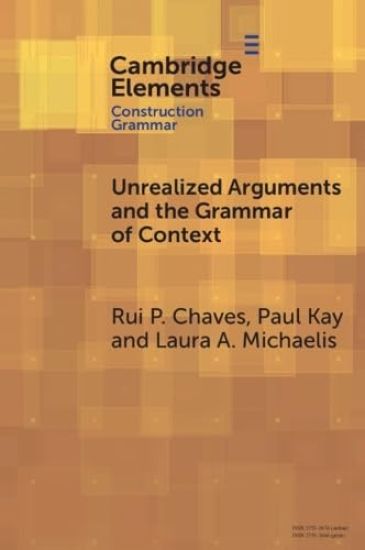
Unrealized Arguments and the Grammar of Context

Unrealized Arguments and the Grammar of Context

Rui P. Chaves; Paul Kay; Laura A. Michaelis

Cambridge University Press
2025
pokkari
In null instantiation (NI) an optionally unexpressed argument receives either anaphoric or existential interpretation. One cannot accurately predict a predicator's NI potential based either on semantic factors (e.g., Aktionsart class of the verb) or pragmatic factors (e.g., relative discourse prominence of arguments), but NI potential, while highly constrained, is not simply lexical idiosyncrasy. It is instead the product of both lexical and constructional licensing. In the latter case, a construction can endow a verb with NI potential that it would not otherwise have. Using representational tools of sign based construction grammar, this Element offers a lexical treatment of English null instantiation that covers both distinct patterns of construal of null-instantiated arguments and the difference between listeme-based and contextually licensed, thus construction-based, null complementation.