Kirjojen hintavertailu. Mukana 12 595 353 kirjaa ja 12 kauppaa.

Kirjailija

Ruth Kinna

Kirjat ja teokset yhdessä paikassa: 11 kirjaa, julkaisuja vuosilta 2009-2026, suosituimpien joukossa Constitutionalising Anarchy. Vertaile teosten hintoja ja tarkista saatavuus suomalaisista kirjakaupoista.

11 kirjaa

Kirjojen julkaisuhaarukka 2009-2026.

Constitutionalising Anarchy

Constitutionalising Anarchy

Ruth Kinna; Alex Prichard

Cambridge University Press
2026
sidottu
Anarchism is often assumed to stand outside constitutionalism, yet it forms a significant, if overlooked, tradition of constitutional thought. Addressing global constitutional crises and the impasses of state-centred politics, this book brings anarchism into productive dialogue with constitutional, political and international theory. At its core is a reconstruction of anarchist social theory grounded in an ontology of anarchy shaped by European social science and republican concerns with dividing and balancing power. These ideas were reinterpreted by major anarchist thinkers - from Proudhon to Lucy Parsons, and from Tolstoy to Kotoku Shusui - who advanced decentralised, federalist alternatives to imperial and hierarchical orders. Combining intellectual history with co-produced research alongside anarchist groups, Constitutionalising Anarchy shows how constitutional practices developed within militant labour unions, protest movements and cooperatives across the twentieth century. It reconsiders anarchy, constitutionalism and the possibilities of political organisation. This title is also available as open access on Cambridge Core.

Constitutionalising Anarchy

Constitutionalising Anarchy

Ruth Kinna; Alex Prichard

Cambridge University Press
2026
pokkari
Anarchism is often assumed to stand outside constitutionalism, yet it forms a significant, if overlooked, tradition of constitutional thought. Addressing global constitutional crises and the impasses of state-centred politics, this book brings anarchism into productive dialogue with constitutional, political and international theory. At its core is a reconstruction of anarchist social theory grounded in an ontology of anarchy shaped by European social science and republican concerns with dividing and balancing power. These ideas were reinterpreted by major anarchist thinkers - from Proudhon to Lucy Parsons, and from Tolstoy to Kotoku Shusui - who advanced decentralised, federalist alternatives to imperial and hierarchical orders. Combining intellectual history with co-produced research alongside anarchist groups, Constitutionalising Anarchy shows how constitutional practices developed within militant labour unions, protest movements and cooperatives across the twentieth century. It reconsiders anarchy, constitutionalism and the possibilities of political organisation. This title is also available as open access on Cambridge Core.
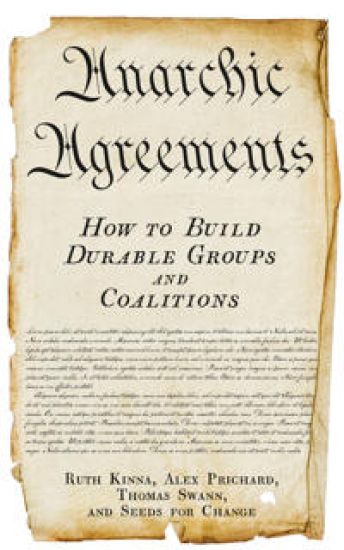
Anarchic Agreements

Anarchic Agreements

Ruth Kinna; Alex Prichard; Thomas Swann

PM Press
2023
nidottu
A new world is possible and not just in our hearts. Anarchic Agreements is a quintessential field guide for the revolution, answering the practical questions often left out of works of political theory and philosophy. How do leaderless groups organize? How might they create constitutions, balance power and write protocols? How do group cultures and institutions maintain coalitions? This urgent and inspiring how-to is the product of more than twenty years of research. Designed explicitly for everyday use, it contains lived examples, illustrations throughout, and text from current horizontally organized constitutions. These documents illustrate the never-ending process of developing community and keeping collaborations alive in the fairest ways possible. Written by dedicated anarchist scholars and organizers, and based on the widely popular Anarchic Agreements pamphlet series, this book facilitates grassroots activism and provides methods to improve and streamline decision making. It is an inspiring celebration of the novel, complex and flexible constitutions Anarchists have created over time. This book shows how to realize another world, collectively without domination, while leaving the future open to infinite other possibilities.
Nikakoj vlasti: teorija i praktika anarkhizma
Akademicheskoe issledovanie po istorii i teorii odnogo iz samykh protivorechivykh politicheskikh dvizhenij.Kniga dopolnena spiskom literatury, napisannoj rossijskimi istorikami.Bolshinstvo SMI traditsionno ochernjajut anarkhizm, svjazyvaja ego s khaosom i besporjadkami, ili poprostu ignorirujut kak javlenie. Odnako eto filosofskoe i politicheskoe dvizhenie - ot Occupy Wall Street do Pussy Riot, ot Noama Khomskogo do Devida Grebera - aktualno segodnja kak nikogda. Vopreki raskhozhemu mneniju, raznoobraznye techenija anarkhizma imejut chetkuju samoidentifikatsiju, a vmeste ikh obedinjaet stremlenie k svobode i kollektivnomu blagu bez vmeshatelstva gosudarstva.Professor politicheskoj filosofii Rut Kinna sozdaet obemnuju kartinu burnoj istorii anarkhizma. Nachinaja s takikh kljuchevykh sobytij, kak Parizhskaja kommuna i Khejmarketskij bunt, ona podrobno znakomit chitatelja s osnovnymi anarkhistskimi gruppami, mysliteljami i aktivistami dvizhenija, pokazyvaja ikh teoreticheskie vykladki i raznoobrazie metodov borby.Perevodchik: Olga KorchevskajaNauchnyj redaktor: Petr Rjabov, kand. filos. nauk
The Government of No One

The Government of No One

Ruth Kinna

Pelican
2020
nidottu
'The standard book on anarchism for the twenty-first century. Written with brio, quiet insight and clarity' Carl LevyA magisterial study of the history and theory of one of the most controversial political movementsAnarchism routinely gets a bad press. It's usually seen as meaning chaos and disorder -- or even nothing at all. And yet, from Occupy Wall Street to Pussy Riot, Noam Chomsky to David Graeber, this philosophical and political movement is as relevant as ever. Contrary to popular perception, different strands of anarchism -- from individualism to collectivism -- do follow certain structures and a shared sense of purpose: a belief in freedom and working towards collective good without the interference of the state. In this masterful, sympathetic account, political theorist Ruth Kinna traces the tumultuous history of anarchism, starting with thinkers and activists such as Peter Kropotkin and Emma Goldman and through key events like the Paris Commune and the Haymarket affair. Skilfully introducing us to the nuanced theories of anarchist groups from Russia to Japan to the United States, The Government of No One reveals what makes a supposedly chaotic movement particularly adaptable and effective over centuries -- and what we can learn from it.
Kropotkin

Kropotkin

Ruth Kinna

Edinburgh University Press
2015
sidottu
Ruth Kinna reassesses Kropotkin's political thought and suggests that the 'classical' tradition which has provided a lens for the discussion of his work has had a distorting effect on the interpretation of his ideas. By setting the analysis of his thought in a number of key historical contexts, she reveals the enduring significance of his political thought and questions the usefulness of those approaches to the history of ideas that map historical changes to philosophical and theoretical shifts. One of the key arguments of the book is that Kropotkin contributed to the elaboration of an anarchist ideology, which has been badly misunderstood and which today is too often dismissed as outdated. Kinna corrects some popular myths about Kropotkin's thought, explains his unique contribution to the history of socialist ideas and sheds new light on the nature of anarchist ideology.
Anarchism

Anarchism

Ruth Kinna

Oneworld Publications
2009
nidottu
In this clear and penetrating study, Ruth Kinna goes directly to the heart of this controversial ideology, explaining the influences that have shaped anarchism and the different tactics and strategies that have been used by anarchists throughout history to achieve their ends. Kinna covers themes both historical and acutely contemporary, including: Could anarchy ever really be a viable alternative to the state? Can anarchist ideals ever be consistent with the justification of violence? How has anarchism influenced the anti-globalization movement?