Kirjojen hintavertailu. Mukana 12 390 323 kirjaa ja 12 kauppaa.

Kirjailija

Ruth O'Brien

Kirjat ja teokset yhdessä paikassa: 7 kirjaa, julkaisuja vuosilta 2001-2013, suosituimpien joukossa Crippled Justice. Vertaile teosten hintoja ja tarkista saatavuus suomalaisista kirjakaupoista.

7 kirjaa

Kirjojen julkaisuhaarukka 2001-2013.

Out of Many, One

Out of Many, One

Ruth O'Brien; Thomas Byrne Edsall

University of Chicago Press
2013
sidottu
Feared by conservatives and embraced by liberals when he entered the White House, Barack Obama has since been battered by criticism from both sides. In "Out of Many, One", Ruth O'Brien explains why. We are accustomed to seeing politicians supporting either a minimalist state characterized by unfettered capitalism and individual rights or a relatively strong welfare state and regulatory capitalism. Obama, O'Brien argues, represents the values of a lesser-known third tradition in American political thought that defies the usual left-right categorization. Bearing traces of Baruch Spinoza, John Dewey, and Saul Alinsky, Obama's progressivism embraces the ideas of mutual reliance and collective responsibility and adopts an interconnected view of the individual and the state. So, while Obama might emphasize difference, he rejects identity politics, which can create permanent minorities and diminish individual agency. Analyzing Obama's major legislative victories - financial regulation, health care, and the stimulus package - O'Brien shows how they reflect a stakeholder society that neither regulates in the manner of the New Deal nor deregulates. Instead, Obama focuses on negotiated rule making and allows executive branch agencies to fill in the details when dealing with a deadlocked Congress. Similarly, his commitment to difference and his resistance to universal mandates underlies his reluctance to advocate for human rights as much as many on the Democratic left had hoped. By establishing Obama within the context of a much longer and broader political tradition, this book sheds critical light on both the political and philosophical underpinnings of his presidency and a fundamental shift in American political thought.
Out of Many, One

Out of Many, One

Ruth O'Brien; Thomas Byrne Edsall

University of Chicago Press
2013
nidottu
Feared by conservatives and embraced by liberals when he entered the White House, Barack Obama has since been battered by criticism from both sides. In "Out of Many, One", Ruth O'Brien explains why. We are accustomed to seeing politicians supporting either a minimalist state characterized by unfettered capitalism and individual rights or a relatively strong welfare state and regulatory capitalism. Obama, O'Brien argues, represents the values of a lesser-known third tradition in American political thought that defies the usual left-right categorization. Bearing traces of Baruch Spinoza, John Dewey, and Saul Alinsky, Obama's progressivism embraces the ideas of mutual reliance and collective responsibility and adopts an interconnected view of the individual and the state. So, while Obama might emphasize difference, he rejects identity politics, which can create permanent minorities and diminish individual agency. Analyzing Obama's major legislative victories - financial regulation, health care, and the stimulus package - O'Brien shows how they reflect a stakeholder society that neither regulates in the manner of the New Deal nor deregulates. Instead, Obama focuses on negotiated rule making and allows executive branch agencies to fill in the details when dealing with a deadlocked Congress. Similarly, his commitment to difference and his resistance to universal mandates underlies his reluctance to advocate for human rights as much as many on the Democratic left had hoped. By establishing Obama within the context of a much longer and broader political tradition, this book sheds critical light on both the political and philosophical underpinnings of his presidency and a fundamental shift in American political thought.
The Case for Big Government

The Case for Big Government

Jeff Madrick; Ruth O'Brien

Princeton University Press
2010
pokkari
Political conservatives have long believed that the best government is a small government. But if this were true, noted economist Jeff Madrick argues, the nation would not be experiencing stagnant wages, rising health care costs, increasing unemployment, and concentrations of wealth for a narrow elite. In this perceptive and eye-opening book, Madrick proves that an engaged government--a big government of high taxes and wise regulations--is necessary for the social and economic answers that Americans desperately need in changing times. He shows that the big governments of past eras fostered greatness and prosperity, while weak, laissez-faire governments marked periods of corruption and exploitation. The Case for Big Government considers whether the government can adjust its current policies and set the country right. Madrick explains why politics and economics should go hand in hand; why America benefits when the government actively nourishes economic growth; and why America must reject free market orthodoxy and adopt ambitious government-centered programs. He looks critically at today's politicians--at Republicans seeking to revive nineteenth-century principles, and at Democrats who are abandoning the pioneering efforts of the Great Society. Madrick paints a devastating portrait of the nation's declining social opportunities and how the economy has failed its workers. He looks critically at today's politicians and demonstrates that the government must correct itself to address these serious issues. A practical call to arms, The Case for Big Government asks for innovation, experimentation, and a willingness to fail. The book sets aside ideology and proposes bold steps to ensure the nation's vitality.
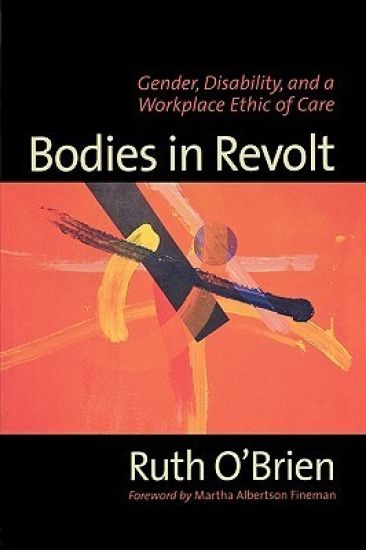
Bodies in Revolt

Bodies in Revolt

Ruth O'Brien

Routledge
2005
nidottu
Bodies in Revolt argues that the Americans with Disabilities Act (ADA) could humanize capitalism by turning employers into care-givers, creating an ethic of care in the workplace. Unlike other feminists, Ruth O'Brien bases her ethics not on benevolence, but rather on self-preservation. She relies on Deleuze's and Guttari's interpretation of Spinoza and Foucault's conception of corporeal resistance to show how a workplace ethic that is neither communitarian nor individualistic can be based upon the rallying cry "one for all and all for one."
Bodies in Revolt

Bodies in Revolt

Ruth O'Brien

Routledge
2005
sidottu
Bodies in Revolt argues that the Americans with Disabilities Act (ADA) could humanize capitalism by turning employers into care-givers, creating an ethic of care in the workplace. Unlike other feminists, Ruth O'Brien bases her ethics not on benevolence, but rather on self-preservation. She relies on Deleuze's and Guttari's interpretation of Spinoza and Foucault's conception of corporeal resistance to show how a workplace ethic that is neither communitarian nor individualistic can be based upon the rallying cry "one for all and all for one."
Crippled Justice

Crippled Justice

Ruth O'Brien

University of Chicago Press
2001
sidottu
This intellectual history of disability policy in the workplace from World War II to the 21st century, explains why American employers and judges, despite the Americans with Disabilities Act, have been so resistant to accommodating the disabled in the workplace. Ruth O'Brien traces the origins of this resistance to the postwar disability policies inspired by physicians and psychotherapists that were based on the notion that disabled people should accommodate society rather than having society accommodate them. O'Brien shows how the remnants of postwar cultural values bogged the rights-orientated policy in the 1970s and how they continue to permeate judicial interpretations of provisions under the Americans with Disabilities Act. In effect, O'Brien argues, these decisions have created a lose/lose situation for the very people the act was meant to protect.
Crippled Justice

Crippled Justice

Ruth O'Brien

University of Chicago Press
2001
nidottu
This intellectual history of disability policy in the workplace from World War II to the 21st century, explains why American employers and judges, despite the Americans with Disabilities Act, have been so resistant to accommodating the disabled in the workplace. Ruth O'Brien traces the origins of this resistance to the postwar disability policies inspired by physicians and pschotherapists that were based on the notion that disabled people should accommodate society rather than having society accommodate them. O'Brien shows how the remnants of postwar cultural values bogged the rights-orientated policy in the 1970s and how they continue to permeate judicial interpretations of provisions under the Americans with Disabilities Act. In effect, O'Brien argues, these decisions have created a lose/lose situation for the very people the act was meant to protect.