Kirjojen hintavertailu. Mukana 12 595 353 kirjaa ja 12 kauppaa.

Kirjailija

Ryan Kastner

Kirjat ja teokset yhdessä paikassa: 5 kirjaa, julkaisuja vuosilta 2003-2014, suosituimpien joukossa Synthesis Techniques and Optimizations for Reconfigurable Systems. Vertaile teosten hintoja ja tarkista saatavuus suomalaisista kirjakaupoista.

5 kirjaa

Kirjojen julkaisuhaarukka 2003-2014.

Handbook of FPGA Design Security

Handbook of FPGA Design Security

Ted Huffmire; Cynthia Irvine; Thuy D. Nguyen; Timothy Levin; Ryan Kastner; Timothy Sherwood

Springer
2014
nidottu
The purpose of this book is to provide a practical approach to managing security in FPGA designs for researchers and practitioners in the electronic design automation (EDA) and FPGA communities, including corporations, industrial and government research labs, and academics. This book combines theoretical underpinnings with a practical design approach and worked examples for combating real world threats. To address the spectrum of lifecycle and operational threats against FPGA systems, a holistic view of FPGA security is presented, from formal top level speci?cation to low level policy enforcement mechanisms, which integrates recent advances in the ?elds of computer security theory, languages, compilers, and hardware. The net effect is a diverse set of static and runtime techniques that, working in coope- tion, facilitate the composition of robust, dependable, and trustworthy systems using commodity components. We wish to acknowledge the many people who helped us ensure the success of ourworkonrecon?gurablehardwaresecurity.Inparticular,wewishtothankAndrei Paun and Jason Smith of Louisiana Tech University for providing us with a Lin- compatible version of Grail+. We also wish to thank those who gave us comments on drafts of this book, including Marco Platzner of the University of Paderborn, and Ali Irturk and Jason Oberg of the University of California, San Diego. This research was funded in part by National Science Foundation Grant CNS-0524771 and NSF Career Grant CCF-0448654.
Synthesis Techniques and Optimizations for Reconfigurable Systems

Synthesis Techniques and Optimizations for Reconfigurable Systems

Ryan Kastner; Adam Kaplan; Majid Sarrafzadeh

Springer-Verlag New York Inc.
2010
nidottu
Synthesis Techniques and Optimization for Reconfigurable Systems discusses methods used to model reconfigurable applications at the system level, many of which could be incorporated directly into modern compilers. The book also discusses a framework for reconfigurable system synthesis, which bridges the gap between application-level compiler analysis and high-level device synthesis. The development of this framework (discussed in Chapter 5), and the creation of application analysis which further optimize its output (discussed in Chapters 7, 8, and 9), represent over four years of rigorous investigation within UCLA's Embedded and Reconfigurable Laboratory (ERLab) and UCSB's Extensible, Programmable and Reconfigirable Embedded SystemS (ExPRESS) Group. The research of these systems has not yet matured, and we continually strive to develop data and methods, which will extend the collective understanding of reconfigurable system synthesis.
Handbook of FPGA Design Security

Handbook of FPGA Design Security

Ted Huffmire; Cynthia Irvine; Thuy D. Nguyen; Timothy Levin; Ryan Kastner; Timothy Sherwood

Springer
2010
sidottu
The purpose of this book is to provide a practical approach to managing security in FPGA designs for researchers and practitioners in the electronic design automation (EDA) and FPGA communities, including corporations, industrial and government research labs, and academics. This book combines theoretical underpinnings with a practical design approach and worked examples for combating real world threats. To address the spectrum of lifecycle and operational threats against FPGA systems, a holistic view of FPGA security is presented, from formal top level speci?cation to low level policy enforcement mechanisms, which integrates recent advances in the ?elds of computer security theory, languages, compilers, and hardware. The net effect is a diverse set of static and runtime techniques that, working in coope- tion, facilitate the composition of robust, dependable, and trustworthy systems using commodity components. We wish to acknowledge the many people who helped us ensure the success of ourworkonrecon?gurablehardwaresecurity.Inparticular,wewishtothankAndrei Paun and Jason Smith of Louisiana Tech University for providing us with a Lin- compatible version of Grail+. We also wish to thank those who gave us comments on drafts of this book, including Marco Platzner of the University of Paderborn, and Ali Irturk and Jason Oberg of the University of California, San Diego. This research was funded in part by National Science Foundation Grant CNS-0524771 and NSF Career Grant CCF-0448654.
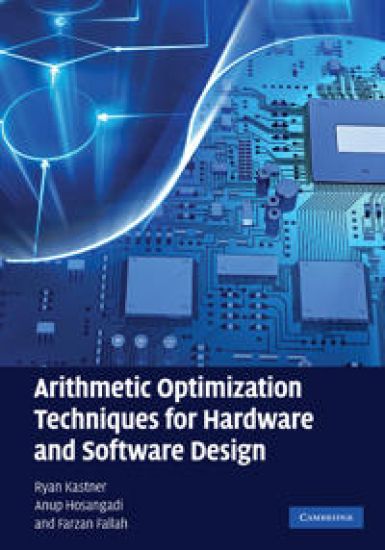
Arithmetic Optimization Techniques for Hardware and Software Design

Arithmetic Optimization Techniques for Hardware and Software Design

Ryan Kastner; Anup Hosangadi; Farzan Fallah

Cambridge University Press
2010
sidottu
Obtain better system performance, lower energy consumption, and avoid hand-coding arithmetic functions with this concise guide to automated optimization techniques for hardware and software design. High-level compiler optimizations and high-speed architectures for implementing FIR filters are covered, which can improve performance in communications, signal processing, computer graphics, and cryptography. Clearly explained algorithms and illustrative examples throughout make it easy to understand the techniques and write software for their implementation. Background information on the synthesis of arithmetic expressions and computer arithmetic is also included, making the book ideal for newcomers to the subject. This is an invaluable resource for researchers, professionals, and graduate students working in system level design and automation, compilers, and VLSI CAD.
Synthesis Techniques and Optimizations for Reconfigurable Systems

Synthesis Techniques and Optimizations for Reconfigurable Systems

Ryan Kastner; Adam Kaplan; Majid Sarrafzadeh

Springer-Verlag New York Inc.
2003
sidottu
Synthesis Techniques and Optimization for Reconfigurable Systems discusses methods used to model reconfigurable applications at the system level, many of which could be incorporated directly into modern compilers. The book also discusses a framework for reconfigurable system synthesis, which bridges the gap between application-level compiler analysis and high-level device synthesis. The development of this framework (discussed in Chapter 5), and the creation of application analysis which further optimize its output (discussed in Chapters 7, 8, and 9), represent over four years of rigorous investigation within UCLA's Embedded and Reconfigurable Laboratory (ERLab) and UCSB's Extensible, Programmable and Reconfigirable Embedded SystemS (ExPRESS) Group. The research of these systems has not yet matured, and we continually strive to develop data and methods, which will extend the collective understanding of reconfigurable system synthesis.