Kirjojen hintavertailu. Mukana 12 595 353 kirjaa ja 12 kauppaa.

Kirjailija

S. R. St. J. Neill

Kirjat ja teokset yhdessä paikassa: 5 kirjaa, julkaisuja vuosilta 1994-2017, suosituimpien joukossa The Meaning of Infant Teachers' Work. Vertaile teosten hintoja ja tarkista saatavuus suomalaisista kirjakaupoista.

Mukana myös kirjoitusasut: S.R. St. J. Neill

5 kirjaa

Kirjojen julkaisuhaarukka 1994-2017.

The Meaning of Infant Teachers' Work

The Meaning of Infant Teachers' Work

Linda Evans; Angie Packwood; S.R. St. J. Neill; R.J. Campbell

Routledge
2017
sidottu
Teachers of the youngest children at school were the first to bear the brunt of the policies to change the curriculum after the 1988 Education Act. What did the changes mean to them? How did they perceive their impact upon their work, on standards in the curriculum, on assessment and testing, and on their relationships with pupils and colleagues? How did they cope with stress, long working hours, intrusions into their home lives, and with change imposed from outside? The authors capture in detail the views of thirty infant teachers and compare their subjective perceptions, dominated by a sense of massive change, with the objective record of both continuities and changes in their work.
Primary Teachers at Work

Primary Teachers at Work

R. J. Campbell; S. R. St. J. Neill

Routledge
1994
sidottu
The first part of this book charts and analyses the working days of 326 primary school teachers. It shows how they spent their working lives, the nature of the curriculum they taught, and analyses their work into five main categories: Teaching, Preparation, Administration, Professional Development and Other Activities. The second part comments on the findings by relating them to issues of school management and curriculum manageability and looks at how the idea of `conscientiousness' among primary school teachers may have lead to their exploitation.
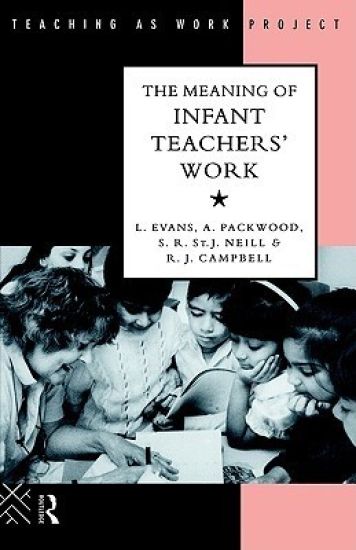
The Meaning of Infant Teachers' Work

The Meaning of Infant Teachers' Work

Linda Evans; Angie Packwood; S.R. St. J. Neill; R.J. Campbell

Routledge
1994
nidottu
Teachers of the youngest children at school were the first to bear the brunt of the policies to change the curriculum after the 1988 Education Act. What did the changes mean to them? How did they perceive their impact upon their work, on standards in the curriculum, on assessment and testing, and on their relationships with pupils and colleagues? How did they cope with stress, long working hours, intrusions into their home lives, and with change imposed from outside? The authors capture in detail the views of thirty infant teachers and compare their subjective perceptions, dominated by a sense of massive change, with the objective record of both continuities and changes in their work.
Secondary Teachers at Work

Secondary Teachers at Work

Jim Campbell; S. R. St. J. Neill

Routledge
1994
sidottu
The first part of this book charts and analyses 2,688 working days of 384 teachers in 91 LEAs in 1991. It shows how they spent their working lives, how well matched their teaching was to their academic background, and the balance between teaching and other aspects of their work. The analysis uses five major categories: Teaching, Preparation, Administration, Professional Development and Other Activities. The authors argue that there is an occupational split between `the managers' and `the teachers'. The second part comments on the findings by relating them to issues of school management, and teacher professionalism, arguing that `conscientiousness' poses a professional dilemma for secondary teachers.
Secondary Teachers at Work

Secondary Teachers at Work

Jim Campbell; S. R. St. J. Neill

Routledge
1994
nidottu
The first part of this book charts and analyses 2,688 working days of 384 teachers in 91 LEAs in 1991. It shows how they spent their working lives, how well matched their teaching was to their academic background, and the balance between teaching and other aspects of their work. The analysis uses five major categories: Teaching, Preparation, Administration, Professional Development and Other Activities. The authors argue that there is an occupational split between `the managers' and `the teachers'. The second part comments on the findings by relating them to issues of school management, and teacher professionalism, arguing that `conscientiousness' poses a professional dilemma for secondary teachers.