Kirjojen hintavertailu. Mukana 12 585 927 kirjaa ja 12 kauppaa.

Kirjailija

Sabine Hyland

Kirjat ja teokset yhdessä paikassa: 5 kirjaa, julkaisuja vuosilta 2004-2017, suosituimpien joukossa The Quito Manuscript. Vertaile teosten hintoja ja tarkista saatavuus suomalaisista kirjakaupoista.

5 kirjaa

Kirjojen julkaisuhaarukka 2004-2017.

The Chankas and the Priest

The Chankas and the Priest

Sabine Hyland

Pennsylvania State University Press
2017
pokkari
How does society deal with a serial killer in its midst? What if the murderer is a Catholic priest living among native villagers in colonial Peru?In The Chankas and the Priest, Sabine Hyland chronicles the horrifying story of Father Juan Bautista de Albadán, a Spanish priest to the Chanka people of Pampachiri in Peru from 1601 to 1611. During his reign of terror over his Andean parish, Albadán was guilty of murder, sexual abuse, sadistic torture, and theft from his parishioners, amassing a personal fortune at their expense. For ten years, he escaped punishment for these crimes by deceiving and outwitting his superiors in the colonial government and church administration.Drawing on a remarkable collection of documents found in archives in the Americas and Europe, including a rare cache of Albadán’s candid family letters, Hyland reveals what life was like for the Chankas under this corrupt and brutal priest, and how his actions sparked the instability that would characterize Chanka political and social history for the next 123 years. Through this tale, she vividly portrays the colonial church and state of Peru as well as the history of Chanka ethnicity, the nature of Spanish colonialism, and the changing nature of Chanka politics and kinship from the fifteenth to the eighteenth century.
The Chankas and the Priest

The Chankas and the Priest

Sabine Hyland

Pennsylvania State University Press
2016
sidottu
How does society deal with a serial killer in its midst? What if the murderer is a Catholic priest living among native villagers in colonial Peru?In The Chankas and the Priest, Sabine Hyland chronicles the horrifying story of Father Juan Bautista de Albadán, a Spanish priest to the Chanka people of Pampachiri in Peru from 1601 to 1611. During his reign of terror over his Andean parish, Albadán was guilty of murder, sexual abuse, sadistic torture, and theft from his parishioners, amassing a personal fortune at their expense. For ten years, he escaped punishment for these crimes by deceiving and outwitting his superiors in the colonial government and church administration.Drawing on a remarkable collection of documents found in archives in the Americas and Europe, including a rare cache of Albadán’s candid family letters, Hyland reveals what life was like for the Chankas under this corrupt and brutal priest, and how his actions sparked the instability that would characterize Chanka political and social history for the next 123 years. Through this tale, she vividly portrays the colonial church and state of Peru as well as the history of Chanka ethnicity, the nature of Spanish colonialism, and the changing nature of Chanka politics and kinship from the fifteenth to the eighteenth century.
Gods of the Andes

Gods of the Andes

Sabine Hyland

Pennsylvania State University Press
2011
pokkari
Gods of the Andes provides the first English translation of the earliest lengthy description of Inca religion, An Account of the Ancient Customs of the Natives of Peru (1594). The Account is part of a Jesuit tradition of ecumenical works on religion that encompasses the more famous writings of Matteo Ricci in China and Roberto de Nobili in India. It includes original descriptions of many different aspects of Inca religion, including human sacrifice, the use of hallucinogens, mummification rituals, the existence of transgendered priests in the ancient Andes, divination rituals based on animal entrails, oracles, burials, and confession. In her introductory chapters, Sabine Hyland presents the controversial life of the ascribed author, Blas Valera, a Jesuit who was ultimately imprisoned and exiled by the Jesuits for his “heretical” belief that the Incas worshipped the same creator god the Christians did; examines the Account in the light of other colonial writings about the Incas; and outlines what we know about Inca religion through other sources, comparing Valera’s version to those of other writers.
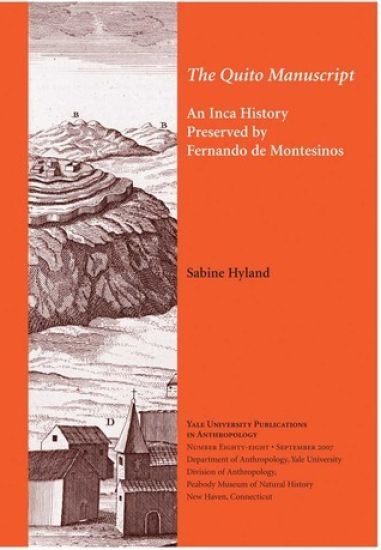
The Quito Manuscript

The Quito Manuscript

Sabine Hyland

Yale University Publications in Anthropology
2010
pokkari
This is a transcription of Spanish priest and explorer Fernando de Montesinos’ 1644 manuscript for Book II of Memorias historiales, a rare reference on early Peru and Andean culture. Distributed for the Yale Peabody Museum of Natural History
The Jesuit and the Incas

The Jesuit and the Incas

Sabine Hyland

The University of Michigan Press
2004
nidottu
In the spirit of justice Blas Valera broke all the rules-and paid with his life. Hundreds of years later, his ghost has returned to haunt the official story. But is it the truth, and will it set the record straight?This is the tale of Father Blas Valera, the child of a native Incan woman and Spanish father, caught between the ancient world of the Incas and the conquistadors of Spain. Valera, a Jesuit in sixteenth-century Peru, believed in what to his superiors was pure heresy: that the Incan culture, religion, and language were equal to their Christian counterparts.As punishment for his beliefs he was imprisoned, beaten, and, finally, exiled to Spain, where he died at the hands of English pirates in 1597.Four centuries later, this Incan chronicler had been all but forgotten, until an Italian anthropologist discovered some startling documents in a private Neapolitan collection. The documents claimed, among other things, that Valera's death had been faked by the Jesuits; that he had returned to Peru; and, intriguingly, while there had taught his followers that the Incas used a secret phonetic quipu-a record-keeping device of the Inca empire-to record history.Far from settling anything, the documents created an international sensation among scholars and led to bitter disputes over how they should be assessed. Are they forgeries, authentic documents, or something in between? If genuine, they will radically reform our view of Inca culture and Valera. The author insightfully examines the evidence, showing how fact and fiction intertwine, and brings the dimly understood history of this author-priest to light. Sabine Hyland is Co-director of a multidisciplinary project studying the Chanka people of Peru. She holds a doctoral degree in anthropology from Yale, and is Assistant Professor of Anthropology at St. Norbert College.