Kirjojen hintavertailu. Mukana 12 390 323 kirjaa ja 12 kauppaa.

Kirjailija

Sabine Kowal

Kirjat ja teokset yhdessä paikassa: 4 kirjaa, julkaisuja vuosilta 2008-2014, suosituimpien joukossa Communicating with One Another. Vertaile teosten hintoja ja tarkista saatavuus suomalaisista kirjakaupoista.

4 kirjaa

Kirjojen julkaisuhaarukka 2008-2014.

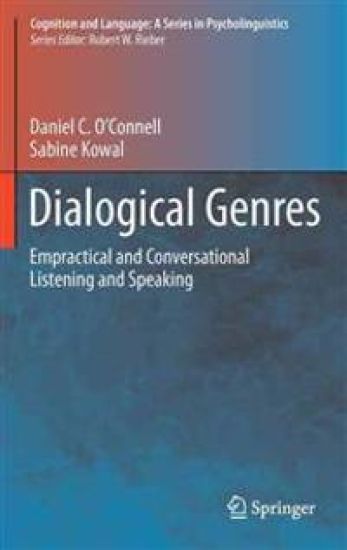
Dialogical Genres

Dialogical Genres

Daniel C. O'Connell; Sabine Kowal

Springer-Verlag New York Inc.
2014
nidottu
This work gives a thorough revision of history through a psychological approach to verbal interaction between listeners and speakers. This book offers a large amount of information on the psychology of language and on psycholinguistics, and focuses on a new direction for a psychology of verbal communication. Empirical research includes media interviews, public speeches, and dramatic performances.
Dialogical Genres

Dialogical Genres

Daniel C. O'Connell; Sabine Kowal

Springer-Verlag New York Inc.
2012
sidottu
This work gives a thorough revision of history through a psychological approach to verbal interaction between listeners and speakers. This book offers a large amount of information on the psychology of language and on psycholinguistics, and focuses on a new direction for a psychology of verbal communication. Empirical research includes media interviews, public speeches, and dramatic performances.
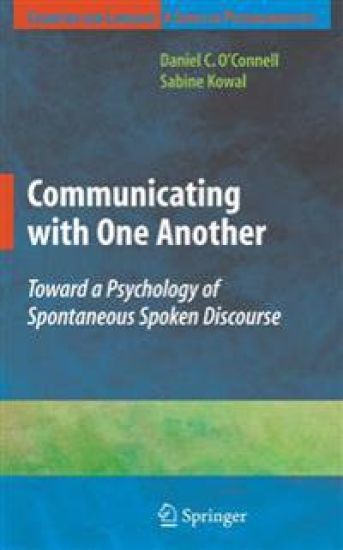
Communicating with One Another

Communicating with One Another

Sabine Kowal

Springer-Verlag New York Inc.
2010
nidottu
In contrast to traditional approaches of mainstream psycholinguists, the authors of Communicating with One Another approach spontaneous spoken discourse as a dynamic process, rich with structures, patterns, and rules other than conventional grammar and syntax. Daniel C. O’Connell and Sabine Kowal thoroughly critique mainstream psycholinguistics, proposing instead a shift in theoretical focus from experimentation to field observation, from monologue to dialogue, and from the written to the spoken. They invoke four theoretical principles: intersubjectivity, perspectivity, open-endedness, and verbal integrity. Their analyses of historical and original research raise significant questions about the relationship between spoken and written discourse, particularly with regard to transcription and punctuation. With emphasis on political discourse, media interviews, and dramatic performance, the authors review both familiar and unexplored characteristics of spontaneous spoken communication, including: (1) The speaker’s use of prosody. (2) The functions of interjections. (3) What fillers do for a living. (4) Turn-taking: Smooth and otherwise. (5) Laughter, applause, and booing: from individual listener to collective audience. (6) Pauses, silence, and the art of listening. The paradigm shift proposed in Communicating with One Another will interest and provoke readers concerned about communicative language use – including psycholinguists, sociolinguists, and anthropological linguists.
Communicating with One Another

Communicating with One Another

Sabine Kowal

Springer-Verlag New York Inc.
2008
sidottu
In contrast to traditional approaches of mainstream psycholinguists, the authors of Communicating with One Another approach spontaneous spoken discourse as a dynamic process, rich with structures, patterns, and rules other than conventional grammar and syntax. Daniel C. O’Connell and Sabine Kowal thoroughly critique mainstream psycholinguistics, proposing instead a shift in theoretical focus from experimentation to field observation, from monologue to dialogue, and from the written to the spoken. They invoke four theoretical principles: intersubjectivity, perspectivity, open-endedness, and verbal integrity. Their analyses of historical and original research raise significant questions about the relationship between spoken and written discourse, particularly with regard to transcription and punctuation. With emphasis on political discourse, media interviews, and dramatic performance, the authors review both familiar and unexplored characteristics of spontaneous spoken communication, including: (1) The speaker’s use of prosody. (2) The functions of interjections. (3) What fillers do for a living. (4) Turn-taking: Smooth and otherwise. (5) Laughter, applause, and booing: from individual listener to collective audience. (6) Pauses, silence, and the art of listening. The paradigm shift proposed in Communicating with One Another will interest and provoke readers concerned about communicative language use – including psycholinguists, sociolinguists, and anthropological linguists.