Kirjojen hintavertailu. Mukana 12 390 323 kirjaa ja 12 kauppaa.

Kirjailija

Sabine Wilhelm

Kirjat ja teokset yhdessä paikassa: 6 kirjaa, julkaisuja vuosilta 2006-2013, suosituimpien joukossa Managing Tourette Syndrome. Vertaile teosten hintoja ja tarkista saatavuus suomalaisista kirjakaupoista.

6 kirjaa

Kirjojen julkaisuhaarukka 2006-2013.

Managing Tourette Syndrome

Managing Tourette Syndrome

Douglas W Woods; John Piacentini; Susanna Chang; Thilo Deckersbach; Golda Ginsburg; Alan Peterson; Lawrence D Scahill; John Walup; Sabine Wilhelm

Oxford University Press Inc
2008
nidottu
In 2002, the Tourette Syndrome Association formed the TS Behavioral Sciences Consortium (BSC). The charge of the BSC was to develop and test nonpharmacological treatment options for individuals, both children and adults with Tourette Syndrome. This manual is the result of their work, and represents the most scientifically effective behavioral treatment for Tourette Syndrome available today. The treatment program uses Habit Reversal Training (HRT) for children and adults with chronic tic disorder. Individual treatment is based at its core on awareness training, the development of a specific competing response for each tic, and the use of functionally-based strategies for the elimination of tic-exacerbating antecedent and consequent variables. In addition, individual treatment includes techniques designed to enhance patient compliance, including social support and an inconvenience review, as well as scheduled time for the therapist and client to discuss areas of functioning that individuals with TS may find difficult, such as social/familial difficulties and disruptive anger/rage behavior. Each week, clients are given homework assignments, to be done 4-5 times per week, consisting of 20 to 30 minutes of awareness and competing response training to tics addressed in session. The client will be encouraged to keep tally marks to monitor tic behavior. Home-based monitoring and competing response training are reviewed at each session. All homework assignments will be available in this companion workbook.
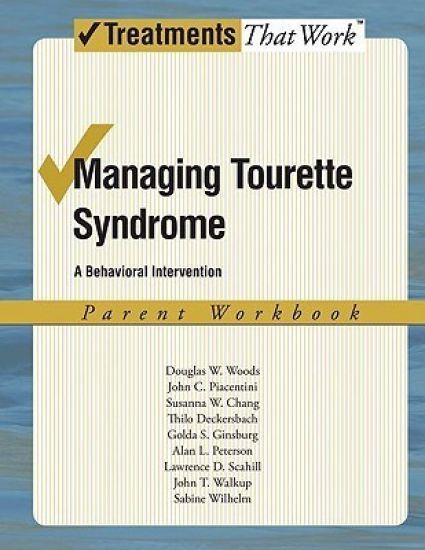
Managing Tourette Syndrome

Managing Tourette Syndrome

Douglas W Woods; John Piacentini; Susanna Chang; Thilo Deckersbach; Golda Ginsburg; Alan Peterson; Lawrence d Scahill; John T Walkup; Sabine Wilhelm

Oxford University Press Inc
2008
nidottu
In 2002, the Tourette Syndrome Association formed the TS Behavioral Sciences Consortium (BSC). The charge of the BSC was to develop and test nonpharmacological treatment options for individuals, both children and adults with Tourette Syndrome. This manual is the result of their work, and represents the most scientifically effective behavioral treatment for Tourette Syndrome available today. The treatment program uses Habit Reversal Training (HRT) for children and adults with chronic tic disorder. Individual treatment is based at its core on awareness training, the development of a specific competing response for each tic, and the use of functionally-based strategies for the elimination of tic-exacerbating antecedent and consequent variables. In addition, individual treatment includes techniques designed to enhance patient compliance, including social support and an inconvenience review, as well as scheduled time for the therapist and client to discuss areas of functioning that individuals with TS may find difficult, such as social/familial difficulties and disruptive/anger/rage behavior. Each week, clients are given homework assignments, to be done 4-5 times per week, consisting of 20 to 30 minutes of awareness and competing response training to tics addressed in session. The client will be encouraged to keep tally marks to monitor tic behavior. Home-based monitoring and competing response training are reviewed at each session. All homework assignments will be available in the companion workbook.
Managing Tourette Syndrome

Managing Tourette Syndrome

Douglas W Woods; John Piacentini; Susanna Chang; Thilo Deckersbach; Golda Ginsburg; Alan Peterson; Lawrence D Scahill; John T Walkup; Sabine Wilhelm

Oxford University Press Inc
2008
nidottu
In 2002, the Tourette Syndrome Association formed the TS Behavioral Sciences Consortium (BSC). The charge of the BSC was to develop and test nonpharmacological treatment options for individuals, both children and adults with Tourette Syndrome. This manual is the result of their work, and represents the most scientifically effective behavioral treatment for Tourette Syndrome available today. The treatment program uses Habit Reversal Training (HRT) for children and adults with chronic tic disorder. Individual treatment is based at its core on awareness training, the development of a specific competing response for each tic, and the use of functionally-based strategies for the elimination of tic-exacerbating antecedent and consequent variables. In addition, individual treatment includes techniques designed to enhance patient compliance, including social support and an inconvenience review, as well as scheduled time for the therapist and client to discuss areas of functioning that individuals with TS may find difficult, such as social/familial difficulties and disruptive/anger/rage behavior. Each week, clients are given homework assignments, to be done 4-5 times per week, consisting of 20 to 30 minutes of awareness and competing response training to tics addressed in session. The client will be encouraged to keep tally marks to monitor tic behavior. Home-based monitoring and competing response training are reviewed at each session. All homework assignments will be available in the companion workbook.
Cognitive-Behavioral Therapy for Body Dysmorphic Disorder

Cognitive-Behavioral Therapy for Body Dysmorphic Disorder

Sabine Wilhelm; Katharine A. Phillips; Gail Steketee

Guilford Press
2013
nidottu
Presenting an effective treatment approach specifically tailored to the unique challenges of body dysmorphic disorder (BDD), this book is grounded in state-of-the-art research. The authors are experts on BDD and related conditions. They describe ways to engage patients who believe they have defects or flaws in their appearance. Provided are clear-cut strategies for helping patients overcome the self-defeating thoughts, impairments in functioning, and sometimes dangerous ritualistic behaviors that characterize BDD. Clinician-friendly features include step-by-step instructions for conducting each session and more than 50 reproducible handouts and forms; the large-size format facilitates photocopying.See also the related self-help guide by Dr. Wilhelm, Feeling Good about the Way You Look, an ideal recommendation for clients with BDD or less severe body image problems.
Covering the war in Iraq

Covering the war in Iraq

Sabine Wilhelm

AV Akademikerverlag
2012
pokkari
Inhaltlich unver nderte Neuauflage. Coverage during conflicts with threatening potential put a pressing note on accurate information about and interpretation of events. When delivering news worldwide, national spotlights as well as cross-cultural notions are set to create unique themes of interest. Those frames - offered by mass media - are vital organizing concepts to establish public agendas. The ambiguously perceived warfare on Iraq was chosen to identify differences in American and German newspaper reports. Using a quantitative content analysis, following focuses could be examined: (a) The basal organization of war-related frames in articles, and furthermore (b) formal and linguistic disparities. Results show that only slight variances emerge in formal characteristics (format, images). However, the linguistic analysis of frame choices (variety, war motives and metaphors, evaluation of political leaders) revealed to be an expandable indicator for intercultural and intra-national discrepancies.
Feeling Good about the Way You Look

Feeling Good about the Way You Look

Sabine Wilhelm

Guilford Publications
2006
nidottu
In a society where a blemish or “bad hair” can ruin an otherwise perfect day and airbrushed abs dominate the magazine rack, many of us feel ashamed of our bodies. If dissatisfaction with your looks is a distressing preoccupation, this compassionate book offers a way to break free from the mirror. Harvard psychologist Sabine Wilhelm leads you through a step-by-step program that helps you fight the urge to spend hours “fixing” your skin and hair, working out, or shopping for flattering clothes. Reality-check exercises based on cognitive-behavioral therapy demonstrate how to identify unfounded beliefs about your appearance. Once you understand the negative thoughts and feelings that distort your self-image, you’ll be able to shed lengthy grooming rituals and overcome the embarrassment that keeps you from enjoying life. With Dr. Wilhelm’s expert guidance, you’ll learn to replace self-doubt and insecurity with confidence and a positive outlook. Whether you’ve spent thousands on plastic surgery or avoid trips to the beach, dating, or socializing, you owe yourself this opportunity to make peace with your looks. If you or someone you care about is struggling with a body image problem, effective care is finally at hand. Health care professionals, see also the related treatment manual: Cognitive-Behavioral Therapy for Body Dysmorphic Disorder.