Kirjojen hintavertailu. Mukana 12 595 353 kirjaa ja 12 kauppaa.

Kirjailija

Sam Glucksberg

Kirjat ja teokset yhdessä paikassa: 5 kirjaa, julkaisuja vuosilta 2001-2015, suosituimpien joukossa Understanding Figurative Language. Vertaile teosten hintoja ja tarkista saatavuus suomalaisista kirjakaupoista.

5 kirjaa

Kirjojen julkaisuhaarukka 2001-2015.

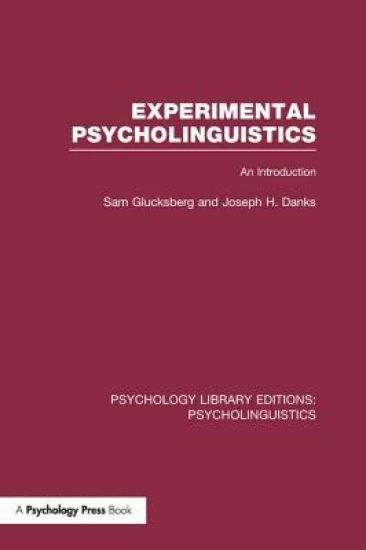
Experimental Psycholinguistics (PLE: Psycholinguistics)

Experimental Psycholinguistics (PLE: Psycholinguistics)

Sam Glucksberg; Joseph H. Danks

Psychology Press Ltd
2015
nidottu
How is speech produced and understood in the context of everyday communication?First published in 1975, this book is considered one the best of the early books in this field. The task of psycholinguistics is to discover how people produce and comprehend speech. This encompasses virtually all aspects of psychology, including perceptual, conceptual, and social processes. The authors tried to capture the flavour of this approach to the psychology of language by describing the major contemporary issues, problems, and phenomena, of the time, being dealt with in laboratories and in field studies, and by trying to make sense of the data they had. Experimental Psycholinguistics: An Introduction does not try to deal exhaustively with any one issue in linguistics or in psychology. Rather it tries to integrate the authors’ knowledge of language and language behaviour so that someone entering the field has an intelligible framework with which to start.

Experimental Psycholinguistics (PLE: Psycholinguistics)

Experimental Psycholinguistics (PLE: Psycholinguistics)

Sam Glucksberg; Joseph H. Danks

Psychology Press Ltd
2013
sidottu
How is speech produced and understood in the context of everyday communication?First published in 1975, this book is considered one the best of the early books in this field. The task of psycholinguistics is to discover how people produce and comprehend speech. This encompasses virtually all aspects of psychology, including perceptual, conceptual, and social processes. The authors tried to capture the flavour of this approach to the psychology of language by describing the major contemporary issues, problems, and phenomena, of the time, being dealt with in laboratories and in field studies, and by trying to make sense of the data they had. Experimental Psycholinguistics: An Introduction does not try to deal exhaustively with any one issue in linguistics or in psychology. Rather it tries to integrate the authors’ knowledge of language and language behaviour so that someone entering the field has an intelligible framework with which to start.

Optimality Theory and Pragmatics

Optimality Theory and Pragmatics

Reinhard Blutner; Anne Bezuidenhout; Richard Breheny; Sam Glucksberg; Francesca Happé

Palgrave Macmillan
2003
nidottu
Ten leading scholars provide exacting research results and a reliable and accessible introduction to the new field of optimality theoretic pragmatics. The book includes a general introduction that overviews the foundations of this new research paradigm. The book is intended to satisfy the needs of students and professional researchers interested in pragmatics and optimality theory, and will be of particular interest to those exploring the interfaces of formal pragmatics with grammar, semantics, philosophy of language, information theory and cognitive psychology.
Optimality Theory and Pragmatics

Optimality Theory and Pragmatics

Reinhard Blutner; Anne Bezuidenhout; Richard Breheny; Sam Glucksberg; Francesca Happé

Palgrave Macmillan
2003
sidottu
Ten leading scholars provide exacting research results and a reliable and accessible introduction to the new field of optimality theoretic pragmatics. The book includes a general introduction that overviews the foundations of this new research paradigm. The book is intended to satisfy the needs of students and professional researchers interested in pragmatics and optimality theory, and will be of particular interest to those exploring the interfaces of formal pragmatics with grammar, semantics, philosophy of language, information theory and cognitive psychology.
Understanding Figurative Language

Understanding Figurative Language

Sam Glucksberg

Oxford University Press Inc
2001
sidottu
This book examines how people understand utterances that are intended figuratively. Traditionally, figurative language such as metaphors and idioms has been considered derivative from more complex than ostensibly straightforward literal language. Glucksberg argues that figurative language involves the same kinds of linguistic and pragmatic operations that are used for ordinary, literal language. Glucksberg's research in this book is concerned with ordinary language: expressions that are used in daily life, including conversations about everyday matters, newspaper and magazine articles, and the media. Metaphor is the major focus of the book. Idioms, however, are also treated comprehensively, as is the theory of conceptual metaphor in the context of how people understand both conventional and novel figurative expressions. A new theory of metaphor comprehension is put forward, and evaluated with respect to competing theories in linguistics and in psychology. The central tenet of the theory is that ordinary conversational metaphors are used to create new concepts and categories. This process is spontaneous and automatic. Metaphor is special only in the sense that these catagories get their names from the best examples of the things they represent, and that these categories get their names from the best examples of those categories. Thus, the literal "shark" can be a metaphor for any vicious and predatory being, from unscrupulous salespeople to a murderous character in The Threepenny Opera. Because the same term, e.g.,"shark," is used both for its literal referent and for the metaphorical category, as in "My lawyer is a shark," we call it the dual-reference theory. The theory is then extended to two other domains: idioms and conceptual metaphors. The book presents the first comprehensive account of how people use and understand metaphors in everyday life.