Kirjojen hintavertailu. Mukana 12 595 353 kirjaa ja 12 kauppaa.

Kirjailija

Sam Pickering

Kirjat ja teokset yhdessä paikassa: 18 kirjaa, julkaisuja vuosilta 1998-2025, suosituimpien joukossa Parade’s End. Vertaile teosten hintoja ja tarkista saatavuus suomalaisista kirjakaupoista.

18 kirjaa

Kirjojen julkaisuhaarukka 1998-2025.

"The Truth"

"The Truth"

Sam Pickering

Madville Publishing LLC
2023
pokkari
This summer Sam Pickering and his wife Vicki attended a pro-fessional wrestling match in a small arena in Nova Scotia. They sat in folding chairs on the front row. They ate "Montreal Sausages" drowning in ketchup and awash with onions. They cheered heroes and laughed at villains. In the middle of one match, a naughty wrestler leaned over the ropes and staring at Sam, said, "If you keep laughing that hard, old-timer, you'll have a heart attack." "What?" Sam said to Vicki. "Old-timer? Not me. That poor man had better see an eye doctor before he gets hurt."
Terrible Sanity

Terrible Sanity

Sam Pickering

Madville Publishing
2021
pokkari
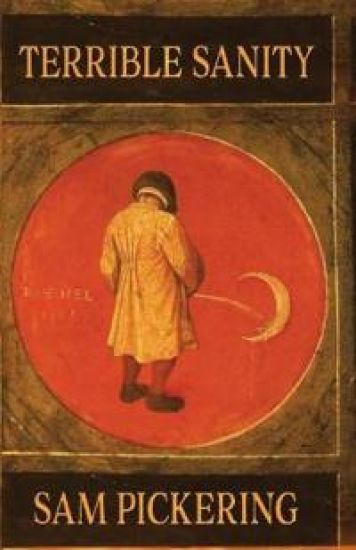
Terrible Sanity is wondrous sanity. Pickering's essays are acetaminophen for hippish days. "Life doesn't have a neat beginning and a tidy end," Roger, a character in V. S. Naipaul's Half a Life, says. "Life is always going on." In this collection, Pickering depicts the joy and sadness of life's going on. He observes that great knowledge often brings small pleasure while the small knowledge that all people experience brings great pleasure. A dental hygienist tells him that every day patients greet her on the street and in stores. "Their faces are always unfamiliar, and I never recognize them," she says, "but if they opened their mouths wide, I'd know them immediately." For the record she also volunteers that in twenty years of tooth-scrubbing, she had only been bitten once.Pickering is nomadic, and his essays explore place and thought. He quotes the old Afghan proverb that doing good to the wicked is doing evil to the good. He discusses how to teach and avoid becoming an inspiration. He describes "Smoking Allowed Churches" and suggests replacing the mealy phrase student athlete with the more accurate entertainer athlete. He notes that people of a certain age attend funerals not to mourn the deceased but to see how many of their mutual friends are still alive and almost kicking. A reviewer once called him "the last Southwestern humorist," and he is an exhilarating teller of tall tales, Mark Twain's stretchers. He is also an omnivorous reader reaping pleasure from both the famous and the lesser known, an example of the latter being the romance novel with the enticing title The Billionaire in Penthouse B.He is also an amateur naturalist, and animal familiars wander through his days like characters from children's books, backyard rabbits, foxes, reclusive opossums, lonely deer, and ill-mannered skunks. He watches birds. Flowers illuminate his paragraphs and trees grow bosky on the margins of his pages. Down in the soiling dirt is where most gods live, rooting and flowering, dying, and being reborn, he writes. Consequently, he avoids arid heights where dogma flourishes.No book or person is a "thing of beauty or joy forever," but some books sparkle and so entertain that they brighten the passing hours. Terrible Sanity is just such a book.
The World Was My Garden, Too

The World Was My Garden, Too

Sam Pickering

Madville Publishing LLC
2019
pokkari
He roams New England, Arkansas, the Caribbean, Nova Scotia and the familiar and odd plots of mind and thought. He explores shorelines and climbs "hillish" mountains. He sits on porches and talks to passersby and their dogs. He meets strange and delightful people, most of whom are real. "Reading Pickering," a reviewer wrote in The Smithsonian decades ago, "is like taking a walk with your oldest, wittiest friend." "Now," Pickering says, "I am old, and the friends who thought me witty have fallen off the perch. But that's okay. What I write makes me smile and mutter, 'What a guy.'" And what wonderful essays these are--pages that awaken the affections and make readers smile and embrace the beauty of this bruised world.
Parade’s End

Parade’s End

Sam Pickering

Mercer University Press
2018
nidottu
Parade's End is a collection of familiar essays. The author comes from the generation in which girls read books about horses, and boys, about dogs, and his prose is old-fashioned and marvelously clear. He is a meanderer, and Parade's End celebrates the passing drift of days and the quiet miracles of living. Trees bud, snow falls, and Christmas blooms green and red with joy and happiness. As Time passes, acquaintances vanish. In these essays the author cruises the Adriatic and the Caribbean, he summers on a farm in Nova Scotia, receives an honorary degree in Tennessee, and roams the fields and woods of Eastern Connecticut. During his travels he meets many improbable people, most of whom exist. However, he follows the advice of Oscar Wilde and does not degrade truth into facts. Amid the bony ruins of Olympia, a man says, ""All in all, I prefer the Alamo."" The sweet bird of youth left the author's shoulder long ago, and the author writes about the pleasures of aging. He refuses to sink into an armchair and wait for himself or others to die. Time, of course, brings changes. Every day the author runs six miles. Recently as he was ""whizzing along,"" a man standing beside the road said, ""I can't run any more either."" ""You will die jogging,"" his wife Vicki said last month, ""in full stride or in the middle of one of the tip-toeing steps you call running. The battery in your pace-maker will spring a leak, and you will be short-circuited."" Vicki then laughed and laughed. For a moment the author frowned, but then he laughed, for Parade's End is a remarkably bright book. At times the band saunters out of tune, but that is the way things are--some moments blare and others are melodious. No matter the air, though, this book is a rich concert of high-stepping fun and thought.
One Grand, Sweet Song

One Grand, Sweet Song

Sam Pickering

Texas Review Press
2016
nidottu
One Grand, Sweet Song is a collection of familiar essays in which Sam Pickering explores libraries and woods and fields. He wanders over hills and far away—to the Caribbean and Canada—but he always returns to the local, to Connecticut and his memories of a Southern childhood. He ponders writing and aging, joy and lunacy. He celebrates family and Christmas. He laughs and tells terrible lies, and jokes. He runs half-marathons, and on a farm in Nova Scotia, he tries to write his Walden. In these pages Pickering embraces his world with great love, wrapping it in words and pulling it and the reader unforgettably close.Pickering has written 28 books and hundreds of articles. Three are scholarly studies, two of which focus on 18th century children’s literature. Four are travel books, three of these describing his family’s meanderings in Australia. One book mulls teaching, and another is a memoir. The rest of Pickering’s books are collections of familiar essays, providing his take or perhaps ""untake"" on things.
Happy Vagrancy

Happy Vagrancy

Sam Pickering

University of Tennessee Press
2015
nidottu
The essays in Sam Pickering’s new collection sing with thoughtful observations on life, death, love, and literature. Whether attending a reunion at Sewanee, cruising the Caribbean, wander­ing the streets of Storrs, Connecticut, or rambling through Nova Scotia, Pickering is able to work a quotation, insight, or reminiscence into almost every page. His collection sparks with copious observations from other writers and books that he’s devoured through the years. One of the many joys in Happy Vagrancy is finding a new author or essay hiding in the deep foliage of Pickering’s prose. He delivers his insights with humor, wit, and a keen eye for the ordinary wonders that surround us.Many of the essays touch on death and the dying, and nothing escapes description and fascination whether profound or seemingly less so: the death of a dear friend or two fledgling cardinals blown from a nest in the backyard and now covered with “periwinkle at the corner of the yard.” During a walk down a country lane, the names of flowers, birds, and bugs fill the page. Even in a meadow buzzing with life, there are reminders of our mortality and brief light too soon gone—and they remind us to read, think, and live with gusto and love.
All My Days Are Saturdays

All My Days Are Saturdays

Sam Pickering

University of Missouri Press
2014
nidottu
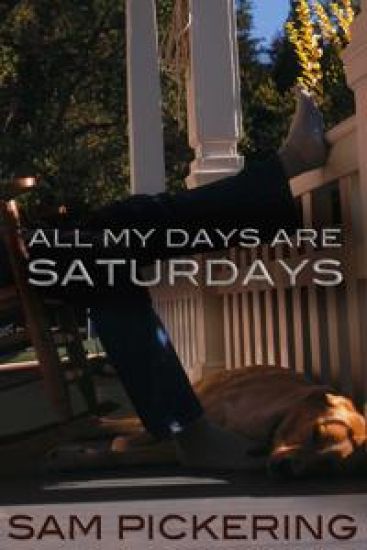
A New York Times article once stated that “the art of the essay as delivered by [Sam] Pickering is the art of the front porch ramble.” As Pickering himself puts it, “Well, I have gotten considerably older, and humor has come to mean more and more to me. And if I’m on the front porch, I am in a rocking chair.” All My Days Are Saturdays offers fifteen new pieces in which he ponders a world that has changed and, in new ways, still delights him. This collection features Pickering writing about teaching and his recent retirement, visits to various locales, and, as he tell us, “the many people I meet…who tell me their stories, small tales that make one laugh and sigh.”Distinctive and unmistakable, Pickering’s style deftly mixes the colloquial language of everyday life with references to a lifetime of extensive reading. The seamless blend of these two worlds in his writing is indicative of how they fuse together in his daily life. As Pickering puts it, “All my life I have roamed libraries, almost as much as I have roamed the natural world. I try to get at many truths, but when I tell the truth, I ‘tell it slant.’ I do so to describe life as it is and indeed celebrate that ‘as it is.”“Pickering is a master of his craft, one of the finest of personal essayists around, and these essays bear many of the characteristics of his other volumes - reflections on his everyday activities and on individuals around him, humorous exchanges with his wife, and so forth. But this volume seems to have something else as well. We find here a thoughtful meditation on time and self and relative old age demonstrating a close attention to the natural world - a tone not unlike Thoreau’s at times.” - Fred C. Hobson, Professor of English, University of North Carolina, Chapel Hill, and author or editor of fourteen books, most recently A Southern Enigma: Essays on the U.S. South.
Dreamtime

Dreamtime

Sam Pickering

University of South Carolina Press
2011
nidottu
Sweeping in and out of real and imagined places, Dreamtime highlights the curious character of an unconventional teacher, writer, traveler, husband, and father as he takes stock of his multifaceted life. Sam Pickering the inspiration for the main character in Dead Poets Society guides us on a journey through his reflections on retirement, aging, gardening, and travel. He describes the pleasures of domesticity, summers spent in Nova Scotia, and the joy of sharing a simple life with his wife of almost forty years. Life is a tiresome journey, Pickering muses, and when a man arrives at the end, he is generally out of breath. Although Pickering is now more likely to shuffle than gallop, he isn t yet out of breath, ideas, or ink. The refreshing and reflective substance of these essays shines through a patina of wit in Pickering s characteristically evocative and sincere prose. The separate events depicted in Dreamtime invite the reader into Pickering s personal experiences as well as into his viewpoints on teaching and encounters with former students. In Spring Pruning, Pickering describes the precarious tumor in his parathyroid and the possibility of cancer affecting his daily life. In a refreshingly honest tone Pickering says, Moreover the funeral had become a staple of chat, so much so I d recently mulled having the raucous, insolent ringer on my telephone replaced by the recording of taps. Appealing to creative writers and readers who enjoy an adventurous account of travels through life, Dreamtime accentuates the lifestyle of a longtime master teacher whose experiences take him from sunny days in the classroom to falling headfirst over a fence after running a half-marathon. Unpredictable, spontaneous, and always enlightening, Pickering s idiosyncratic approach and companionable charm will delight anyone who shares his intoxication with all the surprising treasures that might furnish a life with happiness.
Autumn Spring

Autumn Spring

Sam Pickering

University of Tennessee Press
2007
nidottu
“No one creates so many memorable, saucy aphorisms-piquant, bitter-sweet, arousing.” -Pat C. Hoy II, New York UniversitySam Pickering's essays are funny and wise-and always intoxicating, eggnog to warm glazed winter nights and juleps to cool sweltering summer days. He wanders Connecticut, Canada, and the South, seeding his old farm in Nova Scotia with words and scattering paragraphs in and about classrooms at the University of Connecticut. He describes the great flowerings of summers and falls. He mulls over vanishing friendships, then hunts for buried treasure in a library. He endures a massage, ponders the genteel, and explores shadowy alcoves and books. For him home is where heart and heartache thrive together. Students make him laugh and weep, and in part his book is a teaching manual crammed with anecdotal good sense. He buries his old dog George and picks up Bert, a rescue dachshund addicted to unmentionable munchies and cloddish doggy behavior, an animal who obstinately refuses to cross the Rainbow Bridge. Pickering runs road races, although he says anyone in a motorized walker could leave him far behind. In “Premortem” he anatomizes his vanishing muscles and then decides to have a knee operation in hopes of shuffling fast enough to keep a heeltap ahead of the pale rider on the white horse.This is a book about love and happiness-a restorative collection that shows readers how to enjoy life's small glories even among its indignities. When the going gets sour, Pickering tells a joke and transforms the sour into sweet delight.Sam Pickering teaches English at the University of Connecticut. The inspiration for the teacher in the movie Dead Poets Society, Pickering is a member of the Fellowship of Southern Writers and a master of the essay form. Among his dozen collections of essays are A Little Fling and The Last Book, both published by the University of Tennessee Press.
Letters to a Teacher

Letters to a Teacher

Sam Pickering

Grove Press / Atlantic Monthly Press
2005
nidottu
Ten witty, eloquent essays on literature, competition, curiosity, enthusiasm, and truth from the teacher who inspired The Dead Poet's Society reveal the joys of teaching and the power of innovation over stale formalism. Reprint.
The Best of Pickering

The Best of Pickering

Sam Pickering

The University of Michigan Press
2004
sidottu
Pickering's greatest themes, including nature, family, and living life to the fullest are captured in more than two dozen of the author's finest essays--including "Still Life" and "Magic."
Waltzing the Magpies

Waltzing the Magpies

Sam Pickering

The University of Michigan Press
2004
sidottu
Praise for Sam Pickering:"The art of the essay as delivered by Mr. Pickering is the art of the front porch ramble." ---The New York Times Book Review"Reading Pickering . . . is like taking a walk with your oldest, wittiest friend."---Smithsonian"What a joy it is to 'mess around' with Professor Sam Pickering!"---The Chattanooga Times"Pickering is a barefoot observer of the quotidian who revels in the spectacle and its gift for surprise, prefers the rumpled to the starched, has raised puttering and messing about to an art form, and wrings from it more than a pennyworth of happiness and a life well lived."---Kirkus ReviewsThe movie Dead Poets Society is where most Americans first met Sam Pickering, the University of Connecticut English professor. Robin Williams plays the lead character (loosely based on Pickering), an idiosyncratic instructor who employs some over-the-top teaching methods to keep his subjects fresh and his students learning. Fewer know that Pickering is the author of more than 16 books and nearly 200 articles, or that he's inspired thousands of university students to think in new ways. And, while Williams may have captured Pickering's madcap classroom antics, he didn't uncover the other side of the author-Sam Pickering as one of our great American men of letters. Like the music of Mozart, the painting of Picasso, or the poetry of Emily Dickinson, you can spot Pickering's writing a mile away; there's no mistaking the Pickering pen. As an ample demonstration of the author's literary gifts, Waltzing the Magpies is his unabashedly lush and Technicolor travelogue from Down Under.On the face of it, Waltzing is the chronicle of a sabbatical year spent with family in Australia. Yet beneath the surface Pickering's big themes-family, nature, seizing the moment-move in a powerful current that frequently bursts out in moments of ecstatic revelation and intense sensual flourish. Through it all Pickering weaves stories from his fictional Southern town of Carthage, Tennessee, especially when the goings of the outside world get rough.Waltzing the Magpies is classic Pickering at the height of his literary powers, and places him in the company of such great American essayists as E. B. White and James Thurber, but with an irony and observational prowess that is pure Pickering.
The Last Book

The Last Book

Sam Pickering

University of Tennessee Press
2001
sidottu
Readers familiar with Sam Pickering's delightful essays will certainly hope that the title of his latest collection is not intended as prophecy. A true original, Pickering offers observation on everyday life that never fail to sparkle with wit, insight, amusement, and wonder. Freely blending fact with fiction-"Writing makes liars of us all," he notes-Pickering ranges easily and amiably from his home base in Storrs, Connecticut, to his roots in middle Tennessee, with numerous side trips to observe the natural world to refelct on the bonds of family and friends. One essay finds him playing auctioneer at a local arts council event, jollying the attendees with "tattered country tales" and fanciful, extravagant claims for items being sold. In another piece, his tongue-in-check remarks about the split infinitive, when quoted in a newspaper, ignite a small controversy that lands him on radio talk shows and provokes a flood of sometimes angry e-mail. Yet, whenever the irritations of the human world become a bit too wearying, Pickering finds ready refreshment in the doings of birds and insects and the splash of sunlight on a tree or flower. Throughout these sixteen essays, Pickering implicitly heeds the advice he offers his son just before the boy much meet the parents of his prom date: :The good storyteller, I instructed Francis, heaps paragraph upon paragraph, just like a waitress serving mashed potatoes in a family-style restaurant." Having dined at the table of a master storyteller, readers will depart this collection feeling fully sated-indeed, well nourished.The Author:A native of Nashville, Sam Pickering is a professor of English at the University of Connecticut and author of eleven previous books of essays. His most recent collections are Living to Prowl, Deprived of Happiness, and A Little Fling.
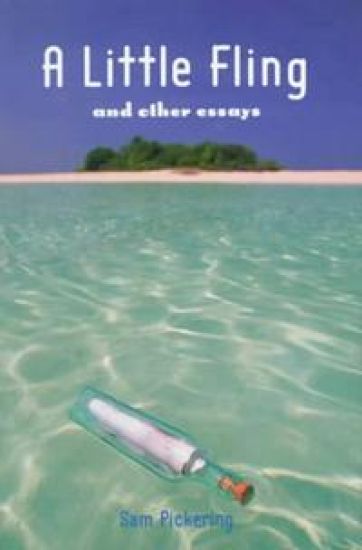
Little Fling

Little Fling

Sam Pickering

University of Tennessee Press
1999
sidottu
“These essays are saturated in Pickering’s quirky, warm, amusing, and bemused sense of the world.”Jay PariniAuthor of Robert Frost: A Life and Benjamin’s CrossingNo matter where he finds himself, Sam Pickering’s thoughts invariably return to his roots. Whether traipsing through a New England field near his home, overhearing a conversation at the local coffee shop, or enjoying idle time in Nova Scotia, he finds connections in life that always seem to lead him back to Tennessee.Pickering’s “little flings” with language-his fleeting, well turned phrases that sparkle for a moment and make one forget weighty significance-fill the essays. With a style renowned for humor and craft, Pickering writes essays that he likens to three-legged stools, equally supported by observations of nature, commentaries on family activities, and anecdotes drawn from memory. A Little Fling and Other Essays brings readers more of this delightful prose.Pickering captures the rich wonder of daily life: a son’s playing high school football, the friendly scorn of a wife long-married to the same conversation, the sound of sparrows flicking tails and cries through brambles. In the course of his verbal strolls, he transports readers to places and states of mind that are both real and mythic. Describing humorous and human characters like Googoo Hooberry and minister Slubey Garts, and events like a “Homegoing” parade, he finds lessons for modern life in the eccentricities of small-town Tennessee. Through his close observations, Pickering reminds us how varied the world is and how it can restore the spirit, examining things we often overlook, like moss or beetles or the quality of November light.Here, then, are what Pickering describes as “miscellanies green and blue with family doings, ramblings over hill and field, old country tales dressed up and gone to prose.” Through essays grounded in his rich sense of the world and a poet’s feel for language, he invites readers to recognize bits of their own hours on these pages, to laugh without feeling guilty, and to appreciate the simple glories blooming in their lives.The Author: Sam Pickering is professor of English at he University of Connecticut and was the inspiration for the character of Professor John Keating in the movie Dead Poets Society. He is the author of more than a dozen other books, the most recent of which are Deprived of Unhappiness and Living to Prowl.
Deprived of Unhappiness

Deprived of Unhappiness

Sam Pickering

Ohio University Press
1998
sidottu
In this, his tenth book of essays, renowned raconteur Sam Pickering wanders from Nova Scotia to Tennessee, from a middle school athletic field to an English department. He tells stories about people named Googoo and Loppie. He examines trees and flowers. He watches a daughter play soccer and a son row. He attends funerals and remembers the past and imagines the future. His is the ordinary world observed closely. But reading Pickering makes life blossom. Suddenly the small and the neglected bloom and charm. He is opinionated, too. "Foolishness in low places," as a reviewer put it, is also his subject. Critics have compared him to Twain and Montaigne and have said his sentences flow like silk, caught in a breeze of verbs and nouns. Deprived of Unhappiness is a book that describes living—living within a family and with Everyman's hopes and fears. As the narrator roams hill and field, he tries to make sense of life. Even better, he enjoys life, its big rooms and its small, dusty corners. Pickering breathes life into the weary letters of carpe diem.
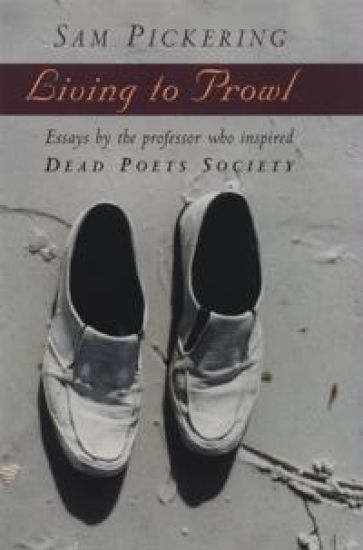
Living to Prowl

Living to Prowl

Sam Pickering

University of Georgia Press
1998
sidottu
Reading Pickering is like taking a walk with your oldest, wittiest friend, said Smithsonian magazine. Living to Prowl, Sam Pickering's ninth collection of essays, finds the acclaimed author walking familiar paths, taking time to enjoy family, friends, nature, and other simple pleasures.Like Pickering's earlier books, this collection records in highly personal and idiosyncratic terms a year in the life of a man with a tenacious commitment to pausing and wondering. Moving easily between humor and seriousness, the mundane and the philosophical, stark truth and evocative fictions, his essays saunter through life and rummage through lives. As Pickering himself puts it, Living to Prowl is meant to make people "turn away from the 'razzleum-dazzleum' of dream and abstraction to see the rich greens and blues at their doorsteps."