Kirjojen hintavertailu. Mukana 12 595 353 kirjaa ja 12 kauppaa.

Kirjailija

Sam Wineburg

Kirjat ja teokset yhdessä paikassa: 5 kirjaa, julkaisuja vuosilta 2001-2023, suosituimpien joukossa Verified. Vertaile teosten hintoja ja tarkista saatavuus suomalaisista kirjakaupoista.

5 kirjaa

Kirjojen julkaisuhaarukka 2001-2023.

Verified

Verified

Mike Caulfield; Sam Wineburg

THE UNIVERSITY OF CHICAGO PRESS
2023
sidottu
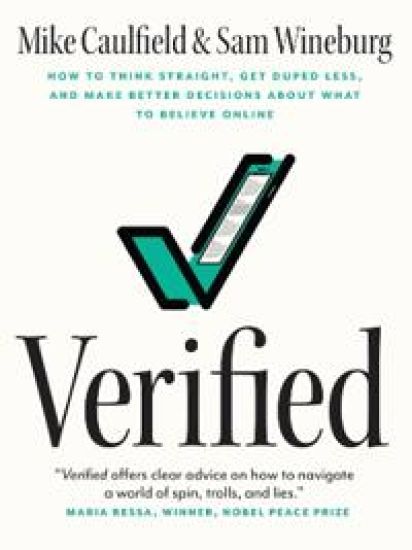
An indispensable guide for telling fact from fiction on the internet—often in less than 30 seconds. The internet brings information to our fingertips almost instantly. The result is that we often jump to thinking too fast, without taking a few moments to verify the source before engaging with a claim or viral piece of media. Information literacy expert Mike Caulfield and educational researcher Sam Wineburg are here to enable us to take a moment for due diligence with this informative, approachable guide to the internet. With this illustrated tool kit, you will learn to identify red flags, get quick context, and make better use of common websites like Google and Wikipedia that can help and hinder in equal measure. This how-to guide will teach you how to use the web to verify the web, quickly and efficiently, including how to • Verify news stories and other events in as little as thirty seconds (seriously) • Determine if the article you’re citing is by a reputable scholar or a quack • Detect the slippery tactics scammers use to make their sites look credible • Decide in a minute if that shocking video is truly shocking • Deduce who’s behind a site—even when its ownership is cleverly disguised • Uncover if that feature story is actually a piece planted by a foreign government • Use Wikipedia wisely to gain a foothold on new topics and leads for digging deeper And so much more. Building on techniques like SIFT and lateral reading, Verified will help students and anyone else looking to get a handle on the internet’s endless flood of information through quick, practical, and accessible steps. For more information, visit the website for the book.
Verified

Verified

Mike Caulfield; Sam Wineburg

THE UNIVERSITY OF CHICAGO PRESS
2023
nidottu
An indispensable guide for telling fact from fiction on the internet—often in less than 30 seconds. The internet brings information to our fingertips almost instantly. The result is that we often jump to thinking too fast, without taking a few moments to verify the source before engaging with a claim or viral piece of media. Information literacy expert Mike Caulfield and educational researcher Sam Wineburg are here to enable us to take a moment for due diligence with this informative, approachable guide to the internet. With this illustrated tool kit, you will learn to identify red flags, get quick context, and make better use of common websites like Google and Wikipedia that can help and hinder in equal measure. This how-to guide will teach you how to use the web to verify the web, quickly and efficiently, including how to • Verify news stories and other events in as little as thirty seconds (seriously) • Determine if the article you’re citing is by a reputable scholar or a quack • Detect the slippery tactics scammers use to make their sites look credible • Decide in a minute if that shocking video is truly shocking • Deduce who’s behind a site—even when its ownership is cleverly disguised • Uncover if that feature story is actually a piece planted by a foreign government • Use Wikipedia wisely to gain a foothold on new topics and leads for digging deeper And so much more. Building on techniques like SIFT and lateral reading, Verified will help students and anyone else looking to get a handle on the internet’s endless flood of information through quick, practical, and accessible steps. For more information, visit the website for the book.
Why Learn History (When It's Already on Your Phone)

Why Learn History (When It's Already on Your Phone)

Sam Wineburg

University of Chicago Press
2018
pokkari
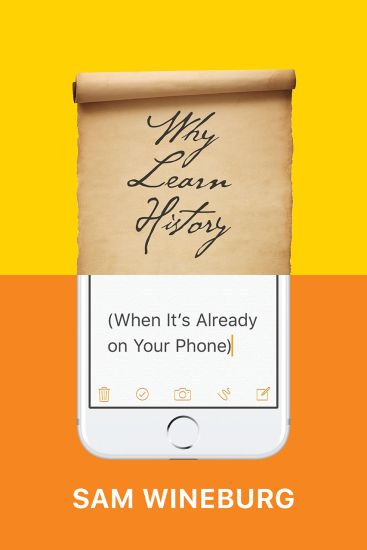
Let's start with two truths about our era that are so inescapable as to have become cliches: We are surrounded by more readily available information than ever before. And a huge percentage of it is inaccurate. Some of the bad info is well-meaning but ignorant. Some of it is deliberately deceptive. All of it is pernicious. With the internet always at our fingertips, what's a teacher of history to do? Sam Wineburg has answers, beginning with this: We definitely can't stick to the same old read-the-chapter-answer-the-questions-at-the-back snoozefest we've subjected students to for decades. If we want to educate citizens who can sift through the mass of information around them and separate fact from fake, we have to explicitly work to give them the necessary critical thinking tools. Historical thinking, Wineburg shows us in Why Learn History (When it's Already on Your Phone), has nothing to do with test prep-style ability to memorize facts. Instead, it's an orientation to the world that we can cultivate, one that encourages reasoned skepticism, discourages haste, and counters our tendency to confirm our biases. Wineburg draws on surprising discoveries from an array of research and experiments-including surveys of students, recent attempts to update history curricula, and analyses of how historians, students, and even fact checkers approach online sources-to paint a picture of a dangerously mine-filled landscape, but one that, with care, attention, and awareness, we can all learn to navigate. It's easy to look around at the public consequences of historical ignorance and despair. Wineburg is here to tell us it doesn't have to be that way. The future of the past may rest on our screens. But its fate rests in our hands.
Reading Like a Historian

Reading Like a Historian

Sam Wineburg; Daisy Martin; Chauncey Monte-Sano

Teachers' College Press
2012
nidottu
Featuring an expanded introduction, this award-winning bestseller has been updated to link curriculum to the Common Core State Standards. This popular text shows how to apply Wineburg’s highly acclaimed approach to teaching—Reading Like a Historian—to middle and high school classrooms, increasing academic literacy and sparking students’ curiosity. Each chapter begins with an introductory essay that sets the stage of a key moment in American history—beginning with exploration and colonisation and the events at Jamestown and ending with the Cuban Missile Crisis. Primary documents, charts, graphic organisers, visual images, and political cartoons follow each essay, as well as suggestions for where to find additional resources on the Internet and guidance for assessing students’ understanding of core historical ideas. Reading Like a Historian helps teachers use textbooks creatively and provides a wealth of ideas for how historical instruction can enhance students’ skills in reading comprehension.
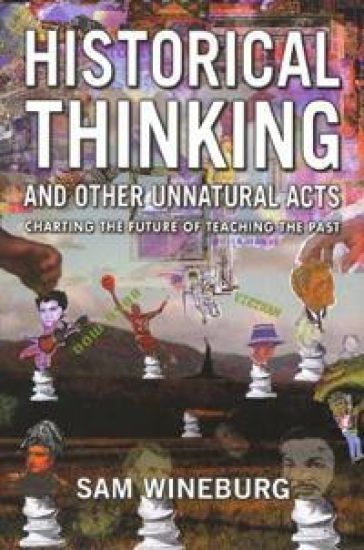
Historical Thinking

Historical Thinking

Sam Wineburg

Temple University Press,U.S.
2001
pokkari
Since ancient times, the pundits have lamented young people's lack of historical knowledge and warned that ignorance of the past surely condemns humanity to repeating its mistakes. In the contemporary United States, this dire outlook drives a contentious debate about what key events, nations, and people are essential for history students. Sam Wineburg says that we are asking the wrong questions. This book demolishes the conventional notion that there is one true history and one best way to teach it. Although most of us think of history -- and learn it -- as a conglomeration of facts, dates, and key figures, for professional historians it is a way of knowing, a method for developing and understanding about the relationships of peoples and events in the past. A cognitive psychologist, Wineburg has been engaged in studying what is intrinsic to historical thinking, how it might be taught, and why most students still adhere to the \u0022one damned thing after another\u0022 concept of history. Whether he is comparing how students and historians interpret documentary evidence or analyzing children's drawings, Wineburg's essays offer \u0022rough maps of how ordinary people think about the past and use it to understand the present.\u0022 Arguing that we all absorb lessons about history in many settings -- in kitchen table conversations, at the movies, or on the world-wide web, for instance -- these essays acknowledge the role of collective memory in filtering what we learn in school and shaping our historical thinking.