

Kirjailija
Samir Amin
Kirjat ja teokset yhdessä paikassa: 59 kirjaa, julkaisuja vuosilta 1982-2022, suosituimpien joukossa Europe and the Arab World. Vertaile teosten hintoja ja tarkista saatavuus suomalaisista kirjakaupoista.
59 kirjaa
Kirjojen julkaisuhaarukka 1982-2022.


AFRIQUE : POUR UN NOUVEAU CONTRAT DE DEVELOPPEMENT
Samir Amin; Hakim Ben Hammouda
Forum du Tiers-monde
2022
nidottu

Amin, S: Afrique et monde arabe
Samir Amin; Bernard Founou-Tchuigoua; Hakim Ben Hammouda
Editions L'Harmattan
2022
nidottu

The slave trade, the conquest of the Americas and the invasion of Africa have deeply transformed the relations between Europeans and other groups. The jump from difference to superiority and racial hierarchy was so swift that it led to the moral collapse of Europe and North America. By shifting the devaluation of so-called 'inferior' beings from non-Whites to non-Aryans, Nazism committed the unforgivable crime of bringing into the heart of the European world a ferocity up to then reserved for other continents.In this book, White Ferocity: The Genocides of Non-Whites and Non-Aryans from 1492 to Date, Plumelle-Uribe investigates and demonstrates, with harrowing evidence and analyses, how Europeans justified the destruction of other peoples as unavoidable based on the officially declared belief of others being inferior.
BRICS and the New American Imperialism
Vishwas Satgar; Ferrial Adam; Samir Amin; Patrick Bond; William K Carroll; Christopher Chase-Dunn; Alexander Gallas; Ana Garcia; Karina Kato; Nivedita Majumdar; Keamogetswe Seipato
Wits University Press
2020
pokkari
Challenges the mainstream understanding of BRICS and US dominance to situate the new global rivalries engulfing capitalism BRICS is a grouping of the five major emerging economies of Brazil, Russia, India, China and South Africa. Volume five in the Democratic Marxism series, BRICS and the New American Imperialism challenges the mainstream understanding of BRICS and US dominance to situate the new global rivalries engulfing capitalism. It offers novel analyses of BRICS in the context of increasing US induced imperial chaos, deepening environmental crisis tendencies (such as climate change and water scarcity), contradictory dynamics inside BRICS countries and growing subaltern resistance. The authors revisit contemporary thinking on imperialism and anti-imperialism, drawing on the work of Rosa Luxemburg, one of the leading theorists after Marx, who attempted to understand the expansionary nature of capitalism from the heartlands to the peripheries. The richness of Luxemburg's pioneering work inspires most of the volume's contributors in their analyses of the dangerous contradictions of the contemporary world as well as forms of democratic agency advancing resistance. While various forms of resistance are highlighted, among them water protests, mass worker strikes, anti-corporate campaigning and forms of cultural critique, this volume grapples with the challenge of renewing anti-imperialism beyond the NGO-driven World Social Forum and considers the prospects of a new horizontal political vessel to build global convergence. It also explores the prospects of a Fifth International of Peoples and Workers.
Brics and the New American Imperialism
Vishwas Satgar; Ferrial Adam; Samir Amin; Patrick Bond; William K Carroll; Christopher Chase-Dunn; Alexander Gallas; Ana Garcia; Karina Kato; Nivedita Majumdar; Keamogetswe Seipato
WITS UNIVERSITY PRESS
2020
sidottu
Challenges the mainstream understanding of BRICS and US dominance to situate the new global rivalries engulfing capitalism BRICS is a grouping of the five major emerging economies of Brazil, Russia, India, China and South Africa. Volume five in the Democratic Marxism series, BRICS and the New American Imperialism challenges the mainstream understanding of BRICS and US dominance to situate the new global rivalries engulfing capitalism. It offers novel analyses of BRICS in the context of increasing US induced imperial chaos, deepening environmental crisis tendencies (such as climate change and water scarcity), contradictory dynamics inside BRICS countries and growing subaltern resistance. The authors revisit contemporary thinking on imperialism and anti-imperialism, drawing on the work of Rosa Luxemburg, one of the leading theorists after Marx, who attempted to understand the expansionary nature of capitalism from the heartlands to the peripheries. The richness of Luxemburg's pioneering work inspires most of the volume's contributors in their analyses of the dangerous contradictions of the contemporary world as well as forms of democratic agency advancing resistance. While various forms of resistance are highlighted, among them water protests, mass worker strikes, anti-corporate campaigning and forms of cultural critique, this volume grapples with the challenge of renewing anti-imperialism beyond the NGO-driven World Social Forum and considers the prospects of a new horizontal political vessel to build global convergence. It also explores the prospects of a Fifth International of Peoples and Workers.
The final writings of Samir Amin--a mix of personal experiences and theoretical analysis of global challenges and movementsIn this second volume of his memoirs, Amin takes us on a journey to a dizzying array of countries, recounting the stages of his ongoing dialogue over several decades with popular movements struggling for a better future. As in his many works over the years, The Long Revolution of the Global South combines Amin's astute theoretical analyses of the challenges confronting the world's oppressed peoples with militant action. In these final writings based on his life, Amin presents us with theoretical interventions, analyses of political conjunctures, and narration of personal experiences. Amin's reminiscences of travels to places too often overlooked by the world at large are a joy to read. We even catch a glimpse of some of his memorable--and sometimes not so memorable--culinary adventures.
The final writings of Samir Amin--a mix of personal experiences and theoretical analysis of global challenges and movementsIn this second volume of his memoirs, Amin takes us on a journey to a dizzying array of countries, recounting the stages of his ongoing dialogue over several decades with popular movements struggling for a better future. As in his many works over the years, The Long Revolution of the Global South combines Amin's astute theoretical analyses of the challenges confronting the world's oppressed peoples with militant action. In these final writings based on his life, Amin presents us with theoretical interventions, analyses of political conjunctures, and narration of personal experiences. Amin's reminiscences of travels to places too often overlooked by the world at large are a joy to read. We even catch a glimpse of some of his memorable--and sometimes not so memorable--culinary adventures.
A collection of Samir Amin's ten most influential essays of the 21st centuryRadical political economist Samir Amin left behind a cherished oeuvre of Marxist writings. Amin's intellectual range--from economics to culture--was admirable, and his lessons remain essential. Monthly Review Press is honored to publish this volume, culled from the Monthly Review magazine, of ten of Samir Amin's most significant essays written in the twenty-first century. The collection is introduced by Amin's friend and comrade, the Marxist philosopher Aijaz Ahmad, who provides a comprehensive survey of Amin's life and path-breaking work. Ahmad also offers a contextual focus by which to read such stunningly astute pieces as "Revolution or Decadence?" and "Contemporary Imperialism." Only People Make Their Own History is a loving and enlightening look at what the work of Samir Amin has meant--and will mean-- to millions of people the world over.
A collection of Samir Amin's ten most influential essays of the 21st centuryRadical political economist Samir Amin left behind a cherished oeuvre of Marxist writings. Amin's intellectual range--from economics to culture--was admirable, and his lessons remain essential. Monthly Review Press is honored to publish this volume, culled from the Monthly Review magazine, of ten of Samir Amin's most significant essays written in the twenty-first century. The collection is introduced by Amin's friend and comrade, the Marxist philosopher Aijaz Ahmad, who provides a comprehensive survey of Amin's life and path-breaking work. Ahmad also offers a contextual focus by which to read such stunningly astute pieces as "Revolution or Decadence?" and "Contemporary Imperialism." Only People Make Their Own History is a loving and enlightening look at what the work of Samir Amin has meant--and will mean-- to millions of people the world over.

Modern Imperialism, Monopoly Finance Capital, and Marx's Law of Value
Samir Amin
Monthly Review Press,U.S.
2018
pokkari
The complete collection of Samir Amin's work on Marxism value theoryUnlike such obvious forms of oppression as feudalism or slavery, capitalism has been able to survive through its genius for disguising corporate profit imperatives as opportunities for individual human equality and advancement. But it was the genius of Karl Marx, in his masterwork, Capital, to discover the converse law of surplus value: behind the illusion of the democratic, supply-and-demand marketplace, lies the workplace, where people trying to earn a living are required to work way beyond the time it takes to pay their wages. Leave it to the genius of Samir Amin to advance Marx's theories--adding to them the work of radical economists such as Michal Kalecki, Josef Steindl, Paul Baran, and Paul Sweezy--to show how Marxian theory can be adapted to modern economic conditions. Amin extends Marx's analysis to describe a concept of "imperialist rent" derived from the radically unequal wages paid for the same labor done by people in both the Global North and the Global South, the rich nations and the poor ones. This is global oligopolistic capitalism, in which finance capital has come to dominate worldwide production and distribution. Amin also advances Baran and Sweezy's notion of economic surplus to explain a globally monopolized system in which Marx's "law of value" takes the form of a "law of globalized value," generating a super-exploitation of workers in the Global South. Modern Imperialism, Monopoly Finance Capital, and Marx's Law of Value offers readers, in one volume, the complete collection of Samir Amin's work on Marxian value theory. The book includes texts from two of Amin's recent works, Three Essays on Marx's Value Theory and The Law of Worldwide Value, which have provoked considerable controversy and correspondence. Here, Amin answers his critics with a series of letters, clarifying and developing his ideas. This work will occupy an important place among the theoretical resources for anyone involved in the study of contemporary Marxian economic and political theory.

Modern Imperialism, Monopoly Finance Capital, and Marx's Law of Value
Samir Amin
Monthly Review Press,U.S.
2018
sidottu
The complete collection of Samir Amin's work on Marxism value theoryUnlike such obvious forms of oppression as feudalism or slavery, capitalism has been able to survive through its genius for disguising corporate profit imperatives as opportunities for individual human equality and advancement. But it was the genius of Karl Marx, in his masterwork, Capital, to discover the converse law of surplus value: behind the illusion of the democratic, supply-and-demand marketplace, lies the workplace, where people trying to earn a living are required to work way beyond the time it takes to pay their wages. Leave it to the genius of Samir Amin to advance Marx's theories--adding to them the work of radical economists such as Michal Kalecki, Josef Steindl, Paul Baran, and Paul Sweezy--to show how Marxian theory can be adapted to modern economic conditions. Amin extends Marx's analysis to describe a concept of "imperialist rent" derived from the radically unequal wages paid for the same labor done by people in both the Global North and the Global South, the rich nations and the poor ones. This is global oligopolistic capitalism, in which finance capital has come to dominate worldwide production and distribution. Amin also advances Baran and Sweezy's notion of economic surplus to explain a globally monopolized system in which Marx's "law of value" takes the form of a "law of globalized value," generating a super-exploitation of workers in the Global South. Modern Imperialism, Monopoly Finance Capital, and Marx's Law of Value offers readers, in one volume, the complete collection of Samir Amin's work on Marxian value theory. The book includes texts from two of Amin's recent works, Three Essays on Marx's Value Theory and The Law of Worldwide Value, which have provoked considerable controversy and correspondence. Here, Amin answers his critics with a series of letters, clarifying and developing his ideas. This work will occupy an important place among the theoretical resources for anyone involved in the study of contemporary Marxian economic and political theory.
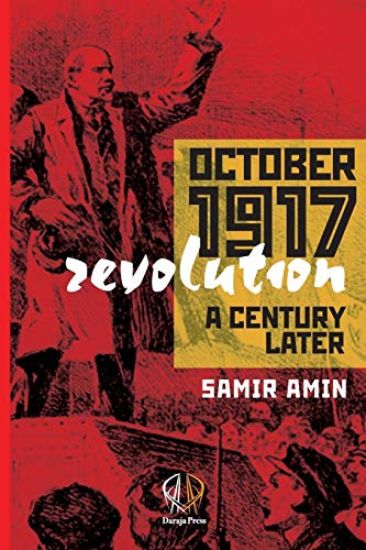

Russia and the Long Transition from Capitalism to Socialism
Samir Amin
Monthly Review Press,U.S.
2016
sidottu
Out of early twentieth-century Russia came the world's first significant effort to build a modern revolutionary society. According to Marxist economist Samir Amin, the great upheaval that once produced the Soviet Union has also produced a movement away from capitalism - a long transition that continues even today. In seven concise, provocative chapters, Amin deftly examines the trajectory of Russian capitalism, the Bolshevik Revolution, the collapse of the Soviet Union, the possible future of Russia - and, by extension, the future of socialism itself. Amin manages to combine an analysis of class struggle with geopolitics - each crucial to understanding Russia's singular and complex political history. He first looks at the development (or lack thereof) of Russian capitalism. He sees Russia's geopolitical isolation as the reason its capitalist empire developed so differently from Western Europe, and the reason for Russia's perceived "backwardness." Yet Russia's unique capitalism proved to be the rich soil in which the Bolsheviks were able to take power, and Amin covers the rise and fall of the revolutionary Soviet system. Finally, in a powerful chapter on Ukraine and the rise of global fascism, Amin lays out the conditions necessary for Russia to recreate itself, and perhaps again move down the long road to socialism. Samir Amin's great achievement in this book is not only to explain Russia's historical tragedies and triumphs, but also to temper our hopes for a quick end to an increasingly insufferable capitalism. This book offers a cornucopia of food for thought, as well as an enlightening means to transcend reductionist arguments about "revolution" so common on the left. Samir Amin's book - and the actions that could spring from it - are more necessary than ever, if the world is to avoid the barbarism toward which capitalism is hurling humanity.

According to renowned Marxist economist Samir Amin, the recent Arab Spring uprisings comprise an integral part of a massive "second awakening" of the Global South. From the self-immolation in December 2010 of a Tunisian street vendor, to the consequent outcries in Cairo's Tahrir Square against poverty and corruption, to the ongoing upheavals across the Middle East and Northern Africa, the Arab world is shaping what may become of Western imperialism - an already tottering and overextended system.The Reawakening of the Arab World examines the complex interplay of nations regarding the Arab Spring and its continuing, turbulent seasons. Beginning with Amin's compelling interpretation of the 2011 popular Arab explosions, the book is comprised of five chapters - including a new chapter analyzing U.S. geo-strategy. Amin sees the United States, in an increasingly multi-polar world, as a victim of overreach, caught in its own web of attempts to contain the challenge of China, while confronting the staying power of nations such as Syria and Iran. The growing, deeply-felt need of the Arab people for independent, popular democracy is the cause of their awakening, says Amin. It is this awakening to democracy that the United States fears most, since real self-government by independent nations would necessarily mean the end of U.S. empire, and the economic liberalism that has kept it in place. The way forward for the Arab world, Amin argues, is to take on, not just Western imperialism, but also capitalism itself.
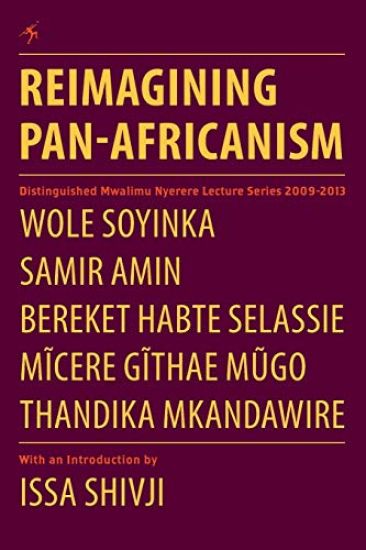
Reimagining Pan-Africanism. Distinguished Mwalimu Nyerere Lecture Series 2009-2013
Wole Soyinka; Samir Amin; Thandika Mkandawire
Mkuki na Nyota Publishers
2015
pokkari
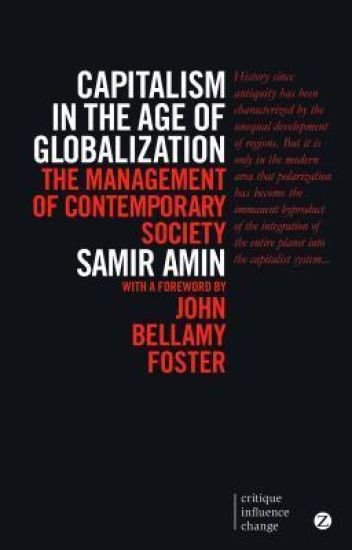
Samir Amin remains one of the world's most influential thinkers about the changing nature of North-South relations in the development of contemporary capitalism. In this highly prescient book, originally published in 1997, he provides a powerful analysis of the new unilateral capitalist era following the collapse of the Soviet model, and the apparent triumph of the market and globalization. Amin's innovative analysis charts the rise of ethnicity and fundamentalism as consequences of the failure of ruling classes in the South to counter the exploitative terms of globalization. This has had profound implications and continues to resonate today. Furthermore, his deconstruction of the Bretton Woods institutions as managerial mechanisms which protect the profitability of capital provides an important insight into the continued difficulties in reforming them. Amin's rejection of the apparent inevitability of globalization in its present polarising form is particularly prophetic - instead he asserts the need for each society to negotiate the terms of its inter-dependence with the rest of the global economy. A landmark work by a key contemporary thinker.