Kirjojen hintavertailu. Mukana 12 657 676 kirjaa ja 12 kauppaa.

Kirjailija

Sandhya Shukla

Kirjat ja teokset yhdessä paikassa: 4 kirjaa, julkaisuja vuosilta 2003-2024, suosituimpien joukossa Cross-Cultural Harlem. Vertaile teosten hintoja ja tarkista saatavuus suomalaisista kirjakaupoista.

4 kirjaa

Kirjojen julkaisuhaarukka 2003-2024.

Cross-Cultural Harlem

Cross-Cultural Harlem

Sandhya Shukla

Columbia University Press
2024
pokkari
Over the course of the twentieth and twenty-first centuries, Harlem has been the capital of both Black America and a global African diaspora, an early home for Italian and Jewish immigrant communities, an important Puerto Rican neighborhood, and a representative site of gentrification. How do we understand the power of a place with so many claims and identifications? Drawing on fiction, sociology, political speech, autobiography, and performance, Sandhya Shukla develops a living theory of Harlem, in which peoples of different backgrounds collide, interact, and borrow from each other, even while Blackness remains crucial.Cross-Cultural Harlem reveals a dynamic of exchange that provokes a rethinking of spaces such as Black Harlem, El Barrio, and Italian Harlem. Cross-cultural encounters among African Americans, West Indians, Puerto Ricans, Jews, and Italians provide a story of multiplicity that challenges the framework of territorial enclaves. Shukla illuminates the historical processes that have shaped the diversity of Harlem, examining the many dimensions of its Blackness—Southern, African, Caribbean, Puerto Rican, and more—as well as how white ethnicities have been constructed. Considering literary and historical examples such as Langston Hughes’s short story “Spanish Blood,” the career of the Italian American left-wing Harlem congressman Vito Marcantonio, and the autobiography of Puerto Rican–Cuban writer Piri Thomas, Shukla argues that cosmopolitanism and racial belonging need not be seen as contradictory. Cross-Cultural Harlem offers a vision of sustained dialogue to respond to the challenges of urban transformations and to affirm the future of Harlem as actual place and global symbol.

Cross-Cultural Harlem

Cross-Cultural Harlem

Sandhya Shukla

Columbia University Press
2024
sidottu
Over the course of the twentieth and twenty-first centuries, Harlem has been the capital of both Black America and a global African diaspora, an early home for Italian and Jewish immigrant communities, an important Puerto Rican neighborhood, and a representative site of gentrification. How do we understand the power of a place with so many claims and identifications? Drawing on fiction, sociology, political speech, autobiography, and performance, Sandhya Shukla develops a living theory of Harlem, in which peoples of different backgrounds collide, interact, and borrow from each other, even while Blackness remains crucial.Cross-Cultural Harlem reveals a dynamic of exchange that provokes a rethinking of spaces such as Black Harlem, El Barrio, and Italian Harlem. Cross-cultural encounters among African Americans, West Indians, Puerto Ricans, Jews, and Italians provide a story of multiplicity that challenges the framework of territorial enclaves. Shukla illuminates the historical processes that have shaped the diversity of Harlem, examining the many dimensions of its Blackness—Southern, African, Caribbean, Puerto Rican, and more—as well as how white ethnicities have been constructed. Considering literary and historical examples such as Langston Hughes’s short story “Spanish Blood,” the career of the Italian American left-wing Harlem congressman Vito Marcantonio, and the autobiography of Puerto Rican–Cuban writer Piri Thomas, Shukla argues that cosmopolitanism and racial belonging need not be seen as contradictory. Cross-Cultural Harlem offers a vision of sustained dialogue to respond to the challenges of urban transformations and to affirm the future of Harlem as actual place and global symbol.

Our Americas

Our Americas

Sandhya Shukla; Heidi Tinsman

Duke University Press
2004
pokkari
Named 2004 Best Special Issue by the Council of Editors of Learned JournalsThis special issue of Radical History Review takes as its inspiration Cuban writer and revolutionary JosÉ MartÍ’s famous 1891 essay “Our America.” Focusing on MartÍ’s appropriation of the term “America”-used to refer to a transnational, regional project of solidarity in Latin America and to suggest a new epistemology that challenged the ideologies underpinning U.S. imperialism-Our Americas: Political and Cultural Imaginings investigates the highly contested concept of “the Americas” as it has been defined and deployed in differing strategic and politically informed ways across history. The issue is dedicated to probing the transnational political and social possibilities that emerge when the discursive boundaries established by fields such as “Latin American studies” and “American studies”-as well as the geopolitical boundaries drawn during the colonial era-are expanded or transgressed.Drawing on history, cultural anthropology, literary criticism, and memoirs, the works in this collection, gathered from contributors from an array of geographic locales, seek to integrate “Latin America,” “North America,” “the Caribbean,” and other regions. Striving to move beyond a simple joining of “Latin America” and the United States, the transnational concept of “the Americas” is explored and complicated through essays that examine the contrasting visions of Latin American independence embodied in the writings of revolutionaries from different nations; discuss the ramifications of a political treaty that institutionalized a separation between Mexico and the United States; deconstruct the exclusionary discourses of U.S. nationalism; and expose the ways in which institutionalized racism and homophobia are roadblocks to social and political solidarity in Latin America. In discussion forums, contributors plumb the history and current relevance of the concept of “Latin America” for intellectual, social, and political work and address the unique challenges facing those who seek to teach “the Americas.”Contributors. Arturo Arias, John Beck, John D. Blanco, Nestor Garcia Canclini, Patricio Del Real, Ian Christopher Fletcher, Paul Giles, Salah D. Hassan, Martin Hopenhayn, Aisha Khan, R. J. Lambrose, Ian Lekus, Kate Masur, Enrique C. Ochoa, Diana Paton, Rossana Reguillo, Gemma Robinson, Aimee Carillo Rowe, Maria Josefina Saldana-Portillo, Sandhya Shukla, Heidi Tinsman, Carlos E. Bojorquez Urzaiz
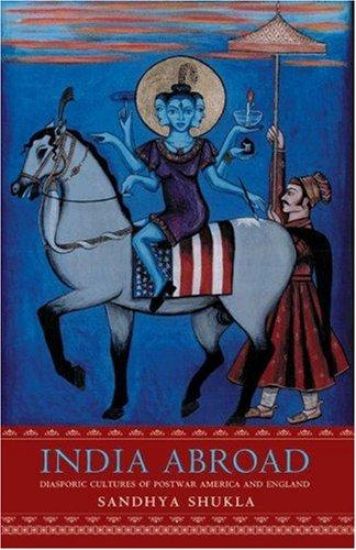
India Abroad

India Abroad

Sandhya Shukla

Princeton University Press
2003
pokkari
India Abroad analyzes the development of Indian diasporas in the United States and England from 1947, the year of Indian independence, to the present. Across different spheres of culture--festivals, entrepreneurial enclaves, fiction, autobiography, newspapers, music, and film--migrants have created India as a way to negotiate life in the multicultural United States and Britain. Sandhya Shukla considers how Indian diaspora has become a contact zone for various formations of identity and discourses of nation. She suggests that carefully reading the production of a diasporic sensibility, one that is not simply an outgrowth of the nation-state, helps us to conceive of multiple imaginaries, of America, England, and India, as articulated to one another. Both the connections and disconnections among peoples who see themselves as in some way Indian are brought into sharp focus by this comparativist approach. This book provides a unique combination of rich ethnographic work and textual readings to illuminate the theoretical concerns central to the growing fields of diaspora studies and transnational cultural studies. Shukla argues that the multi-sitedness of diaspora compels a rethinking of time and space in anthropology, as well as in other disciplines. Necessarily, the standpoint of global belonging and citizenship makes the boundaries of the "America" in American studies a good deal more porous. And in dialogue with South Asian studies and Asian American studies, this book situates postcolonial Indian subjectivity within migrants' transnational recastings of the meanings of race and ethnicity. Interweaving conceptual and material understandings of diaspora, India Abroad finds that in constructed Indias, we can see the contradictions of identity and nation that are central to the globalized condition in which all peoples, displaced and otherwise, live.