Kirjojen hintavertailu. Mukana 12 318 058 kirjaa ja 12 kauppaa.

Kirjailija

Sandra Braman

Kirjat ja teokset yhdessä paikassa: 2 kirjaa, julkaisuja vuosilta 1995-2009, suosituimpien joukossa Last Rights. Vertaile teosten hintoja ja tarkista saatavuus suomalaisista kirjakaupoista.

2 kirjaa

Kirjojen julkaisuhaarukka 1995-2009.

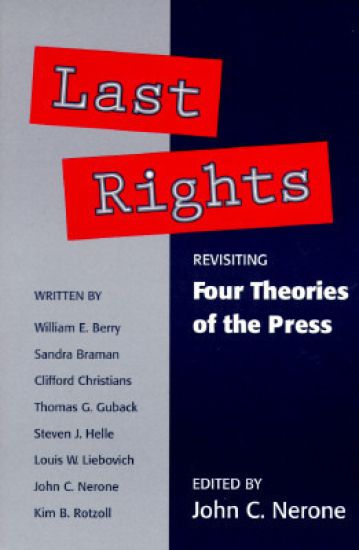
Last Rights

Last Rights

William E Berry; Sandra Braman; Clifford G. Christians; Thomas Guback; Steve J Helle; Louis W Liebovich; John C. Nerone; Kim B Rotzoll

University of Illinois Press
1995
nidottu
Though subjected to years of criticism, Four Theories of the Press remains a core text in communications. Its influence on the field, impact on generations of journalists, and ability to spark debate on why the press acts as it does continue to make it an oft-quoted source and classroom staple. In Last Rights, eight communications scholars critique and expand on the classic text. The authors argue that Four Theories spoke to and for a world beset by a cold war ended long ago. At the same time, they praise the book for offering an alternative view of the press and society and as a useful tool for helping scholars and citizens alike grapple with contradictions in classical liberalism. They also raise important questions about the Internet and other major changes in communications systems and society since the original publication of Four Theories. Contributors: William E. Berry, Sandra Braman, Clifford Christians, Thomas G. Guback, Steven J. Helle, Louis W. Liebovich, John C. Nerone, and Kim B. Rotzoll
Change of State

Change of State

Sandra Braman

MIT Press
2009
pokkari
How control over information creation, processing, flows, and use has become the most effective form of power: theoretical foundations and empirical examples of information policy in the U.S., an innovator informational state.As the informational state replaces the bureaucratic welfare state, control over information creation, processing, flows, and use has become the most effective form of power. In Change of State Sandra Braman examines the theoretical and practical ramifications of this "change of state." She looks at the ways in which governments are deliberate, explicit, and consistent in their use of information policy to exercise power, exploring not only such familiar topics as intellectual property rights and privacy but also areas in which policy is highly effective but little understood. Such lesser-known issues include hybrid citizenship, the use of "functionally equivalent borders" internally to allow exceptions to U.S. law, research funding, census methods, and network interconnection. Trends in information policy, argues Braman, both manifest and trigger change in the nature of governance itself.After laying the theoretical, conceptual, and historical foundations for understanding the informational state, Braman examines 20 information policy principles found in the U.S Constitution. She then explores the effects of U.S. information policy on the identity, structure, borders, and change processes of the state itself and on the individuals, communities, and organizations that make up the state. Looking across the breadth of the legal system, she presents current law as well as trends in and consequences of several information policy issues in each category affected.Change of State introduces information policy on two levels, coupling discussions of specific contemporary problems with more abstract analysis drawing on social theory and empirical research as well as law. Most important, the book provides a way of understanding how information policy brings about the fundamental social changes that come with the transformation to the informational state.