Kirjojen hintavertailu. Mukana 12 218 793 kirjaa ja 12 kauppaa.

Kirjailija

Sandra Leaton Gray

Kirjat ja teokset yhdessä paikassa: 9 kirjaa, julkaisuja vuosilta 2018-2026, suosituimpien joukossa A Decolonial Curriculum. Vertaile teosten hintoja ja tarkista saatavuus suomalaisista kirjakaupoista.

9 kirjaa

Kirjojen julkaisuhaarukka 2018-2026.

A Decolonial Curriculum

A Decolonial Curriculum

David Scott; Sandra Leaton Gray; Rita Chawla-Duggan

TAYLOR FRANCIS LTD
2026
sidottu
A Decolonial Curriculum advances the claim that a decolonial and transcolonial curriculum must be grounded in a substantive account of what human beings do, have done, and might yet do. It proposes twelve fundamental domains of human life - knowing, communicating, genealogising, positioning, cognising, understanding, enhancing, philosophising, acting in the world, valuing, embodying, and creating - as generative elements for curriculum design. Taken together, these domains offer a non-reductive framework that resists the false dichotomy between ‘colonial’ epistemologies and ‘indigenous’ ways of knowing and being. Rather than opposing knowledge traditions, the book argues for a pedagogy that is dialogical, embodied, and reflexive, while recognising the limits of decolonial critique alone. It therefore advances a transcolonial pedagogy oriented towards hybrid, relational, and productive epistemic formations, capable of preparing learners for materially and historically interconnected futures. It is an essential read for academics, educators, policymakers, and anyone engaged in designing, developing, and rethinking curriculum.
Colonising and Decolonising

Colonising and Decolonising

David Scott; Sandra Leaton Gray; Rita Chawla-Duggan

TAYLOR FRANCIS LTD
2025
sidottu
Colonising and Decolonising argues for a decolonised and ethicised curriculum. Grounded in an interdisciplinary approach, it draws upon the fields of history, sociology, education, anthropology, philosophy, indigenous studies, and more, to allow a nuanced and multifaceted exploration of the subject matter. Focusing on the concepts and practices of coloniality and decoloniality, it uses this focus as a framework for positioning concepts as acquired dispositions in the way we live. Philosophical topics addressed include: concepts and descriptors, knowledge, facts and values, free will and volition, coloniality, decoloniality, curriculum, sapience, strong normative evaluations, pedagogy, rationality, freedom, ethics, learning practices, thinking, ecology, imaginative possibility, and inclusion. A robust and erudite exploration of the imperative of decolonisation, this volume will appeal to scholars and researchers across a broad range of disciplines including specialist fields of education research, decolonial theory, sociology, epistemology, and philosophy of education. The Open Access version of this book, available at http://www.taylorfrancis.com, has been made available under a Creative Commons [Attribution-Non Commercial-No Derivatives (CC BY-NC-ND)] 4.0 license.
Intelligence, Sapience and Learning

Intelligence, Sapience and Learning

David Scott; Sandra Leaton Gray

TAYLOR FRANCIS LTD
2025
nidottu
Examining the idea of intelligence in its diverse sociological and philosophical formations, Intelligence, Sapience and Learning explores the multiple and often complex meanings associated with the concept of intelligence, and its relationships with learning, curriculum and sapience. Scott and Leaton Gray explain a series of key concepts central to understanding the meta-concepts and practices of intelligence, learning and curriculum. These concepts include epistemology, free will and volition, hermeneutics, pragmatism, strong normative evaluations and pedagogy, amongst others. Focusing on six praxes that form a genealogy of the concept of intelligence, Scott and Leaton Gray argue for a re-framing of the concept and practice of intelligence, with profound consequences for how modern societies should be organised and how people should live their lives. This book is a follow-up to Women Curriculum Theorists: Power, Knowledge and Subjectivity, and takes a fresh look at the concept and practice of intelligence. It will appeal to curriculum theorists and those with an interest in curriculum and learning matters, as well as those working in the philosophy and sociology of education.
Women Curriculum Theorists

Women Curriculum Theorists

Sandra Leaton Gray; David Scott

TAYLOR FRANCIS LTD
2024
nidottu
Most published bodies of work relating to curriculum theory focus exclusively, or almost exclusively, on the contributions of men. This is not representative of influences on educational practices as a whole, and it is certainly not representative of educational theory generally, as women have played a significant role in framing the theory and practice of education in the past. Their contribution is at least equal to that of men, even though it may not immediately appear as visible on library shelves or lecture lists. This book addresses this egregious deficit by asking readers to engage in an intellectual conversation about the nature of women’s curriculum theory, as well as its impact on society and thought in general. It does this by examining the work of twelve women curriculum theorists: Maxine Greene, Susan Haack, Julia Kristeva, Martha Nussbaum, Nel Noddings, Jane Roland Martin, Marie Battiste, Dorothea Beale, Susan Isaacs, Maria Montessori, Mary Warnock and Lucy Diggs Slowe.The book is not an encyclopaedia, nor is it a history book. It aims to bring to the reader’s attention, through a semantic rendition of the world, those seminal relationships that exist between the three meta-concepts that are addressed in the work, feminism, learning and curriculum. It will appeal to scholars and researchers with interests in curriculum, and the philosophy and sociology of education.
Intelligence, Sapience and Learning

Intelligence, Sapience and Learning

David Scott; Sandra Leaton Gray

TAYLOR FRANCIS LTD
2024
sidottu
Examining the idea of intelligence in its diverse sociological and philosophical formations, Intelligence, Sapience and Learning explores the multiple and often complex meanings associated with the concept of intelligence, and its relationships with learning, curriculum and sapience. Scott and Leaton Gray explain a series of key concepts central to understanding the meta-concepts and practices of intelligence, learning and curriculum. These concepts include epistemology, free will and volition, hermeneutics, pragmatism, strong normative evaluations and pedagogy, amongst others. Focusing on six praxes that form a genealogy of the concept of intelligence, Scott and Leaton Gray argue for a re-framing of the concept and practice of intelligence, with profound consequences for how modern societies should be organised and how people should live their lives. This book is a follow-up to Women Curriculum Theorists: Power, Knowledge and Subjectivity, and takes a fresh look at the concept and practice of intelligence. It will appeal to curriculum theorists and those with an interest in curriculum and learning matters, as well as those working in the philosophy and sociology of education.
Women Curriculum Theorists

Women Curriculum Theorists

Sandra Leaton Gray; David Scott

TAYLOR FRANCIS LTD
2023
sidottu
Most published bodies of work relating to curriculum theory focus exclusively, or almost exclusively, on the contributions of men. This is not representative of influences on educational practices as a whole, and it is certainly not representative of educational theory generally, as women have played a significant role in framing the theory and practice of education in the past. Their contribution is at least equal to that of men, even though it may not immediately appear as visible on library shelves or lecture lists. This book addresses this egregious deficit by asking readers to engage in an intellectual conversation about the nature of women’s curriculum theory, as well as its impact on society and thought in general. It does this by examining the work of twelve women curriculum theorists: Maxine Greene, Susan Haack, Julia Kristeva, Martha Nussbaum, Nel Noddings, Jane Roland Martin, Marie Battiste, Dorothea Beale, Susan Isaacs, Maria Montessori, Mary Warnock and Lucy Diggs Slowe.The book is not an encyclopaedia, nor is it a history book. It aims to bring to the reader’s attention, through a semantic rendition of the world, those seminal relationships that exist between the three meta-concepts that are addressed in the work, feminism, learning and curriculum. It will appeal to scholars and researchers with interests in curriculum, and the philosophy and sociology of education.
Digital Children: A Guide for Adults

Digital Children: A Guide for Adults

Andy Phippen; Sandra Leaton Gray

Hachette Learning
2021
nidottu
The digital world is a place where even the most informed parents and teachers can feel one pace behind children. Bombarded with scare stories about the risks of everyday Internet interactions for young people, those caring for them are frequently left to navigate online minefields more or less on their own. This book is here to help. Two leading experts on digital childhoods, Dr Sandra Leaton Gray and Professor Andy Phippen, explore the realities of growing up online in the 21st century. They provide an informative and accessible guide to the issues young people face today, based on the latest research and scholarship. They also expose the many ways the child safeguarding industry means well, but often gets things very wrong. The authors explain the latest research on topics such as biometrics, encryption, cyphertext and sexting, and analyse their relevance to the next generation. They raise a number of key questions about the contemporary lives of young people, including their relationship with digital technologies such as games, social media, surveillance and tracking devices. They also challenge conventional thinking on these issues. Rather than relying on technology, they argue we should instead focus on the quality of relationships between children, their peers, their parents and with adults generally. Then we can build a healthy digital future for society as a whole.
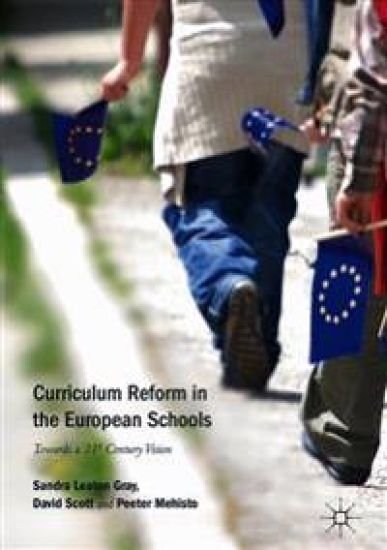
Curriculum Reform in the European Schools

Curriculum Reform in the European Schools

Sandra Leaton Gray; David Scott; Peeter Mehisto

Springer Nature Switzerland AG
2018
nidottu
This book is open access under a CC BY 4.0 license.This open access book examines the modern role of the European School system within the European Union, at a time when the global economy demands a new vision for contemporary education. The European schools are currently in a state of crisis: their 60-year-old tradition of bilingual and multilingual education is being strained by rapid EU expansion and the removal of English speaking teachers as a result of Brexit. Their tried and tested model of mathematics and science education has rapidly been overtaken by new developments in pedagogy and assessment research, while recruitment and retention of students and teachers has become increasingly fraught as European member states review what they are, and what they are not, prepared to fund. The authors draw on original and empirical research to assess the European Schools’ place in a new Europe where the entire post-war European Project is potentially at risk. This well-researched volume will be of interest to practitioners working in European schools as well as students and scholars of EU politics and international education.
Curriculum Reform in the European Schools

Curriculum Reform in the European Schools

Sandra Leaton Gray; David Scott; Peeter Mehisto

Springer International Publishing AG
2018
sidottu
This book is open access under a CC BY 4.0 license.This open access book examines the modern role of the European School system within the European Union, at a time when the global economy demands a new vision for contemporary education. The European schools are currently in a state of crisis: their 60-year-old tradition of bilingual and multilingual education is being strained by rapid EU expansion and the removal of English speaking teachers as a result of Brexit. Their tried and tested model of mathematics and science education has rapidly been overtaken by new developments in pedagogy and assessment research, while recruitment and retention of students and teachers has become increasingly fraught as European member states review what they are, and what they are not, prepared to fund. The authors draw on original and empirical research to assess the European Schools’ place in a new Europe where the entire post-war European Project is potentially at risk. This well-researched volume will be of interest to practitioners working in European schools as well as students and scholars of EU politics and international education.