Kirjojen hintavertailu. Mukana 12 595 353 kirjaa ja 12 kauppaa.

Kirjailija

Sanpei Kageyama

Kirjat ja teokset yhdessä paikassa: 4 kirjaa, julkaisuja vuosilta 2000-2019, suosituimpien joukossa Euclidean Design Theory. Vertaile teosten hintoja ja tarkista saatavuus suomalaisista kirjakaupoista.

4 kirjaa

Kirjojen julkaisuhaarukka 2000-2019.

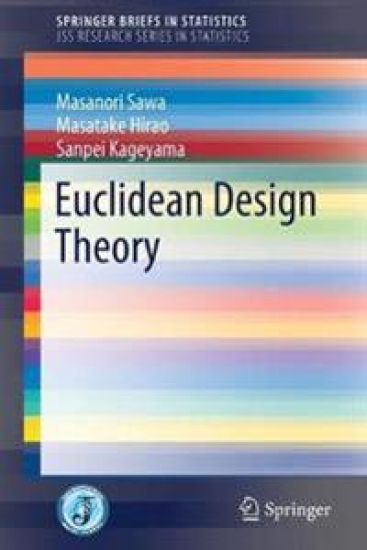
Euclidean Design Theory

Euclidean Design Theory

Masanori Sawa; Masatake Hirao; Sanpei Kageyama

Springer Verlag, Singapore
2019
nidottu
This book is the modern first treatment of experimental designs, providing a comprehensive introduction to the interrelationship between the theory of optimal designs and the theory of cubature formulas in numerical analysis. It also offers original new ideas for constructing optimal designs. The book opens with some basics on reproducing kernels, and builds up to more advanced topics, including bounds for the number of cubature formula points, equivalence theorems for statistical optimalities, and the Sobolev Theorem for the cubature formula. It concludes with a functional analytic generalization of the above classical results. Although it is intended for readers who are interested in recent advances in the construction theory of optimal experimental designs, the book is also useful for researchers seeking rich interactions between optimal experimental designs and various mathematical subjects such as spherical designs in combinatorics and cubature formulas in numerical analysis, both closely related to embeddings of classical finite-dimensional Banach spaces in functional analysis and Hilbert identities in elementary number theory. Moreover, it provides a novel communication platform for “design theorists” in a wide variety of research fields.
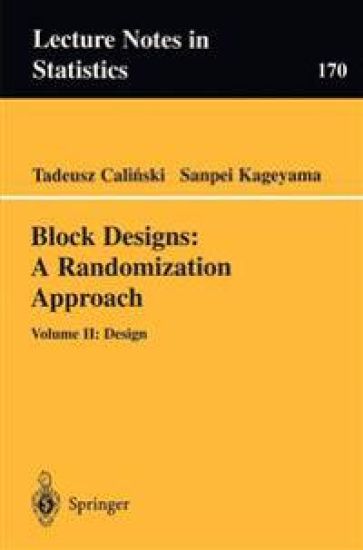
Block Designs: A Randomization Approach

Block Designs: A Randomization Approach

Tadeusz Calinski; Sanpei Kageyama

Springer-Verlag New York Inc.
2002
nidottu
The book is composed of two volumes, each consisting of five chapters. In Vol­ ume I, following some statistical motivation based on a randomization model, a general theory of the analysis of experiments in block designs has been de­ veloped. In the present Volume II, the primary aim is to present methods of that satisfy the statistical requirements described in constructing block designs Volume I, particularly those considered in Chapters 3 and 4, and also to give some catalogues of plans of the designs. Thus, the constructional aspects are of predominant interest in Volume II, with a general consideration given in Chapter 6. The main design investigations are systematized by separating the material into two contents, depending on whether the designs provide unit efficiency fac­ tors for some contrasts of treatment parameters (Chapter 7) or not (Chapter 8). This distinction in classifying block designs may be essential from a prac­ tical point of view. In general, classification of block designs, whether proper or not, is based here on efficiency balance (EB) in the sense of the new termi­ nology proposed in Section 4. 4 (see, in particular, Definition 4. 4. 2). Most of the attention is given to connected proper designs because of their statistical advantages as described in Volume I, particularly in Chapter 3. When all con­ trasts are of equal importance, either the class of (v - 1; 0; O)-EB designs, i. e.
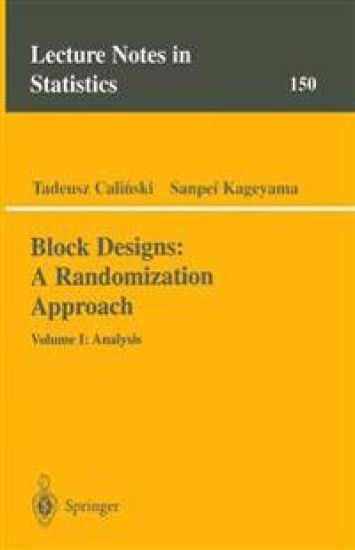
Block Designs: A Randomization Approach

Block Designs: A Randomization Approach

Tadeusz Calinski; Sanpei Kageyama

Springer-Verlag New York Inc.
2000
nidottu
In most of the literature on block designs, when considering the analysis of experimental results, it is assumed that the expected value of the response of an experimental unit is the sum of three separate components, a general mean parameter, a parameter measuring the effect of the treatment applied and a parameter measuring the effect of the block in which the experimental unit is located. In addition, it is usually assumed that the responses are uncorrelated, with the same variance. Adding to this the assumption of normal distribution of the responses, one obtains the so-called "normal-theory model" on which the usual analysis of variance is based. Referring to it, Scheffe (1959, p. 105) writes that "there is nothing in the 'normal-theory model' of the two-way layout . . . that reflects the increased accuracy possible by good blocking. " Moreover, according to him, such a model "is inappropriate to those randomized-blocks experiments where the 'errors' are caused mainly by differences among the experimental units rather than measurement errors. " In view of this opinion, he has devoted one of the chapters of his book (Chapter 9) to randomization models, being convinced that "an understanding of the nature of the error distribution generated by the physical act of randomization should be part of our knowledge of the basic theory of the analysis of variance.