Kirjojen hintavertailu. Mukana 12 290 406 kirjaa ja 12 kauppaa.

Kirjailija

Santiago Castro-Gómez

Kirjat ja teokset yhdessä paikassa: 6 kirjaa, julkaisuja vuosilta 2015-2021, suosituimpien joukossa Historia de la gubernamentalidad II: Filosofía, cristianismo y sexualidad en Michel Foucault. Vertaile teosten hintoja ja tarkista saatavuus suomalaisista kirjakaupoista.

Mukana myös kirjoitusasut: Santiago Castro Gomez, Santiago Castro-Gomez

6 kirjaa

Kirjojen julkaisuhaarukka 2015-2021.

Zero-Point Hubris

Zero-Point Hubris

Santiago Castro-Gómez

BLOOMSBURY PUBLISHING PLC
2021
sidottu
Operating within the framework of postcolonial studies and decolonial theory, this important work starts from the assumption that the violence exercised by European colonialism was not only physical and economic, but also ‘epistemic’. Santiago Castro-Gómez argues that toward the end of the 18th century, this epistemic violence of the Spanish Empire assumed a specific form: zero-point hubris. The ‘many forms of knowing’ were integrated into a chronological hierarchy in which scientific-enlightened knowledge appears at the highest point on the cognitive scale, while all other epistemes are seen as constituting its past. Enlightened criollo thinkers did not hesitate to situate the blacks, Indians, and mestizos of New Granada in the lowest position on this cognitive scale. Castro-Gómez argues that in the colonial periphery of the Spanish Americas, Enlightenment constituted not only the position of epistemic distance separating science from all other knowledges, but also the position of ethnic distance separating the criollos from the ‘castes’. Epistemic violence—and not only physical violence—is thereby found at the very origin of Colombian nationality.

Zero-Point Hubris

Zero-Point Hubris

Santiago Castro-Gómez

BLOOMSBURY PUBLISHING PLC
2021
nidottu
Operating within the framework of postcolonial studies and decolonial theory, this important work starts from the assumption that the violence exercised by European colonialism was not only physical and economic, but also ‘epistemic’. Santiago Castro-Gómez argues that toward the end of the 18th century, this epistemic violence of the Spanish Empire assumed a specific form: zero-point hubris. The ‘many forms of knowing’ were integrated into a chronological hierarchy in which scientific-enlightened knowledge appears at the highest point on the cognitive scale, while all other epistemes are seen as constituting its past. Enlightened criollo thinkers did not hesitate to situate the blacks, Indians, and mestizos of New Granada in the lowest position on this cognitive scale. Castro-Gómez argues that in the colonial periphery of the Spanish Americas, Enlightenment constituted not only the position of epistemic distance separating science from all other knowledges, but also the position of ethnic distance separating the criollos from the ‘castes’. Epistemic violence—and not only physical violence—is thereby found at the very origin of Colombian nationality.

Critique of Latin American Reason

Critique of Latin American Reason

Santiago Castro-Gómez; Linda Martín Alcoff

Columbia University Press
2021
sidottu
Critique of Latin American Reason is one of the most important philosophical texts to have come out of South America in recent decades. First published in 1996, it offers a sweeping critique of the foundational schools of thought in Latin American philosophy and critical theory.Santiago Castro-Gómez argues that “Latin America” is not so much a geographical entity, a culture, or a place, but rather an object of knowledge produced by a family of discourses in the humanities that are inseparably linked to colonial power relationships. Using the archaeological and genealogical methods of Michel Foucault, he analyzes the political, literary, and philosophical discourses and modes of power that have contributed to the making of “Latin America.” Castro-Gómez examines the views of a wide range of Latin American thinkers on modernity, postmodernity, identity, colonial history, and literature, also considering how these questions have intersected with popular culture. His critique spans Central and South America, and it also implicates broader and protracted global processes.This book presents this groundbreaking work of contemporary critical theory in English translation for the first time. It features a foreword by Linda Martín Alcoff, a new preface by the author, and an introduction by Eduardo Mendieta situating Castro-Gómez’s thought in the context of critical theory in Latin America and the Global South. Two appendixes feature an interview with Castro-Gómez that sheds light on the book’s composition and short provocations responding to each chapter from a multidisciplinary forum of contemporary scholars who resituate the work within a range of perspectives including feminist, Francophone African, and decolonial Black political thought.
Critique of Latin American Reason

Critique of Latin American Reason

Santiago Castro-Gómez; Linda Martín Alcoff

Columbia University Press
2021
pokkari
Critique of Latin American Reason is one of the most important philosophical texts to have come out of South America in recent decades. First published in 1996, it offers a sweeping critique of the foundational schools of thought in Latin American philosophy and critical theory.Santiago Castro-Gómez argues that “Latin America” is not so much a geographical entity, a culture, or a place, but rather an object of knowledge produced by a family of discourses in the humanities that are inseparably linked to colonial power relationships. Using the archaeological and genealogical methods of Michel Foucault, he analyzes the political, literary, and philosophical discourses and modes of power that have contributed to the making of “Latin America.” Castro-Gómez examines the views of a wide range of Latin American thinkers on modernity, postmodernity, identity, colonial history, and literature, also considering how these questions have intersected with popular culture. His critique spans Central and South America, and it also implicates broader and protracted global processes.This book presents this groundbreaking work of contemporary critical theory in English translation for the first time. It features a foreword by Linda Martín Alcoff, a new preface by the author, and an introduction by Eduardo Mendieta situating Castro-Gómez’s thought in the context of critical theory in Latin America and the Global South. Two appendixes feature an interview with Castro-Gómez that sheds light on the book’s composition and short provocations responding to each chapter from a multidisciplinary forum of contemporary scholars who resituate the work within a range of perspectives including feminist, Francophone African, and decolonial Black political thought.
Historia de la gubernamentalidad II: Filosofía, cristianismo y sexualidad en Michel Foucault
La obra completa el proyecto iniciado en el volumen anterior, que estaba orientado hacia el estudio de las tecnolog as pol ticas en el pensamiento tard o del fil sofo franc s Michel Foucault; estudia en detalle el problema de las "artes de la existencia" en el mundo griego, romano y cristiano, al que Foucault dedic sus cinco ltimos cursos en el Coll ge de France, y examina las consecuencias del abandono del "modelo b lico" de an lisis para comprender las luchas pol ticas contra el neoliberalismo contempor neo. Seg n Foucault, estas luchas deber an dirigirse exclusivamente hacia el mbito de la subjetividad, ltima trinchera de resistencia frente a la "gubernamentalizaci n" creciente de las sociedades modernas. Este libro eval a cr ticamente ese diagn stico y estudia los alcances pol ticos del viaje hacia la Antig edad emprendido por el fil sofo durante sus ltimos a os.
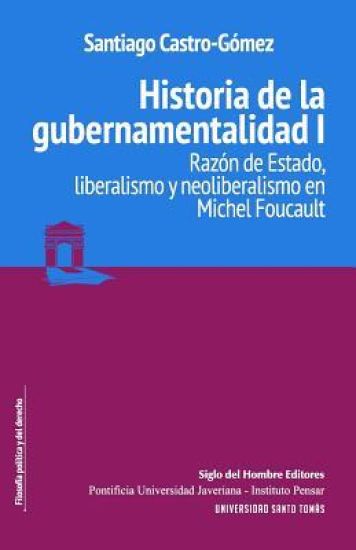
Historia de la gubernamentalidad I: Razón de Estado, liberalismo y neoliberalismo en Michel Foucault
Las lecciones de 1978 y 1979 dictadas por Foucault en el Coll ge de France ocupan un lugar singular en el conjunto de la obra del filosofo. Estos cursos representan una ruptura frente al trabajo que Foucault ven a realizando en la d cada de los setenta, y esto por lo menos de tres formas. Primero, porque en estas lecciones, como en ninguna otra parte del corpus foucaultiano, se lleva a cabo una reflexi n sobre el Estado. Segundo, porque estas lecciones son el nico lugar de toda su obra donde se reflexiona sobre la racionalidad pol tica contempor nea. Y tercero, porque en ellas Foucault "anuncia" el giro investigativo que tomar an sus ltimas obras sobre la tica del mundo greco-romano.