

Kirjailija
Sarah Hayes
Kirjat ja teokset yhdessä paikassa: 12 kirjaa, julkaisuja vuosilta 2014-2026, suosituimpien joukossa The Fruitful Woman. Vertaile teosten hintoja ja tarkista saatavuus suomalaisista kirjakaupoista.
12 kirjaa
Kirjojen julkaisuhaarukka 2014-2026.
This book challenges the notion that static principles of inclusive practice can be embedded and measured in Higher Education. It introduces the original concept of postdigital positionality as a dynamic lens through which inclusivity policies in universities might be reimagined. Much is written about Equality, Diversity and Inclusion (EDI) based on an assumption that such principles are already ‘established’ in educational institutions, to ensure fairness and opportunity for all. In this book, readers are asked: what does an airing cupboard have in common with ‘cancel culture’? This opens a provocative debate concerning the disconnect between EDI policy agendas and the widespread digitalisation of society. Written as Covid-19 has converged with existing political economic spaces of technology, culture, data and digital poverty, Postdigital Positionality calls for more ecologically sustainable inclusivity policies.
Postdigital Positionality: Developing Powerful Inclusive Narratives for Learning, Teaching, Research and Policy in Higher Education
Sarah Hayes
BRILL
2021
sidottu
This book challenges the notion that static principles of inclusive practice can be embedded and measured in Higher Education. It introduces the original concept of postdigital positionality as a dynamic lens through which inclusivity policies in universities might be reimagined. Much is written about Equality, Diversity and Inclusion (EDI) based on an assumption that such principles are already 'established' in educational institutions, to ensure fairness and opportunity for all. In this book, readers are asked: what does an airing cupboard have in common with 'cancel culture'? This opens a provocative debate concerning the disconnect between EDI policy agendas and the widespread digitalisation of society. Written as Covid-19 has converged with existing political economic spaces of technology, culture, data and digital poverty, Postdigital Positionality calls for more ecologically sustainable inclusivity policies.

The Invisible Monster is always lurking in the dark. It may be dormant at times, but it's always there...My non-typical birth has paved the way for my entire non-typical life. I was born in a log cabin with no electricity or running water, then later moved to a teepee. Life happened, and I ended up in a Dayton ghetto. Life happened some more, which landed me in a small town in West Virginia. But everywhere I go, The Invisible Monster is always there. I am learning to slay my Monsters and have become quite fierce in the process. Try as it might, The Invisible Monster has no power over me. My story is not a story of hate. My story is not a story of trauma. My story is a story of HOPE. My story is a story of INSPIRATION. I'm telling my story to encourage others to shoot for the stars no matter what their reality is. I decided long ago I would not let my past dictate my future. From a two-year-old forest kid who was forced to perform oral sex; to a wife, mother, published author, model, actor, podcast host, and I'm just getting started. We all have the power to create the life we want, and I am living proof. I'm not only surviving, I am thriving.

Being a naive, shy girl always worked in Maggie Liken's favor. That was until she met Dan Baker. The first guy to ever pay attention to her just happened to be the town's most sought after bachelor. Maggie, unable to resist his charm and good looks, falls hard and fast in love with him. Little did she know, Dan is dangerous. The morning she awakes with a busted lip, black eye, and red marks around her neck, she makes excuses. Maybe she provoked him. Maybe she should have slept with him. Maybe she can fix him, but the incidents keeping occurring making it harder and harder to deny the truth. He said he was sorry, and he'd never do it again, but was that enough? She finds herself caught between wanting to believe he could change and fearing for her life, knowing he never would. She could forgive, but was she able to forget?
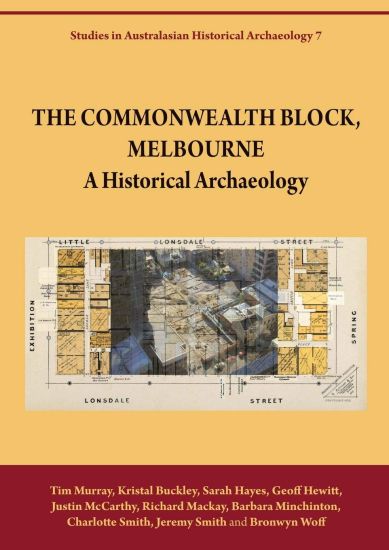
The Commonwealth Block, Melbourne
Tim Murray; Kristal Buckley; Sarah Hayes; Geoff Hewitt; Justin McCarthy; Richard Mackay; Barbara Minchinton; Charlotte Smith; Jeremy Smith; Bronwyn Woff
Sydney University Press
2019
nidottu
For much of the 19th and 20th centuries, Melbourne’s Little Lonsdale Street – locally known as ‘Little Lon’ – was notorious as a foul slum and brothel district, occupied by the itinerant and the criminal. The stereotype of ‘slumdom’ defined ‘Little Lon’ in the minds of Melbournians, and became entrenched in Australian literature and popular culture.The Commonwealth Block, Melbourne tells a different story. This groundbreaking book reports on almost three decades of excavations conducted on the Commonwealth Block – the area of central Melbourne bordered by Little Lonsdale, Lonsdale, Exhibition and Spring streets. Since the 1980s, archaeologists and historians have pieced together the rich and complex history of this area, revealing a working-class and immigrant community that was much more than just a slum. The Commonwealth Block, Melbourne delves into the complex social, cultural and economic history of this forgotten community.
As Higher Education has come to be valued for its direct contribution to the global economy, university policy discourse has reinforced this rationale. In The Labour of Words in Higher Education: Is it Time to Reoccupy Policy? two globes are depicted. One is a beautiful, but complete artefact, that markets a UK university. The second sits on a European city street and is continually inscribed with the markings of passers-by. A distinction is drawn between the rhetoric of university McPolicy, as a discourse that appears to no longer require input from humans, and a more authentic approach to writing policy, that acknowledges the academic labour of staff and students, in effecting change. Inspired by the work of George Ritzer on the McDonaldisation of Society, the term McPolicy is adopted by the author, to describe a rational method of writing policy, now widespread across UK universities. Recent strategies on ‘the student experience’, ‘technology enhanced learning’, ‘student engagement’ and ‘employability’ are explored through a corpus-based Critical Discourse Analysis (CDA). Findings are humourously compared to the marketing of consumer goods, where commodities like cars are invested with human qualities, such as ‘ambition’. Similarly, McPolicy credits non-human strategies, technologies and a range of socially constructed buzz phrases, with the human qualities and labour activities that would normally be enacted by staff and students. This book is written for anyone with an interest in the future of universities. It concludes with suggestions of ways we might all reoccupy McPolicy.
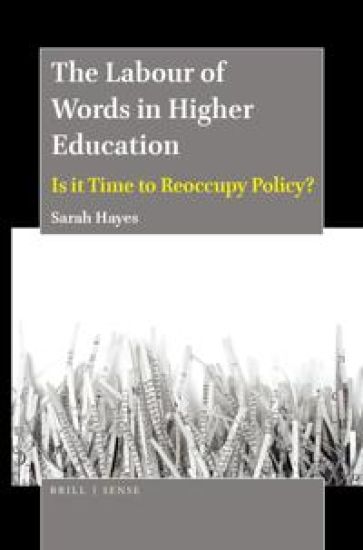
The Labour of Words in Higher Education: Is It Time to Reoccupy Policy?
Sarah Hayes
BRILL
2019
sidottu
As Higher Education has come to be valued for its direct contribution to the global economy, university policy discourse has reinforced this rationale. In The Labour of Words in Higher Education: Is it Time to Reoccupy Policy? two globes are depicted. One is a beautiful, but complete artefact, that markets a UK university. The second sits on a European city street and is continually inscribed with the markings of passers-by. A distinction is drawn between the rhetoric of university McPolicy, as a discourse that appears to no longer require input from humans, and a more authentic approach to writing policy, that acknowledges the academic labour of staff and students, in effecting change. Inspired by the work of George Ritzer on the McDonaldisation of Society, the term McPolicy is adopted by the author, to describe a rational method of writing policy, now widespread across UK universities. Recent strategies on 'the student experience', 'technology enhanced learning', 'student engagement' and 'employability' are explored through a corpus-based Critical Discourse Analysis (CDA). Findings are humourously compared to the marketing of consumer goods, where commodities like cars are invested with human qualities, such as 'ambition'. Similarly, McPolicy credits non-human strategies, technologies and a range of socially constructed buzz phrases, with the human qualities and labour activities that would normally be enacted by staff and students. This book is written for anyone with an interest in the future of universities. It concludes with suggestions of ways we might all reoccupy McPolicy.
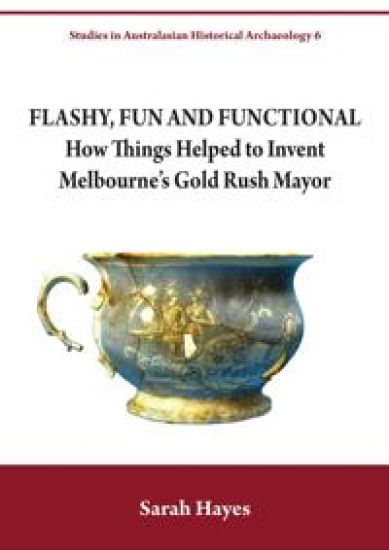
Against the backdrop of embryonic Melbourne, John Thomas Smith left behind his currency roots to become an influential member of society. A widely recognised figure about town smoking a cutty pipe and wearing a white top hat, in 1851 he became Lord Mayor of Melbourne; he went on to be re-elected seven times. His scandalous marriage to the daughter of an Irish Catholic publican, however, and his awkwardly appropriated gentility, made him unpopular with certain sections of society. From 1849 to 1860 Smith and his family occupied 300 Queen Street, Melbourne, one of the first true residential townhouses in the city. Flashy, Fun and Functional: How Things Helped to Invent Melbourne’s Gold Rush Mayor explores the things they left behind.Excavations at the site in 1982 by Judy Birmingham and Associates uncovered a rich and important archaeological record of the Smiths’ lives in the form of a cesspit rubbish deposit. The recovered artefacts can be used to examine the distinctive way the Smith family used material culture to negotiate their position in colonial society. Popular decoration styles and expensive materials suggest the family’s efforts to secure their newly obtained social status. The artefacts evoke the turmoil, volatility and opportunity of life in the first decades of the colony at Port Phillip. They provide an example of the possibility of social mobility in the colony, but also of the challenges of navigating the customs of a newly forming society.
Quantitative Research Methods for Linguists
Tim Grant; Urszula Clark; Gertrud Reershemius; Dave Pollard; Sarah Hayes; Garry Plappert
Routledge
2017
nidottu
Quantitative Research Methods for Linguistics provides an accessible introduction to research methods for undergraduates undertaking research for the first time. Employing a task-based approach, the authors demonstrate key methods through a series of worked examples, allowing students to take a learn-by-doing approach and making quantitative methods less daunting for the novice researcher.Key features include: Chapters framed around real research questions, walking the student step-by-step through the various methods;Guidance on how to design your own research project;Basic questions and answers that every new researcher needs to know;A comprehensive glossary that makes the most technical of terms clear to readers;Coverage of different statistical packages including R and SPSS.Quantitative Research Methods for Linguistics is essential reading for all students undertaking degrees in linguistics and English language studies.

Quantitative Research Methods for Linguists
Tim Grant; Urszula Clark; Gertrud Reershemius; Dave Pollard; Sarah Hayes; Garry Plappert
Routledge
2017
sidottu
Quantitative Research Methods for Linguistics provides an accessible introduction to research methods for undergraduates undertaking research for the first time. Employing a task-based approach, the authors demonstrate key methods through a series of worked examples, allowing students to take a learn-by-doing approach and making quantitative methods less daunting for the novice researcher.Key features include: Chapters framed around real research questions, walking the student step-by-step through the various methods;Guidance on how to design your own research project;Basic questions and answers that every new researcher needs to know;A comprehensive glossary that makes the most technical of terms clear to readers;Coverage of different statistical packages including R and SPSS.Quantitative Research Methods for Linguistics is essential reading for all students undertaking degrees in linguistics and English language studies.
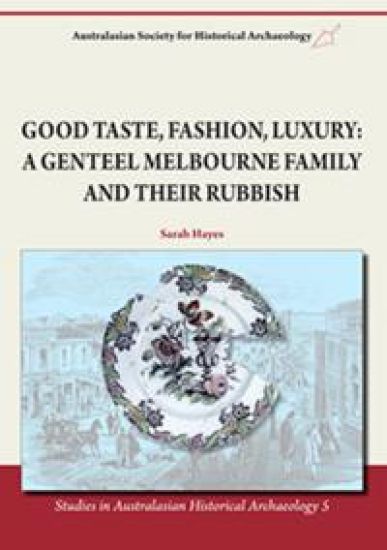
Melbourne grew during the 19th century from its fledgling roots into a global metropolitan centre, and was home to many people from a range of social and cultural backgrounds. The Martin family arrived in Melbourne in 1839 and soon established themselves at the genteel Viewbank estate near Heidelberg.They were typical of the early, middle-class immigrants to Melbourne who brought their gentility and privilege with them to the colony. The Martins spent many years at Viewbank, and the physical remains they left behind provide a valuable case study for examining class negotiation in the colony through historical archaeology. In this important study, material culture is used to understand the unique way in which the Martin family used gentility to establish and maintain their class position.