Kirjojen hintavertailu. Mukana 12 595 353 kirjaa ja 12 kauppaa.

Kirjailija

Scott A. Vanstone

Kirjat ja teokset yhdessä paikassa: 5 kirjaa, julkaisuja vuosilta 1989-2011, suosituimpien joukossa An Introduction to Error Correcting Codes with Applications. Vertaile teosten hintoja ja tarkista saatavuus suomalaisista kirjakaupoista.

5 kirjaa

Kirjojen julkaisuhaarukka 1989-2011.

An Introduction to Error Correcting Codes with Applications

An Introduction to Error Correcting Codes with Applications

Scott A. Vanstone; Paul C. van Oorschot

Springer-Verlag New York Inc.
2011
nidottu
5. 2 Rings and Ideals 148 5. 3 Ideals and Cyclic Subspaces 152 5. 4 Generator Matrices and Parity-Check Matrices 159 5. 5 Encoding Cyclic Codest 163 5. 6 Syndromes and Simple Decoding Procedures 168 5. 7 Burst Error Correcting 175 5. 8 Finite Fields and Factoring xn-l over GF(q) 181 5. 9 Another Method for Factoring xn-l over GF(q)t 187 5. 10 Exercises 193 Chapter 6 BCH Codes and Bounds for Cyclic Codes 6. 1 Introduction 201 6. 2 BCH Codes and the BCH Bound 205 6. 3 Bounds for Cyclic Codest 210 6. 4 Decoding BCH Codes 215 6. 5 Linearized Polynomials and Finding Roots of Polynomialst 224 6. 6 Exercises 231 Chapter 7 Error Correction Techniques and Digital Audio Recording 7. 1 Introduction 237 7. 2 Reed-Solomon Codes 237 7. 3 Channel Erasures 240 7. 4 BCH Decoding with Erasures 244 7. 5 Interleaving 250 7. 6 Error Correction and Digital Audio Recording 256 7.
Applications of Finite Fields

Applications of Finite Fields

Alfred J. Menezes; Ian F. Blake; Ronald C. Mullin; Scott A. Vanstone; Tomik Yaghoobian

Springer-Verlag New York Inc.
2010
nidottu
The theory of finite fields, whose origins can be traced back to the works of Gauss and Galois, has played a part in various branches in mathematics. Inrecent years we have witnessed a resurgence of interest in finite fields, and this is partly due to important applications in coding theory and cryptography. The purpose of this book is to introduce the reader to some of these recent developments. It should be of interest to a wide range of students, researchers and practitioners in the disciplines of computer science, engineering and mathematics. We shall focus our attention on some specific recent developments in the theory and applications of finite fields. While the topics selected are treated in some depth, we have not attempted to be encyclopedic. Among the topics studied are different methods of representing the elements of a finite field (including normal bases and optimal normal bases), algorithms for factoring polynomials over finite fields, methods for constructing irreducible polynomials, the discrete logarithm problem and its implications to cryptography, the use of elliptic curves in constructing public key cryptosystems, and the uses of algebraic geometry in constructing good error-correcting codes. To limit the size of the volume we have been forced to omit some important applications of finite fields. Some of these missing applications are briefly mentioned in the Appendix along with some key references.
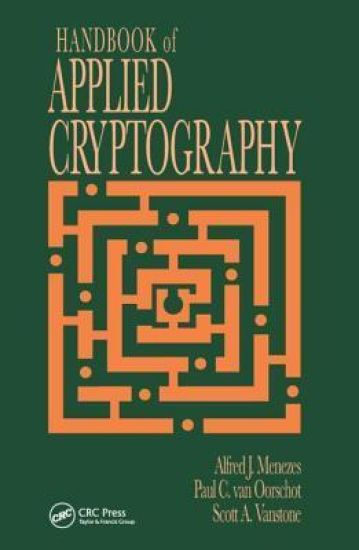
Handbook of Applied Cryptography

Handbook of Applied Cryptography

Alfred J. Menezes; Paul C. van Oorschot; Scott A. Vanstone

CRC Press Inc
1996
sidottu
Cryptography, in particular public-key cryptography, has emerged in the last 20 years as an important discipline that is not only the subject of an enormous amount of research, but provides the foundation for information security in many applications. Standards are emerging to meet the demands for cryptographic protection in most areas of data communications. Public-key cryptographic techniques are now in widespread use, especially in the financial services industry, in the public sector, and by individuals for their personal privacy, such as in electronic mail. This Handbook will serve as a valuable reference for the novice as well as for the expert who needs a wider scope of coverage within the area of cryptography. It is a necessary and timely guide for professionals who practice the art of cryptography. The Handbook of Applied Cryptography provides a treatment that is multifunctional:It serves as an introduction to the more practical aspects of both conventional and public-key cryptography It is a valuable source of the latest techniques and algorithms for the serious practitioner It provides an integrated treatment of the field, while still presenting each major topic as a self-contained unit It provides a mathematical treatment to accompany practical discussions It contains enough abstraction to be a valuable reference for theoreticians while containing enough detail to actually allow implementation of the algorithms discussedNow in its third printing, this is the definitive cryptography reference that the novice as well as experienced developers, designers, researchers, engineers, computer scientists, and mathematicians alike will use.
Applications of Finite Fields

Applications of Finite Fields

Alfred J. Menezes; Ian F. Blake; Ronald C. Mullin; Scott A. Vanstone; Tomik Yaghoobian

Springer
1992
sidottu
The theory of finite fields, whose origins can be traced back to the works of Gauss and Galois, has played a part in various branches in mathematics. Inrecent years we have witnessed a resurgence of interest in finite fields, and this is partly due to important applications in coding theory and cryptography. The purpose of this book is to introduce the reader to some of these recent developments. It should be of interest to a wide range of students, researchers and practitioners in the disciplines of computer science, engineering and mathematics. We shall focus our attention on some specific recent developments in the theory and applications of finite fields. While the topics selected are treated in some depth, we have not attempted to be encyclopedic. Among the topics studied are different methods of representing the elements of a finite field (including normal bases and optimal normal bases), algorithms for factoring polynomials over finite fields, methods for constructing irreducible polynomials, the discrete logarithm problem and its implications to cryptography, the use of elliptic curves in constructing public key cryptosystems, and the uses of algebraic geometry in constructing good error-correcting codes. To limit the size of the volume we have been forced to omit some important applications of finite fields. Some of these missing applications are briefly mentioned in the Appendix along with some key references.
An Introduction to Error Correcting Codes with Applications

An Introduction to Error Correcting Codes with Applications

Scott A. Vanstone; Paul C. van Oorschot

Springer
1989
sidottu
5. 2 Rings and Ideals 148 5. 3 Ideals and Cyclic Subspaces 152 5. 4 Generator Matrices and Parity-Check Matrices 159 5. 5 Encoding Cyclic Codest 163 5. 6 Syndromes and Simple Decoding Procedures 168 5. 7 Burst Error Correcting 175 5. 8 Finite Fields and Factoring xn-l over GF(q) 181 5. 9 Another Method for Factoring xn-l over GF(q)t 187 5. 10 Exercises 193 Chapter 6 BCH Codes and Bounds for Cyclic Codes 6. 1 Introduction 201 6. 2 BCH Codes and the BCH Bound 205 6. 3 Bounds for Cyclic Codest 210 6. 4 Decoding BCH Codes 215 6. 5 Linearized Polynomials and Finding Roots of Polynomialst 224 6. 6 Exercises 231 Chapter 7 Error Correction Techniques and Digital Audio Recording 7. 1 Introduction 237 7. 2 Reed-Solomon Codes 237 7. 3 Channel Erasures 240 7. 4 BCH Decoding with Erasures 244 7. 5 Interleaving 250 7. 6 Error Correction and Digital Audio Recording 256 7.