Kirjojen hintavertailu. Mukana 12 595 353 kirjaa ja 12 kauppaa.

Kirjailija

Scott Gates

Kirjat ja teokset yhdessä paikassa: 9 kirjaa, julkaisuja vuosilta 1997-2022, suosituimpien joukossa Working, Shirking, and Sabotage. Vertaile teosten hintoja ja tarkista saatavuus suomalaisista kirjakaupoista.

9 kirjaa

Kirjojen julkaisuhaarukka 1997-2022.

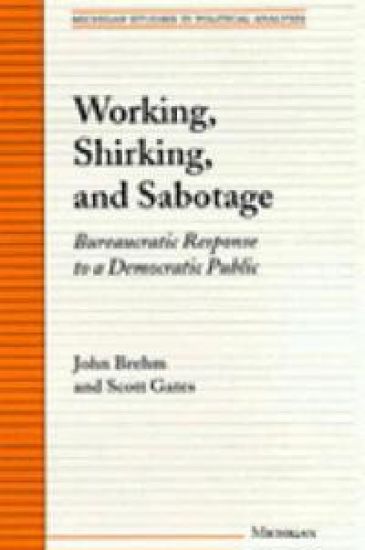
Working, Shirking, and Sabotage

Working, Shirking, and Sabotage

John O. Brehm; Scott Gates

The University of Michigan Press
1999
nidottu
Bureaucrats perform most of the tasks of government, profoundly influencing the daily lives of Americans. But who, or what, controls what bureaucrats do?John Brehm and Scott Gates examine who influences whether federal, state, and local bureaucrats work, shirk, or sabotage policy. The authors combine deductive models and computer simulations of bureaucratic behavior with statistical analysis in order to assess the competing influences over how bureaucrats expend their efforts. Drawing upon surveys, observational studies, and administrative records of the performance of public employees in a variety of settings, Brehm and Gates demonstrate that the reasons bureaucrats work as hard as they do include the nature of the jobs they are recruited to perform and the influence of both their fellow employees and their clients in the public. In contrast to the conclusions of principal-agency models, the authors show that the reasons bureaucrats work so hard have little to do with the coercive capacities of supervisors.This book is aimed at students of bureaucracy and organizations and will be of interest to researchers in political science, economics, public policy, and sociology."This book is breathtaking in its use of models and techniques. . . . The approach developed by Brehm and Gates allows us to re-open empirical questions that have lain dormant for years." --Bryan D. Jones, University of WashingtonJohn Brehm is Associate Professor of Political Science, Duke University. Scott Gates is Associate Professor of Political Science, Michigan State University.
Hard Road South

Hard Road South

Scott Gates

Blue Ink Press
2020
nidottu
The Civil War is over. Soldiers have returned home, and families have begun to piece their lives back together. But for Union Army veteran Solomon Dykes, there is no kin waiting; his Connecticut home holds no promise. He hopes to make a fresh start in Virginia, where he can farm a piece of land and start a family. But the contentious times don't favor such ambition. Dykes settles near Jeb Mosby, a Virginia native farming his family's land near the town of Middleburg. Under different circumstances, the pair might have been fast friends. But with the community still reeling from the stinging defeat of the war, all Northerners are cast under suspicion. Dykes is no exception. Mosby finds himself torn between his faith in humanity and an allegiance to his small town, while Dykes begins to doubt his future as a farmer and finds himself drawn to the cause of the newly freed slaves. The battlefields may have cooled, but passions still run hot in this turbulent era of societal change. Both Dykes and Mosby learn even the smallest actions can carry far-reaching consequences, sending each on a collision course with tragedy.
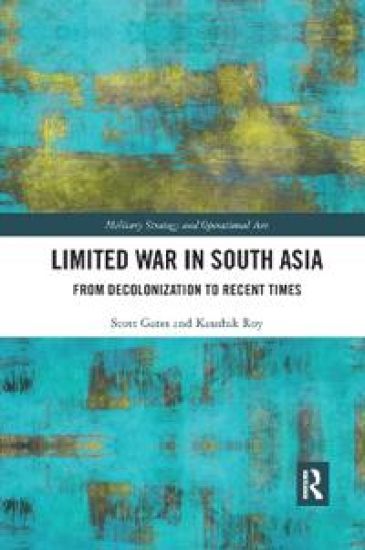
Limited War in South Asia

Limited War in South Asia

Scott Gates; Kaushik Roy

Routledge
2019
nidottu
This book examines the origins, courses and consequences of conventional wars in post-colonial South Asia. Although South Asia has experienced large-scale conventional warfare on several occasions since the end of World War II, there is an almost total neglect of analysis of conventional warfare in the Indian subcontinent. Focusing on China, India and Pakistan, this volume, therefore, takes a unique approach. Regional rivalries between India and Pakistan are linked with global rivalries between the US and USSR (later Russia) and then China, and war is defined in a broader perspective. The book analyses the conduct of land, sea and air warfare, as well as the causes and consequences of conflicts. Tactical conduct of warfare (the nature of mobile armoured strikes and static linear infantry combat supported by heavy artillery) and generalship are studied along with military strategy, doctrine and grand strategy (national security policy), which is an amalgam of diplomacy, military strategy and economic policy. While following a realpolitik approach, this book blends the development of military strategies and doctrines with the religious and cultural ethos of the subcontinent’s inhabitants. Drawing on sources not easily accessible to Western scholars, the overall argument put forward by this work is that conventional warfare has been limited in South Asia from the very beginning for reasons both cultural and realpolitik.This book will be of much interest to students of South Asian politics, security studies, war and conflict studies, military studies and International Relations in general.
Limited War in South Asia

Limited War in South Asia

Scott Gates; Kaushik Roy

Ashgate Publishing Limited
2017
sidottu
This book examines the origins, courses and consequences of conventional wars in post-colonial South Asia. Although South Asia has experienced large-scale conventional warfare on several occasions since the end of World War II, there is an almost total neglect of analysis of conventional warfare in the Indian subcontinent. Focusing on China, India and Pakistan, this volume, therefore, takes a unique approach. Regional rivalries between India and Pakistan are linked with global rivalries between the US and USSR (later Russia) and then China, and war is defined in a broader perspective. The book analyses the conduct of land, sea and air warfare, as well as the causes and consequences of conflicts. Tactical conduct of warfare (the nature of mobile armoured strikes and static linear infantry combat supported by heavy artillery) and generalship are studied along with military strategy, doctrine and grand strategy (national security policy), which is an amalgam of diplomacy, military strategy and economic policy. While following a realpolitik approach, this book blends the development of military strategies and doctrines with the religious and cultural ethos of the subcontinent’s inhabitants. Drawing on sources not easily accessible to Western scholars, the overall argument put forward by this work is that conventional warfare has been limited in South Asia from the very beginning for reasons both cultural and realpolitik.This book will be of much interest to students of South Asian politics, security studies, war and conflict studies, military studies and International Relations in general.
Unconventional Warfare in South Asia

Unconventional Warfare in South Asia

Scott Gates; Kaushik Roy

Routledge
2016
nidottu
India is the world's tenth largest economy and possesses the world's fourth largest military. The subcontinent houses about one-fifth of the world's population and its inhabitants are divided into various tribes, clans and ethnic groups following four great religions: Buddhism, Christianity, Hinduism, and Islam. Framing the debate using case studies from across the region as well as China, Afghanistan and Burma and using a wealth of primary and secondary sources this incisive volume takes a closer look at the organization and doctrines of the 'shadow armies' and the government forces which fight the former. Arranged in a thematic manner, each chapter critically asks; Why stateless marginal groups rebel? How do states attempt to suppress them? What are the consequences in the aftermath of the conflict especially in relation to conflict resolution and peace building? Unconventional Warfare in South Asia is a welcomed addition to the growing field of interest on civil wars and insurgencies in South Asia. An indispensable read which will allow us to better understand whether South Asia is witnessing a 'New War' and whether the twenty-first century belongs to the insurgents.
Unconventional Warfare in South Asia

Unconventional Warfare in South Asia

Scott Gates; Kaushik Roy

Ashgate Publishing Limited
2014
sidottu
India is the world's tenth largest economy and possesses the world's fourth largest military. The subcontinent houses about one-fifth of the world's population and its inhabitants are divided into various tribes, clans and ethnic groups following four great religions: Buddhism, Christianity, Hinduism, and Islam. Framing the debate using case studies from across the region as well as China, Afghanistan and Burma and using a wealth of primary and secondary sources this incisive volume takes a closer look at the organization and doctrines of the 'shadow armies' and the government forces which fight the former. Arranged in a thematic manner, each chapter critically asks; Why stateless marginal groups rebel? How do states attempt to suppress them? What are the consequences in the aftermath of the conflict especially in relation to conflict resolution and peace building? Unconventional Warfare in South Asia is a welcomed addition to the growing field of interest on civil wars and insurgencies in South Asia. An indispensable read which will allow us to better understand whether South Asia is witnessing a 'New War' and whether the twenty-first century belongs to the insurgents.
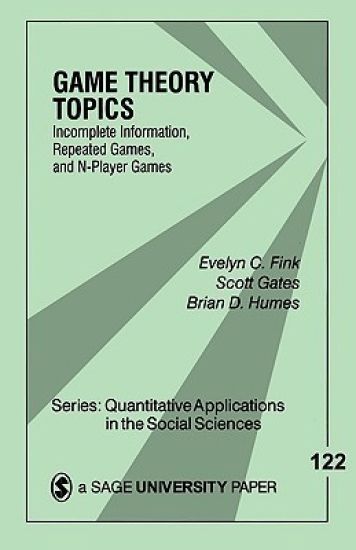
Game Theory Topics

Game Theory Topics

Evelyn C. Fink; Scott Gates; Brian D. Humes

SAGE Publications Inc
1998
nidottu
Game theory, particularly the use of repeated games, N-person games, and incomplete information games have been popular research techniques in political science, sociology, and managementùbut difficult for new social researchers to useùuntil now. Aimed at making these topics accessible to all social scientist, Game Theory Topics shows how game theory can be productively applied to problems in the social sciences. Using a common social science gameùChickenùto illustrate game theory concepts, the authors introduce readers to games of incomplete information; how to build uncertainty into game theoretic models; the concept of Bayesian Nash equilibrium; and the role of repetition in game theory, including how game theoretic models can easily accommodate many players. Throughout the book, the authors use applications to social science problems to illustrate the points being developed in each chapter.
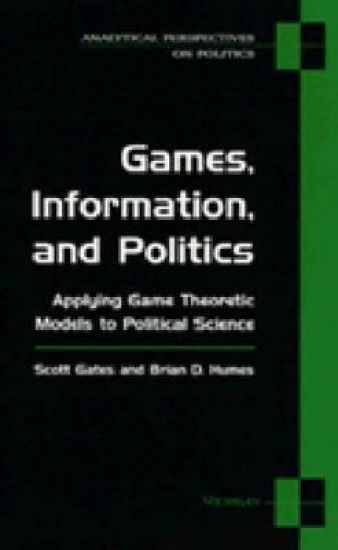
Games, Information, and Politics

Games, Information, and Politics

Scott Gates; Brian D. Humes

The University of Michigan Press
1997
nidottu
To study the strategic interaction of individuals, we can use game theory. Despite the long history shared by game theory and political science, many political scientists remain unaware of the exciting game theoretic techniques that have been developed over the years. As a result they use overly simple games to illustrate complex processes. Games, Information, and Politics is written for political scientists who have an interest in game theory but really do not understand how it can be used to improve our understanding of politics. To address this problem, Gates and Humes write for scholars who have little or no training in formal theory and demonstrate how game theoretic analysis can be applied to politics. They apply game theoretic models to three subfields of political science: American politics, comparative politics, and international relations. They demonstrate how game theory can be applied to each of these subfields by drawing from three distinct pieces of research. By drawing on examples from current research projects the authors use real research problems--not hypothetical questions--to develop their discussion of various techniques and to demonstrate how to apply game theoretic models to help answer important political questions. Emphasizing the process of applying game theory, Gates and Humes clear up some common misperceptions about game theory and show how it can be used to improve our understanding of politics.Games, Information, and Politics is written for scholars interested in understanding how game theory is used to model strategic interactions. It will appeal to sociologists and economists as well as political scientists. Scott Gates is Assistant Professor of Political Science, Michigan State University. Brian D. Humes is Associate Professor of Political Science, University of Nebraska-Lincoln.