Kirjojen hintavertailu. Mukana 12 390 323 kirjaa ja 12 kauppaa.

Kirjailija

Scott J. Peters

Kirjat ja teokset yhdessä paikassa: 9 kirjaa, julkaisuja vuosilta 2013-2021, suosituimpien joukossa Beyond Gifted Education. Vertaile teosten hintoja ja tarkista saatavuus suomalaisista kirjakaupoista.

9 kirjaa

Kirjojen julkaisuhaarukka 2013-2021.

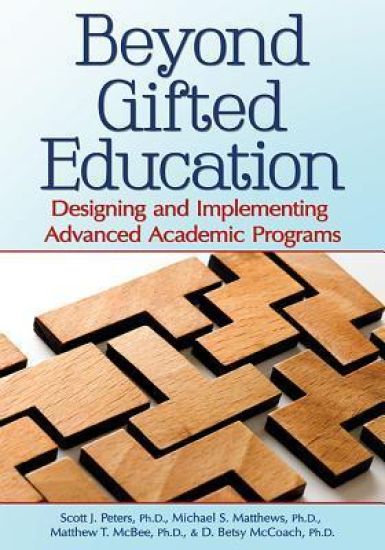
Beyond Gifted Education

Beyond Gifted Education

Scott J. Peters; Michael S. Matthews; Matthew T. McBee; D. Betsy McCoach

Prufrock Press
2013
nidottu
Seeking a more comprehensive vision for gifted education, this book offers a modern vision of programs and services for gifted and talented students. Beyond Gifted Education: Designing and Implementing Advanced Academic Programs provides the first comprehensive look at designing and implementing advanced academic student programs.Written by four leading experts in the field, Beyond Gifted Education reviews the current range of traditional gifted education practices and policies. Then, the book offers the concerned gifted program coordinator or school administrator a more expansive approach to educating gifted learners. The authors lead readers through the process of identifying needs, responding with programming, and then finding students who are well-suited for and would benefit from advanced academic programming. Detailed examples walk the reader through real-world scenarios and programs common to the gifted coordinator on topics such as cluster grouping, acceleration, and increasing diversity. Throughout the book, connections are made to Common Core State Standards, Response to Intervention, and a wealth of outside research in order to support ideas.
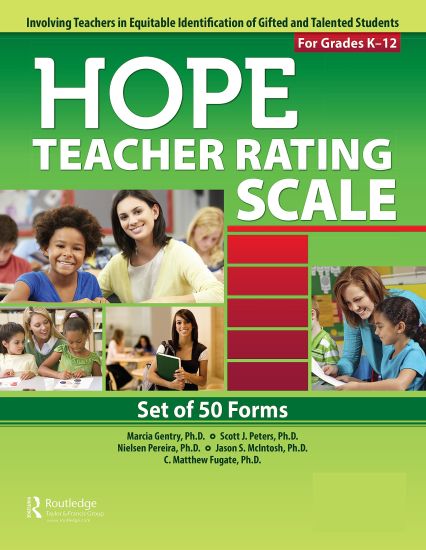
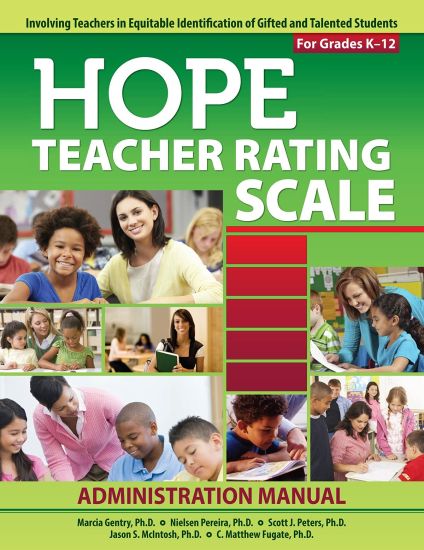
HOPE Teacher Rating Scale Kit

HOPE Teacher Rating Scale Kit

Marcia Gentry; Nielsen Pereira; Scott J. Peters; Jason S. McIntosh; C. Matthew Fugate

TAYLOR FRANCIS INC
2021
muu
The HOPE Teacher Rating Scale is designed to help guide teachers in identifying gifted students for programming. It is unique in several ways. First, it is short, with only 11 items that measure academic and social/affective components of giftedness, making it easy to use. Second, it is invariant when used to identify students from low-income and culturally diverse families. Third, it can be used across grade levels, K-12. Finally, local norms ensure that the data are relevant to the specific school populations. With multiple measures and multiple pathways crucial for reversing the inequities in identifying culturally, economically, and linguistically diverse students, a teacher-nomination instrument like the HOPE Teacher Rating Scale is an important component of identification systems. The HOPE Teacher Rating Scale items have been well-developed and subjected to research using more than 12,000 diverse students in five validity studies to date. The manual is useful in understanding and interpreting the electronic scores generated from teachers' ratings of their students. This instrument is a must-have for any administrator or gifted-program coordinator involved in student identification. The kit includes the manual and 50 forms. To explore the full collection of HOPE print and online resources, please visit: https://www.routledge.com/go/hope-teacher-rating-scales.
In the Struggle

In the Struggle

Daniel J. O'Connell; Scott J. Peters

New Village Press
2021
sidottu
A call to action in an ongoing battle against industrial agriculture From the early twentieth century and across generations to the present, In the Struggle brings together the stories of eight politically engaged scholars, documenting their opposition to industrial-scale agribusiness in California. As the narrative unfolds, their previously censored and suppressed research, together with personal accounts of intimidation and subterfuge, is introduced into the public arena for the first time. In the Struggle lays out historic, subterranean confrontations over water rights, labor organizing, and the corruption of democratic principles and public institutions. As California's rural economy increasingly consolidates into the hands of land barons and corporations, the scholars' work shifts from analyzing problems and formulating research methods to organizing resistance and building community power. Throughout their engagement, they face intense political blowback as powerful economic interests work to pollute and undermine scientific inquiry and the civic purposes of public universities. The findings and the pressure put upon the work of these scholars—Paul Taylor, Ernesto Galarza, and Isao Fujimoto among them—are a damning indictment of the greed and corruption that flourish under industrial-scale agriculture. After almost a century of empirical evidence and published research, a definitive finding becomes clear: land consolidation and economic monopoly are fundamentally detrimental to democracy and the well-being of rural societies.
In the Struggle

In the Struggle

Daniel J. O'Connell; Scott J. Peters

New Village Press
2021
pokkari
A call to action in an ongoing battle against industrial agriculture From the early twentieth century and across generations to the present, In the Struggle brings together the stories of eight politically engaged scholars, documenting their opposition to industrial-scale agribusiness in California. As the narrative unfolds, their previously censored and suppressed research, together with personal accounts of intimidation and subterfuge, is introduced into the public arena for the first time. In the Struggle lays out historic, subterranean confrontations over water rights, labor organizing, and the corruption of democratic principles and public institutions. As California's rural economy increasingly consolidates into the hands of land barons and corporations, the scholars' work shifts from analyzing problems and formulating research methods to organizing resistance and building community power. Throughout their engagement, they face intense political blowback as powerful economic interests work to pollute and undermine scientific inquiry and the civic purposes of public universities. The findings and the pressure put upon the work of these scholars—Paul Taylor, Ernesto Galarza, and Isao Fujimoto among them—are a damning indictment of the greed and corruption that flourish under industrial-scale agriculture. After almost a century of empirical evidence and published research, a definitive finding becomes clear: land consolidation and economic monopoly are fundamentally detrimental to democracy and the well-being of rural societies.
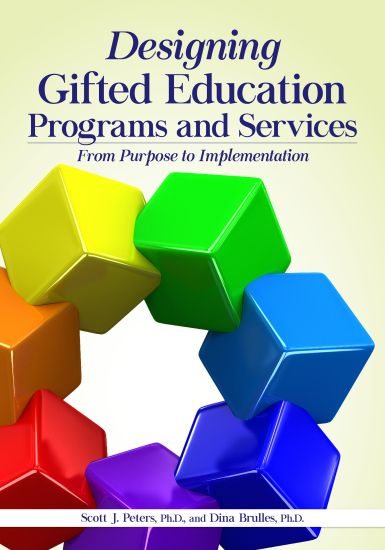
Designing Gifted Education Programs and Services

Designing Gifted Education Programs and Services

Scott J. Peters; Dina Brulles

Prufrock Press
2017
nidottu
This book is intended to support educators in the design and implementation of comprehensive gifted education plans. From planning to actual implementation, this book takes the reader from goals and purpose to assessing student needs and program design. The authors begin with a broad overview of best practices in programming and services, highlighting connections to student needs, programming standards, and state laws. Their recommendations include philosophical, cultural, and practical considerations and data-based decision making. In this book, Peters and Brulles guide the reader through the process of determining the most optimal programming methods for schools to take based on their individual needs and circumstances. With this book, schools will be able to design and develop programs and/or services that lay the foundation necessary to ensure all students are appropriately challenged.
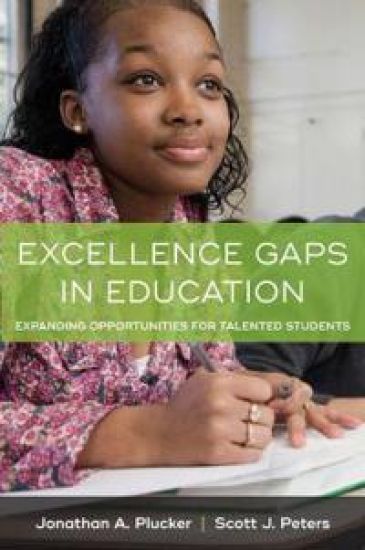
Excellence Gaps in Education

Excellence Gaps in Education

Jonathan A. Plucker; Scott J. Peters

Harvard Educational Publishing Group
2016
nidottu
In Excellence Gaps in Education, Jonathan A. Plucker and Scott J. Peters shine a spotlight on “excellence gaps”—the achievement gaps among subgroups of students performing at the highest levels of achievement. Much of the focus of recent education reform has been on closing gaps in achievement between students from different racial, ethnic, or socioeconomic backgrounds by bringing all students up to minimum levels of proficiency. Yet issues related to excellence gaps have been largely absent from discussions about how to improve our schools and communities. Plucker and Peters argue that these significant gaps reflect the existence of a persistent talent underclass in the United States among African American, Hispanic, Native American, and poor students, resulting in an incalculable loss of potential among our fastest growing populations.Drawing on the latest research and a wide range of national and international data, the authors outline the scope of the problem and make the case that excellence gaps should be targeted for elimination. They identify promising interventions for talent development already underway in schools and provide a detailed review of potential strategies, including universal screening, flexible grouping, targeted programs, and psychosocial interventions. Excellence Gaps in Education has the potential for changing our national conversation about equity and excellence and bringing fresh attention to the needs of high-potential students from underrepresented backgrounds.
Excellence Gaps in Education

Excellence Gaps in Education

Jonathan A. Plucker; Scott J. Peters

Harvard Educational Publishing Group
2016
sidottu
In Excellence Gaps in Education, Jonathan A. Plucker and Scott J. Peters shine a spotlight on “excellence gaps”—the achievement gaps among subgroups of students performing at the highest levels of achievement. Much of the focus of recent education reform has been on closing gaps in achievement between students from different racial, ethnic, or socioeconomic backgrounds by bringing all students up to minimum levels of proficiency. Yet issues related to excellence gaps have been largely absent from discussions about how to improve our schools and communities. Plucker and Peters argue that these significant gaps reflect the existence of a persistent talent underclass in the United States among African American, Hispanic, Native American, and poor students, resulting in an incalculable loss of potential among our fastest growing populations.Drawing on the latest research and a wide range of national and international data, the authors outline the scope of the problem and make the case that excellence gaps should be targeted for elimination. They identify promising interventions for talent development already underway in schools and provide a detailed review of potential strategies, including universal screening, flexible grouping, targeted programs, and psychosocial interventions. Excellence Gaps in Education has the potential for changing our national conversation about equity and excellence and bringing fresh attention to the needs of high-potential students from underrepresented backgrounds.
HOPE Teacher Rating Scale Forms

HOPE Teacher Rating Scale Forms

Marcia Gentry; Nielsen Pereira; Scott J. Peters; Jason S. McIntosh; C. Matthew Fugate

TAYLOR FRANCIS INC
2015
irtolehti
The HOPE Teacher Rating Scale is designed to help guide teachers in identifying gifted students for programming. It is unique in several ways. First, it is short, with only 11 items that measure academic and social/affective components of giftedness, making it easy to use. Second, it is invariant when used to identify students from low-income and culturally diverse families. Third, it can be used across grade levels, K-12. Finally, local norms ensure that the data are relevant to the specific school populations. With multiple measures and multiple pathways crucial for reversing the inequities in identifying culturally, economically, and linguistically diverse students, a teacher-nomination instrument like the HOPE Teacher Rating Scale is an important component of identification systems. The HOPE Teacher Rating Scale items have been well-developed and subjected to research using more than 12,000 diverse students in five validity studies to date. This instrument is a must-have for any administrator or gifted-program coordinator involved in student identification.To explore the full collection of HOPE print and online resources, please visit: https://www.routledge.com/go/hope-teacher-rating-scales.
HOPE Teacher Rating Scale

HOPE Teacher Rating Scale

Marcia Gentry; Nielsen Pereira; Scott J. Peters; Jason S. McIntosh; C. Matthew Fugate

TAYLOR FRANCIS INC
2015
nidottu
The HOPE Teacher Rating Scale is designed to help guide teachers in identifying gifted students for programming. It is unique in several ways. First, it is short, with only 11 items that measure academic and social/affective components of giftedness, making it easy to use. Second, it is invariant when used to identify students from low-income and culturally diverse families. Third, it can be used across grade levels, K-12. Finally, local norms ensure that the data are relevant to the specific school populations. With multiple measures and multiple pathways crucial for reversing the inequities in identifying culturally, economically, and linguistically diverse students, a teacher-nomination instrument like the HOPE Teacher Rating Scale is an important component of identification systems. The HOPE Teacher Rating Scale items have been well-developed and subjected to research using more than 12,000 diverse students in five validity studies to date. This manual is useful in understanding and interpreting the electronic scores generated from teachers' ratings of their students. This instrument is a must-have for any administrator or gifted-program coordinator involved in student identification.To explore the full collection of HOPE print and online resources, please visit: https://www.routledge.com/go/hope-teacher-rating-scales.