Kirjojen hintavertailu. Mukana 12 595 353 kirjaa ja 12 kauppaa.

Kirjailija

Scott Slovic

Kirjat ja teokset yhdessä paikassa: 12 kirjaa, julkaisuja vuosilta 2004-2026, suosituimpien joukossa Literature and the Environment: A Reader on Nature and Culture. Vertaile teosten hintoja ja tarkista saatavuus suomalaisista kirjakaupoista.

12 kirjaa

Kirjojen julkaisuhaarukka 2004-2026.

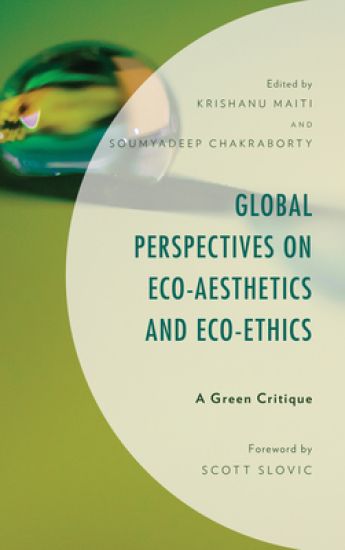
Global Perspectives on Eco-Aesthetics and Eco-Ethics
This volume focuses on the interface of the Anthropocene, sustainability, ecological aesthetics, multispecies relationality, and the environment as reflected in literature and culture. The work examines how writers have addressed ecological crises and environmental challenges that transcend national, cultural, political, social, and linguistic borders. The volume demonstrates how, as the environmental humanities developed and emerged as a critical discipline, it generated a diverse range of interdisciplinary fields of study, such as ecographics, ecodesign, ecocinema, ecotheology, ecofeminism, ethnobotany, ecolinguistics and bioregionalism, and formed valuable, interdisciplinary networks of critique and advocacy—and its contemporary expansion is exceptionally salient to social, political, and public issues today.
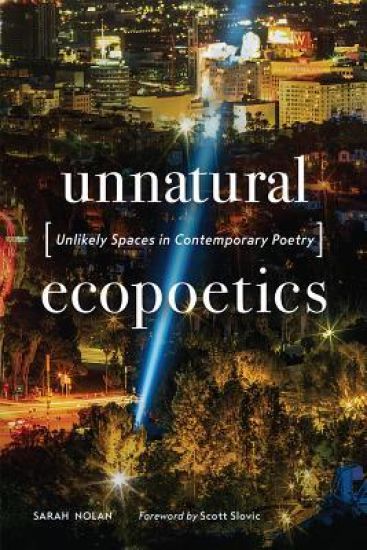
Unnatural Ecopoetics

Unnatural Ecopoetics

Sarah Nolan; Scott Slovic

University of Nevada Press
2017
sidottu
What constitutes an environment in American literature is an issue that has undergone much debate across environmental humanities in the last decade. In the field, some have argued that environments are markedly natural or wild sites while others contend literary spaces can be both wild and urban, or even cultural. Yet, few of the works produced to date have addressed the pronounced influence the author of a text has on a literary environment. Despite exciting work on materiality and culture in conceptions of environments, critics have not yet fully examined the contributions of poetry’s language, form, and self-awareness in rethinking what constitutes an environment. By approaching environments in a new way, Nolan closes this gap and recognizes how contemporary poets employ self-reflexive commentary and formal experimentation in order to create new natural/cultural environments on the page. She proposes a radical new direction for ecopoetics and deploys it in relation to four major American poets. Working from literal to textual spaces through the contemporary poetry of A.R. Ammons’s Garbage, Lyn Hejinian’s My Life, Susan Howe’s The Midnight, and Kenneth Goldsmith’s Seven American Deaths and Disasters, the book presents applications of unnatural ecopoetics in poetic environments, ones that do not engage with traditional ideas of nature and would otherwise remain outside the scope of ecocritical and ecopoetic studies. Nolan proposes a new practical approach for reading poetic language. Ecocriticism is a very fluid and evolving discipline, and Nolan’s pioneering new book pushes the boundaries of second-wave ecopoetics—the fundamental issue being what is nature/natural, and how does poetic language, particularly self-conscious contemporary poetic agency, contribute to and complicate that question.
New International Voices in Ecocriticism

New International Voices in Ecocriticism

Scott Slovic; Greta Gaard

Lexington Books
2016
nidottu
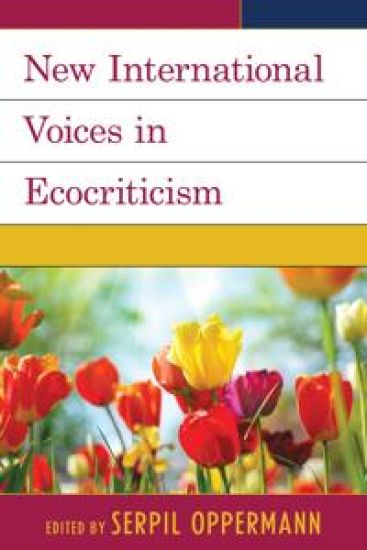
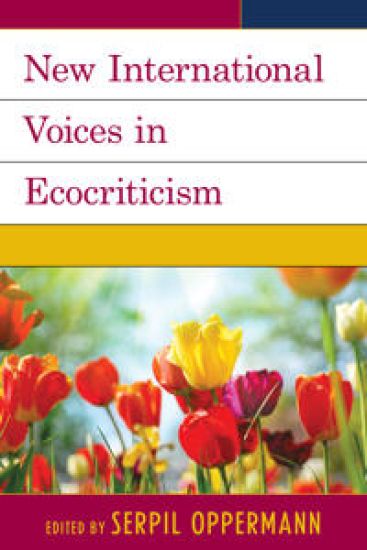
With twelve original essays that characterize truly international ecocriticisms, New International Voices in Ecocriticism presents a compendium of ecocritical approaches, including ecocritical theory, ecopoetics, ecocritical analyses of literary, cultural, and musical texts (especially those not commonly studied in mainstream ecocriticism), and new critical vistas on human-nonhuman relations, postcolonial subjects, material selves, gender, and queer ecologies. It develops new perspectives on literature, culture, and the environment. The essays, written by contributors from the United States, Canada, Germany, Turkey, Spain, China, India, and South Africa, cover novels, drama, autobiography, music, and poetry, mixing traditional and popular forms. Popular culture and the production and circulation of cultural imaginaries feature prominently in this volume—how people view their world and the manner in which they share their perspectives, including the way these perspectives challenge each other globally and locally. In this sense the book also probes borders, border transgression, and border permeability. By offering diverse ecocritical approaches, the essays affirm the significance and necessity of international perspectives in environmental humanities, and thus offer unique responses to environmental problems and that, in some sense, affect many beginning and established scholars.
New International Voices in Ecocriticism

New International Voices in Ecocriticism

Scott Slovic; Greta Gaard

Lexington Books
2014
sidottu
With twelve original essays that characterize truly international ecocriticisms, New International Voices in Ecocriticism presents a compendium of ecocritical approaches, including ecocritical theory, ecopoetics, ecocritical analyses of literary, cultural, and musical texts (especially those not commonly studied in mainstream ecocriticism), and new critical vistas on human-nonhuman relations, postcolonial subjects, material selves, gender, and queer ecologies. It develops new perspectives on literature, culture, and the environment. The essays, written by contributors from the United States, Canada, Germany, Turkey, Spain, China, India, and South Africa, cover novels, drama, autobiography, music, and poetry, mixing traditional and popular forms. Popular culture and the production and circulation of cultural imaginaries feature prominently in this volume—how people view their world and the manner in which they share their perspectives, including the way these perspectives challenge each other globally and locally. In this sense the book also probes borders, border transgression, and border permeability. By offering diverse ecocritical approaches, the essays affirm the significance and necessity of international perspectives in environmental humanities, and thus offer unique responses to environmental problems and that, in some sense, affect many beginning and established scholars.
Literature and the Environment: A Reader on Nature and Culture

Literature and the Environment: A Reader on Nature and Culture

Lorraine Anderson; Scott Slovic; John O'Grady

PEARSON
2012
nidottu
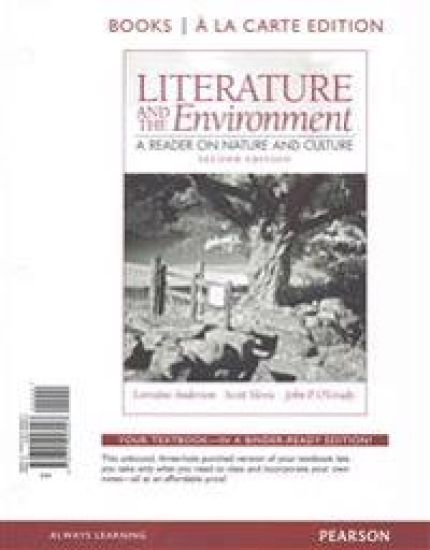
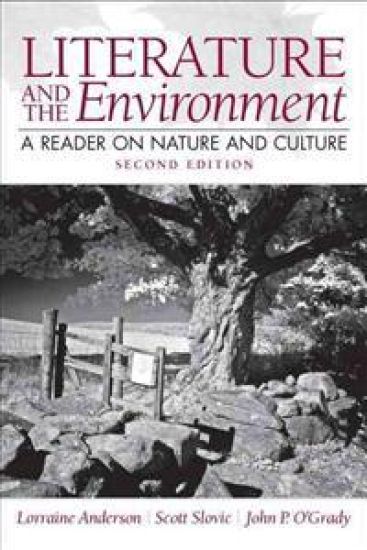
Exploring our relationship to nature and the role literature can play in shaping a culture responsive to environmental realities, this thematic, multi-genre anthology includes early writers such as John Muir, Henry David Thoreau, and Mary Austin, contemporary luminaries such as Gary Snyder and Terry Tempest Williams, and newer voices such as Michael Pollan and Sandra Steingraber.
Xerophilia

Xerophilia

Tom Lynch; Scott Slovic

Texas Tech Press,U.S.
2008
sidottu
The arid American Southwest is host to numerous organisms described as desert-loving, or xerophilous. Extending this term to include the regions writers and the works that mirror their love of desert places, Tom Lynch presents the first systematically ecocritical study of its multicultural literature. By revaluing nature and by shifting literary analysis from an anthropocentric focus to an ecocentric one, ""Xerophilia"" demonstrates how a bioregional orientation opens new ways of thinking about the relationship between literature and place. Applying such diverse approaches as environmental justice theory, phenomenology, border studies, ethnography, entomology, conservation biology, environmental history, and ecoaesthetics, Lynch demonstrates how a rooted literature can be symbiotic with the world that enables and sustains it. Analyzing works in a variety of genres by writers such as Leslie Marmon Silko, Terry Tempest Williams, Edward Abbey, Ray Gonzales, Charles Bowden, Susan Tweit, Gary Paul Nabhan, Pat Mora, Ann Zwinger, and Janice Emily Bowers, this study reveals how southwestern writers, in their powerful role as community storytellers, contribute to a sustainable bioregional culture that persuades inhabitants to live imaginatively, intellectually, and morally in the arid bioregions of the American Southwest. '[W]hether I notice or not, the landscape suffuses my body. Intermingled scents enter my lungs with each breath: dust, rock, juniper, turpentine bush, mountain mahogany, the heady mix of volatile oils of the creosote bush, and the ever-so-subtle odor of blue sky. Though less often articulated, all of my senses, not just vision, are engaged; the phenomena of this world circulate through me, and I through them. The landscape caresses as I pass through...On my feet again, I hobble from stiffness, throw my pack on, and, leaning on my sotol stalk for balance, begin to pick my way zigzag down the long rocky slope. I am in love with this landscape. I am, indeed, a devoted xerophile' - from the introduction.
In the Blast Zone

In the Blast Zone

Scott Slovic

Oregon State University
2008
nidottu
As it erupted in 1980, Mount St. Helens captured the attention of the region, nation, and the world, and it continues to fascinate us today? a constant reminder that we live in a volcanic landscape. In lucid prose and poetry by some of America?s leading writers and ecologists, In the Blast Zone explores this story of destruction and renewal in all its human, geological, and ecological dimensions. Most popular accounts of the momentous eruption have focused on the devastation it caused. More recent scientific work on Mount St. Helens tells a story of unexpectedly rapid and varied ecological and geological change. In the Blast Zone is the first book to present a cross-pollination of literary and scientific perspectives on the mountain?s history of cataclysm and renewal. Most of the contributors to this volume camped together on Mount St. Helens for four days in 2005?the 25th anniversary of the eruption? hiking, learning the ecology, and sharing ideas. They asked the question: What can this radically altered landscape tell us about nature and how to live our lives? In the Blast Zone collects some of their answers. While introducing fascinating ecological and geological insights, it also tells compelling stories about how science informs our lives and our relationship to nature. These writings will startle readers with new recognition of the matchless gift Mount St. Helens makes to our region and the world: the gifts of beauty, of scientific illumination, of hope.
Wild Nevada

Wild Nevada

Roberta Moore; Scott Slovic

University of Nevada Press
2005
nidottu
For many people beyond Nevada’s borders, the state is no more than the nation’s desert dumping ground for dangerous waste. Others know it only for its hedonistic centers of gambling and entertainment. This scandal belies the extraordinary beauty and wonder of the state’s wilderness areas and the precious natural, aesthetic, and cultural resources to be found there. In Wild Nevada, editors Roberta Moore and Scott Slovic have assembled twenty-nine writers who know and love the Nevada wilderness to testify on its behalf. Contributors include literary artists and scholars, environmental and community activists, leading politicians, ranchers, scientists, and park rangers. Some essays offer observations on the political and philosophical discussions of wilderness that heat up the halls of academia and Congress; others recount moving personal encounters with wild places within Nevada; and still others comment on the ambiguities of preserving wild places through wilderness designation. But despite the eclectic backgrounds of the writers and their varied perspectives on public policy, they are all united in their devotion to the ecological and aesthetic values of Nevada’s threatened wilderness areas. Foreword by Michael Frome.
What's Nature Worth

What's Nature Worth

Scott Slovic

University of Utah Press,U.S.
2004
nidottu
Based on either written or oral interviews with a dozen prominent environmental writers, What's Nature Worth? explores how the art of storytelling might bring new perspectives and insights to economic and policy discussions regarding the "value" of nature and the environment. The diverse points of view explored, and the writers' insistence on careful interpretation, demonstrate that environmental values are complex, rich, and deeply felt--far more so than mainstream economic methodology would have us believe. There is general consensus among the contributors that the narrative form allows for an exploration of the richness of what it means to "value" nature without being preachy or didactic. Following interviews with the twelve authors, examples of their work demonstrate how indirect expressions of value, in the words of Allison Hawthorne Deming, have an "emotional hue" that can replenish the energy depleted by the coldness of cost-benefit arguments.