Kirjojen hintavertailu. Mukana 12 595 353 kirjaa ja 12 kauppaa.

Kirjailija

Sebastián Ventura

Kirjat ja teokset yhdessä paikassa: 6 kirjaa, julkaisuja vuosilta 2016-2019, suosituimpien joukossa Supervised Descriptive Pattern Mining. Vertaile teosten hintoja ja tarkista saatavuus suomalaisista kirjakaupoista.

6 kirjaa

Kirjojen julkaisuhaarukka 2016-2019.

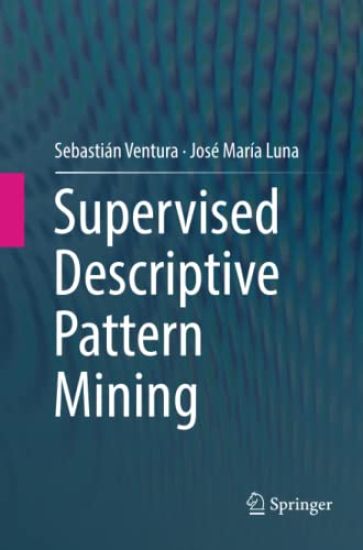
Supervised Descriptive Pattern Mining

Supervised Descriptive Pattern Mining

Sebastián Ventura; José María Luna

Springer Nature Switzerland AG
2019
nidottu
This book provides a general and comprehensible overview of supervised descriptive pattern mining, considering classic algorithms and those based on heuristics. It provides some formal definitions and a general idea about patterns, pattern mining, the usefulness of patterns in the knowledge discovery process, as well as a brief summary on the tasks related to supervised descriptive pattern mining. It also includes a detailed description on the tasks usually grouped under the term supervised descriptive pattern mining: subgroups discovery, contrast sets and emerging patterns. Additionally, this book includes two tasks, class association rules and exceptional models, that are also considered within this field.A major feature of this book is that it provides a general overview (formal definitions and algorithms) of all the tasks included under the term supervised descriptive pattern mining. It considers the analysis of different algorithms either based on heuristics or based on exhaustive search methodologies for any of these tasks. This book also illustrates how important these techniques are in different fields, a set of real-world applications are described.Last but not least, some related tasks are also considered and analyzed. The final aim of this book is to provide a general review of the supervised descriptive pattern mining field, describing its tasks, its algorithms, its applications, and related tasks (those that share some common features).This book targets developers, engineers and computer scientists aiming to apply classic and heuristic-based algorithms to solve different kinds of pattern mining problems and apply them to real issues. Students and researchers working in this field, can use this comprehensive book (which includes its methods and tools) as a secondary textbook.
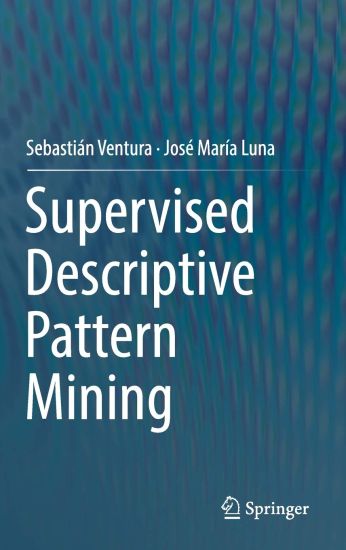
Supervised Descriptive Pattern Mining

Supervised Descriptive Pattern Mining

Sebastián Ventura; José María Luna

Springer International Publishing AG
2018
sidottu
This book provides a general and comprehensible overview of supervised descriptive pattern mining, considering classic algorithms and those based on heuristics. It provides some formal definitions and a general idea about patterns, pattern mining, the usefulness of patterns in the knowledge discovery process, as well as a brief summary on the tasks related to supervised descriptive pattern mining. It also includes a detailed description on the tasks usually grouped under the term supervised descriptive pattern mining: subgroups discovery, contrast sets and emerging patterns. Additionally, this book includes two tasks, class association rules and exceptional models, that are also considered within this field.A major feature of this book is that it provides a general overview (formal definitions and algorithms) of all the tasks included under the term supervised descriptive pattern mining. It considers the analysis of different algorithms either based on heuristics or based on exhaustive search methodologies for any of these tasks. This book also illustrates how important these techniques are in different fields, a set of real-world applications are described.Last but not least, some related tasks are also considered and analyzed. The final aim of this book is to provide a general review of the supervised descriptive pattern mining field, describing its tasks, its algorithms, its applications, and related tasks (those that share some common features).This book targets developers, engineers and computer scientists aiming to apply classic and heuristic-based algorithms to solve different kinds of pattern mining problems and apply them to real issues. Students and researchers working in this field, can use this comprehensive book (which includes its methods and tools) as a secondary textbook.
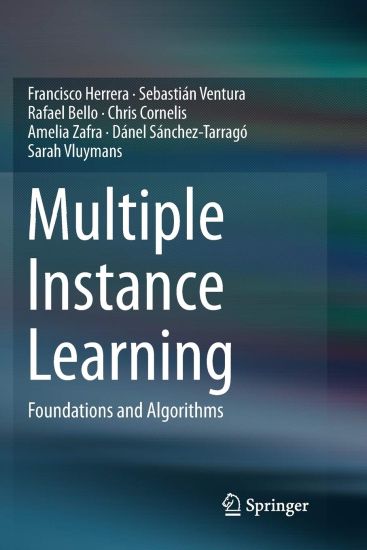
Multiple Instance Learning

Multiple Instance Learning

Francisco Herrera; Sebastián Ventura; Rafael Bello; Chris Cornelis; Amelia Zafra; Dánel Sánchez-Tarragó; Sarah Vluymans

Springer International Publishing AG
2018
nidottu
This book provides a general overview of multiple instance learning (MIL), defining the framework and covering the central paradigms. The authors discuss the most important algorithms for MIL such as classification, regression and clustering. With a focus on classification, a taxonomy is set and the most relevant proposals are specified. Efficient algorithms are developed to discover relevant information when working with uncertainty. Key representative applications are included.This book carries out a study of the key related fields of distance metrics and alternative hypothesis. Chapters examine new and developing aspects of MIL such as data reduction for multi-instance problems and imbalanced MIL data. Class imbalance for multi-instance problems is defined at the bag level, a type of representation that utilizes ambiguity due to the fact that bag labels are available, but the labels of the individual instances are not defined.Additionally, multiple instance multiple label learning is explored. This learning framework introduces flexibility and ambiguity in the object representation providing a natural formulation for representing complicated objects. Thus, an object is represented by a bag of instances and is allowed to have associated multiple class labels simultaneously. This book is suitable for developers and engineers working to apply MIL techniques to solve a variety of real-world problems. It is also useful for researchers or students seeking a thorough overview of MIL literature, methods, and tools.
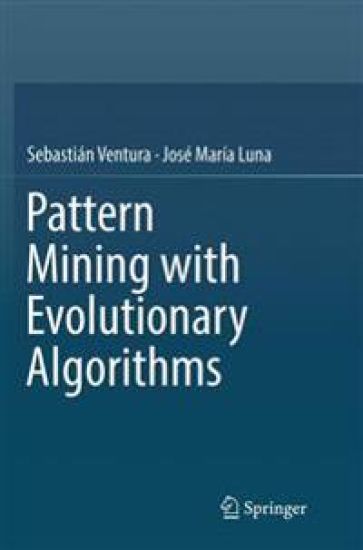
Pattern Mining with Evolutionary Algorithms

Pattern Mining with Evolutionary Algorithms

Sebastián Ventura; José María Luna

Springer International Publishing AG
2018
nidottu
This book provides a comprehensive overview of the field of pattern mining with evolutionary algorithms. To do so, it covers formal definitions about patterns, patterns mining, type of patterns and the usefulness of patterns in the knowledge discovery process. As it is described within the book, the discovery process suffers from both high runtime and memory requirements, especially when high dimensional datasets are analyzed. To solve this issue, many pruning strategies have been developed. Nevertheless, with the growing interest in the storage of information, more and more datasets comprise such a dimensionality that the discovery of interesting patterns becomes a challenging process. In this regard, the use of evolutionary algorithms for mining pattern enables the computation capacity to be reduced, providing sufficiently good solutions.This book offers a survey on evolutionary computation with particular emphasis on genetic algorithms and genetic programming. Also included is an analysis of the set of quality measures most widely used in the field of pattern mining with evolutionary algorithms. This book serves as a review of the most important evolutionary algorithms for pattern mining. It considers the analysis of different algorithms for mining different type of patterns and relationships between patterns, such as frequent patterns, infrequent patterns, patterns defined in a continuous domain, or even positive and negative patterns.A completely new problem in the pattern mining field, mining of exceptional relationships between patterns, is discussed. In this problem the goal is to identify patterns which distribution is exceptionally different from the distribution in the complete set of data records. Finally, the book deals with the subgroup discovery task, a method to identify a subgroup of interesting patterns that is related to a dependent variable or target attribute. This subgroup of patternssatisfies two essential conditions: interpretability and interestingness.
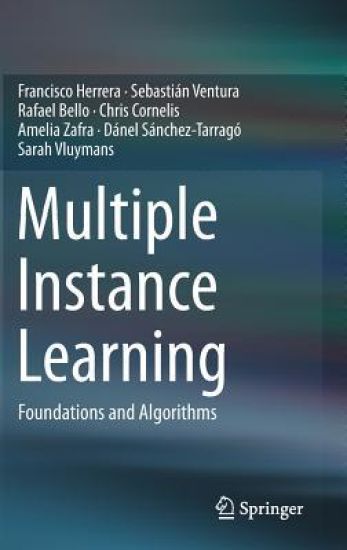
Multiple Instance Learning

Multiple Instance Learning

Francisco Herrera; Sebastián Ventura; Rafael Bello; Chris Cornelis; Amelia Zafra; Dánel Sánchez-Tarragó; Sarah Vluymans

Springer International Publishing AG
2016
sidottu
This book provides a general overview of multiple instance learning (MIL), defining the framework and covering the central paradigms. The authors discuss the most important algorithms for MIL such as classification, regression and clustering. With a focus on classification, a taxonomy is set and the most relevant proposals are specified. Efficient algorithms are developed to discover relevant information when working with uncertainty. Key representative applications are included.This book carries out a study of the key related fields of distance metrics and alternative hypothesis. Chapters examine new and developing aspects of MIL such as data reduction for multi-instance problems and imbalanced MIL data. Class imbalance for multi-instance problems is defined at the bag level, a type of representation that utilizes ambiguity due to the fact that bag labels are available, but the labels of the individual instances are not defined.Additionally, multiple instance multiple label learning is explored. This learning framework introduces flexibility and ambiguity in the object representation providing a natural formulation for representing complicated objects. Thus, an object is represented by a bag of instances and is allowed to have associated multiple class labels simultaneously. This book is suitable for developers and engineers working to apply MIL techniques to solve a variety of real-world problems. It is also useful for researchers or students seeking a thorough overview of MIL literature, methods, and tools.
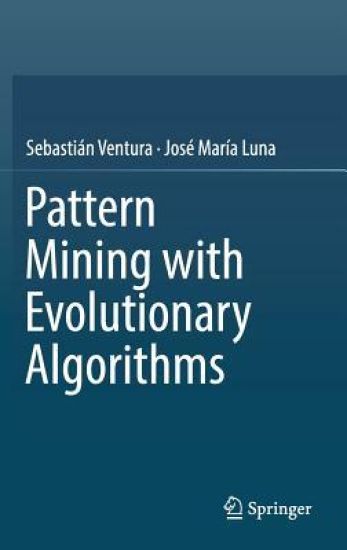
Pattern Mining with Evolutionary Algorithms

Pattern Mining with Evolutionary Algorithms

Sebastián Ventura; José María Luna

Springer International Publishing AG
2016
sidottu
This book provides a comprehensive overview of the field of pattern mining with evolutionary algorithms. To do so, it covers formal definitions about patterns, patterns mining, type of patterns and the usefulness of patterns in the knowledge discovery process. As it is described within the book, the discovery process suffers from both high runtime and memory requirements, especially when high dimensional datasets are analyzed. To solve this issue, many pruning strategies have been developed. Nevertheless, with the growing interest in the storage of information, more and more datasets comprise such a dimensionality that the discovery of interesting patterns becomes a challenging process. In this regard, the use of evolutionary algorithms for mining pattern enables the computation capacity to be reduced, providing sufficiently good solutions.This book offers a survey on evolutionary computation with particular emphasis on genetic algorithms and genetic programming. Also included is an analysis of the set of quality measures most widely used in the field of pattern mining with evolutionary algorithms. This book serves as a review of the most important evolutionary algorithms for pattern mining. It considers the analysis of different algorithms for mining different type of patterns and relationships between patterns, such as frequent patterns, infrequent patterns, patterns defined in a continuous domain, or even positive and negative patterns.A completely new problem in the pattern mining field, mining of exceptional relationships between patterns, is discussed. In this problem the goal is to identify patterns which distribution is exceptionally different from the distribution in the complete set of data records. Finally, the book deals with the subgroup discovery task, a method to identify a subgroup of interesting patterns that is related to a dependent variable or target attribute. This subgroup of patternssatisfies two essential conditions: interpretability and interestingness.