
Kirjojen hintavertailu. Mukana 12 595 353 kirjaa ja 12 kauppaa.

Kirjailija

Sergio G. Lazzarini

Kirjat ja teokset yhdessä paikassa: 3 kirjaa, julkaisuja vuosilta 2014-2024, suosituimpien joukossa The Right Privatization. Vertaile teosten hintoja ja tarkista saatavuus suomalaisista kirjakaupoista.

3 kirjaa

Kirjojen julkaisuhaarukka 2014-2024.

The Right Privatization

The Right Privatization

Sergio G. Lazzarini

Cambridge University Press
2024
pokkari
The public debate is rife with polarized views of how to deliver essential services such as education, health, and security. While some tout privatization as a way to supplant bad governments, others warn that private firms maximize profits at the expense of socially oriented service attributes. In reality, all forms of service delivery—public, private and hybrid public private-collaborations—have merits and flaws. This book scrutinizes the menu of delivery forms in public services and the conditions that should make them work. It argues that privatization benefits from capable government units committing to well-defined policy objectives, mobilizing critical resources, and incentivizing effective and inclusive delivery. Societies counting on capable governments can also reject single solutions and experiment with plural paths of improvement, where public and private organizations co-exist and learn from each other. This book will appeal to students, academics, managers and policy makers interested in examining the public-private boundary and the many ramifications of this focal issue.
The Right Privatization

The Right Privatization

Sergio G. Lazzarini

Cambridge University Press
2022
sidottu
The public debate is rife with polarized views of how to deliver essential services such as education, health, and security. While some tout privatization as a way to supplant bad governments, others warn that private firms maximize profits at the expense of socially oriented service attributes. In reality, all forms of service delivery—public, private and hybrid public private-collaborations—have merits and flaws. This book scrutinizes the menu of delivery forms in public services and the conditions that should make them work. It argues that privatization benefits from capable government units committing to well-defined policy objectives, mobilizing critical resources, and incentivizing effective and inclusive delivery. Societies counting on capable governments can also reject single solutions and experiment with plural paths of improvement, where public and private organizations co-exist and learn from each other. This book will appeal to students, academics, managers and policy makers interested in examining the public-private boundary and the many ramifications of this focal issue.
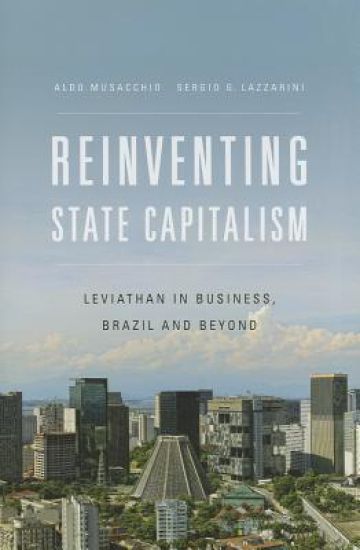
Reinventing State Capitalism

Reinventing State Capitalism

Aldo Musacchio; Sergio G. Lazzarini

Harvard University Press
2014
sidottu
The wave of liberalization that swept world markets in the 1980s and 90s altered the ways that governments manage their economies. Reinventing State Capitalism analyzes the rise of new species of state capitalism in which governments interact with private investors either as majority or minority shareholders in publicly-traded corporations or as financial backers of purely private firms (the so-called “national champions”). Focusing on a detailed quantitative assessment of Brazil’s economic performance from 1976 to 2009, Aldo Musacchio and Sergio Lazzarini examine how these models of state capitalism influence corporate investment and performance.According to one model, the state acts as a majority investor, granting the state-owned enterprise (SOE) financial autonomy and allowing professional management. This form, the authors argue, has reduced many agency problems commonly faced by state ownership. According to another hybrid model, the state uses sovereign wealth funds, holding companies, and development banks to acquire a small share of equity ownership in a corporation, thereby potentially alleviating capital constraints and leveraging latent capabilities.Both models have benefits and costs. Yet neither model has entirely eliminated the temptation of governments to intervene in the operation of natural resource industries and other large strategic enterprises. Nevertheless, the longstanding debate over whether private ownership is superior or inferior to state capitalism has become irrelevant, Musacchio and Lazzarini conclude. Private ownership is now mingled with state capital on a global scale.