Kirjojen hintavertailu. Mukana 12 335 113 kirjaa ja 12 kauppaa.

Kirjailija

Sergio González Rodríguez

Kirjat ja teokset yhdessä paikassa: 4 kirjaa, julkaisuja vuosilta 2012-2019, suosituimpien joukossa The Femicide Machine. Vertaile teosten hintoja ja tarkista saatavuus suomalaisista kirjakaupoista.

4 kirjaa

Kirjojen julkaisuhaarukka 2012-2019.

Field of Battle

Field of Battle

Sergio González Rodríguez

Semiotext (E)
2019
pokkari
The emergence of a geopolitical war scenario, establishing a form of global governance that utilizes methods of surveillance and control.In times of war the law is silent.-from Field of BattleField of Battle presents the world today as nothing less than a war in progress, with Mexico an illustrative microcosm of the developing geopolitical scenario: a battlefield in which violence, drug trafficking, and organized crime-as well as the alegal state that works alongside all of this in the guise of fighting against it-hold sway. The rule of law has been replaced by the dominance of alegality and the rise of the "a-state."This war scenario is establishing a form of global governance that utilizes methods of surveillance and control developed by the United States government and enforced through its global network of military bases and the multinational corporations that work in synergy with its espionage agencies. Geopolitics take advantage of social instability, drug cartels, state repression, and paramilitarism to establish the foundations of a world order.Sergio Gonzalez Rodriguez argues that this surveillance and control model has been imposed on the international community through extreme neoliberal ideology, free markets, the globalized economy, and the rise of the information society. The threats are clear. Nation-states are increasingly unable to respond to societal needs, and the individual has been displaced by money and technique-the axis of the transhumanist future foretold by today's electronic devices. The human being as the prosthesis of an artificial world and as an object of networks and systems: citizens are the victims of a perverse vision of reality, caught between the defense of their rights and their will to insurrection.
The Sorrows of Mexico

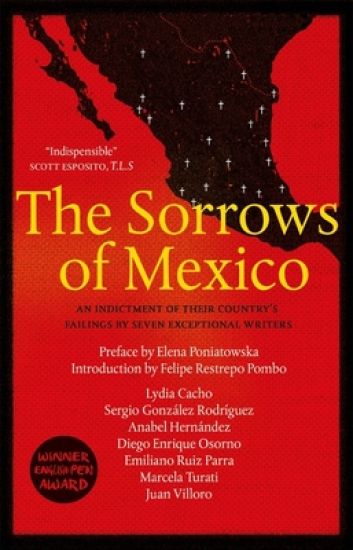
The Sorrows of Mexico

Lydia Cacho; Anabel Hernández; Juan Villoro; Diego Enrique Osorno; Sergio González Rodríguez; Marcela Turati; Emiliano Ruiz Parra; Elena Poniatowska

MacLehose Press
2017
pokkari
With contributions from seven of Mexico's finest journalists, this is reportage at its bravest and most necessary - it has the power to change the world's view of their country, and by the force of its truth, to start to heal the country's many sorrows.Supported the Arts Council Grant's for the Arts Programme and by PEN PromotesVeering between carnival and apocalypse, Mexico has in the last ten years become the epicentre of the international drug trade. The so-called "war on drugs" has been a brutal and chaotic failure (more than 160,000 lives have been lost). The drug cartels and the forces of law and order are often in collusion, corruption is everywhere. Life is cheap and inconvenient people - the poor, the unlucky, the honest or the inquisitive - can be "disappeared" leaving not a trace behind (in September 2015, more than 26,798 were officially registered as "not located"). Yet people in all walks of life have refused to give up. Diego Enrique Osorno and Juan Villoro tell stories of teenage prostitution and Mexico's street children. Anabel Hernández and Emiliano Ruiz Parra give chilling accounts of the "disappearance" of forty-three students and the murder of a self-educated land lawyer. Sergio González Rodríguez and Marcela Turati dissect the impact of the violence on the victims and those left behind, while Lydia Cacho contributes a journal of what it is like to live every day of your life under threat of death. Reading these accounts we begin to understand the true nature of the meltdown of democracy, obscured by lurid headlines, and the sheer physical and intellectual courage needed to oppose it.
The Iguala 43

The Iguala 43

Sergio González Rodríguez

Semiotext (E)
2017
pokkari
A well-researched and powerfully argued account of the disappearance of forty-three students and an analysis of the cruelty that normalizes atrocity.The word "corruption" is insufficient for the magnitude of this evil.-from The Iguala 43On the night of September 26th, 2014, policemen attacked a group of student protestors in the Mexican town of Iguala. Forty-three of these students were then kidnapped and turned over to criminals who allegedly tortured and murdered them, and then burned their corpses. The families of the victims refused to accept the official story, which placed all blame on local actors and absolved the federal government of any culpability. The anger provoked by this atrocity, one of the most barbaric acts in recent times, divided Mexican society in two: on one side were those who unwaveringly supported the cause of the students and on the other those who accepted the government's "historic truth."Written in memory of the forty-three students, this well-researched and powerfully argued book uncovers the agents, causes, and factors responsible for this unspeakable crime. It offers an interpretation of these events that goes beyond the artificial opposition between good and evil, between rulers and insurgents, and tries instead to understand the cruelty that normalizes atrocity. Gonzalez Rodriguez warns us that "this story has been repeated around the world, but we refuse to see it. If anyone doubts or denies this, then I challenge them to finish this book. When faced with the acceptance of horror, we must recover our lucidity and exercise our freedom to transform this tragic reality."
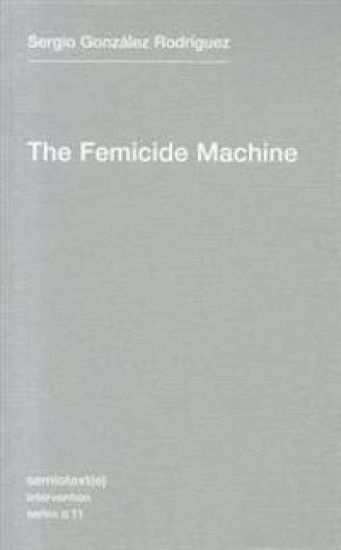
The Femicide Machine

The Femicide Machine

Sergio González Rodríguez

Semiotext (E)
2012
pokkari
An account and analysis of the systematic murder of women and girls in the Mexican border town of Ciudad Juarez. In Ciudad Juarez, a territorial power normalized barbarism. This anomalous ecology mutated into a femicide machine: an apparatus that didn't just create the conditions for the murders of dozens of women and little girls, but developed the institutions that guarantee impunity for those crimes and even legalize them. A lawless city sponsored by a State in crisis. The facts speak for themselves. -from The Femicide Machine Best known to American readers for his cameo appearances as The Journalist in Roberto Bolano's 2666 and as a literary detective in Javier Marias's novel Dark Back of Time, Sergio Gonzalez Rodriguez is one of Mexico's most important contemporary writers. He is the author of Bones in the Desert, the most definitive work on the murders of women and girls in Juarez, Mexico, as well as The Headless Man, a sharp meditation on the recurrent uses of symbolic violence; Infectious, a novel; and Original Evil, a long essay. The Femicide Machine is the first book by Gonzalez Rodriguez to appear in English translation. Written especially for Semiotext(e) Intervention series, The Femicide Machine synthesizes Gonzalez Rodriguez's documentation of the Juarez crimes, his analysis of the unique urban conditions in which they take place, and a discussion of the terror techniques of narco-warfare that have spread to both sides of the border. The result is a gripping polemic. The Femicide Machine probes the anarchic confluence of global capital with corrupt national politics and displaced, transient labor, and introduces the work of one of Mexico's most eminent writers to American readers.