Kirjojen hintavertailu. Mukana 12 595 353 kirjaa ja 12 kauppaa.

Kirjailija

Seumas Miller

Kirjat ja teokset yhdessä paikassa: 26 kirjaa, julkaisuja vuosilta 1999-2025, suosituimpien joukossa The Ethics of National Security Intelligence Institutions. Vertaile teosten hintoja ja tarkista saatavuus suomalaisista kirjakaupoista.

26 kirjaa

Kirjojen julkaisuhaarukka 1999-2025.

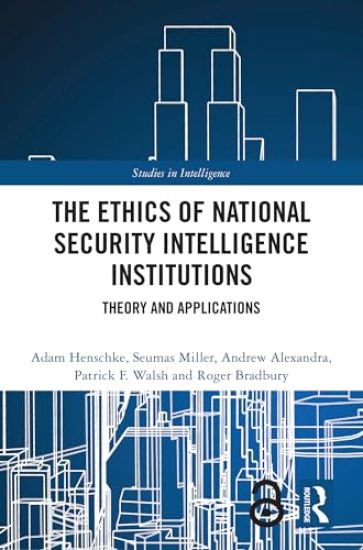
The Ethics of National Security Intelligence Institutions

The Ethics of National Security Intelligence Institutions

Adam Henschke; Seumas Miller; Andrew Alexandra; Patrick F. Walsh; Roger Bradbury

TAYLOR FRANCIS LTD
2025
nidottu
This book explores the ethics of national security intelligence institutions operating in contemporary liberal democracies. Intelligence collection by agencies such as the CIA, MI6, and Mossad involves practices that are apparently inconsistent with the principles of ordinary morality – practices such as lying, spying, manipulation, and covert action. However, in the defence of national security, such practices may not only be morally permissible, but may also under some circumstances be morally obligatory. One approach to the ethics of national security intelligence activity has been to draw from the just war tradition (so-called ‘just intelligence theory’). This book identifies significant limitations of this approach and offers a new, institutionally based, teleological normative framework. In doing so, it revises some familiar principles designed for application to kinetic wars, such as necessity and proportionality, and invokes some additional ones, such as reciprocity and trust. It goes on to explore the applications of this framework and a revised set of principles for national security intelligence institutions and practices in contemporary and emerging political and technological settings. This book will be of much interest to students of intelligence studies, ethics, security studies and International Relations.
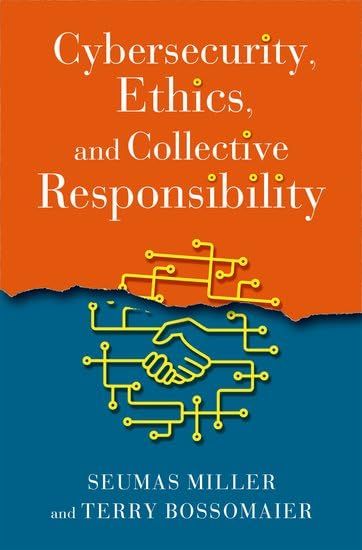
Cybersecurity, Ethics, and Collective Responsibility

Cybersecurity, Ethics, and Collective Responsibility

Seumas Miller; Terry Bossomaier

OXFORD UNIVERSITY PRESS INC
2024
sidottu
This is an open access title. It is made available under a Creative Commons Attribution-Non Commercial-No Derivatives 4.0 International licence. It is available to read and download as a PDF version on the Oxford Academic platform. The advent of the Internet, exponential growth in computing power, and rapid developments in artificial intelligence have raised numerous cybersecurity-related ethical questions in various domains. The dual use character of cybertechnology-that it can be used to provide great benefits to humankind but can also do great harm-means that business (data security, data ownership and privacy), public communication (disinformation and computational propaganda), health (privacy, ransomware attacks), law enforcement (data security, predictive policing) and interstate conflict (cyberwar, autonomous weapons) are of vital interest to cybersecurity ethics. This work analyses the key ethical concepts in the field, such as privacy, freedom of communication, security, and the right to self-defence, and develops sets of ethical guidelines for the regulation of cyberspace in these various domains. From a liberal democratic perspective, Seumas Miller and Terry Bossomaier seek to protect individual rights while ensuring the collective good of cybersecurity. They also pay close attention to institutionally embedded collective moral responsibilities that function as 'webs of prevention' against cyberattacks. These webs, they argue, need new regulation and the redesign of institutional roles, as well as technical countermeasures to cyberattacks, such as passwords, encryption, firewalls, and 'patching.' At times, webs of prevention also involve offensive and defensive measures. In their expert analysis and guidance, Miller and Bossomaier reinforce just how much is at stake in the field of cybersecurity ethics.
The Ethics of National Security Intelligence Institutions

The Ethics of National Security Intelligence Institutions

Adam Henschke; Seumas Miller; Andrew Alexandra; Patrick F. Walsh; Roger Bradbury

TAYLOR FRANCIS LTD
2024
sidottu
This book explores the ethics of national security intelligence institutions operating in contemporary liberal democracies.Intelligence collection by agencies such as the CIA, MI6, and Mossad involves practices that are apparently inconsistent with the principles of ordinary morality – practices such as lying, spying, manipulation, and covert action. However, in the defence of national security, such practices may not only be morally permissible, but may also under some circumstances be morally obligatory. One approach to the ethics of national security intelligence activity has been to draw from the just war tradition (so-called ‘just intelligence theory’). This book identifies significant limitations of this approach and offers a new, institutionally based, teleological normative framework. In doing so, it revises some familiar principles designed for application to kinetic wars, such as necessity and proportionality, and invokes some additional ones, such as reciprocity and trust. It goes on to explore the applications of this framework and a revised set of principles for national security intelligence institutions and practices in contemporary and emerging political and technological settings.This book will be of much interest to students of intelligence studies, ethics, security studies and International Relations.
Biometric Identification, Law and Ethics

Biometric Identification, Law and Ethics

Marcus Smith; Seumas Miller

Springer Nature Switzerland AG
2021
nidottu
This book is open access. This book undertakes a multifaceted and integrated examination of biometric identification, including the current state of the technology, how it is being used, the key ethical issues, and the implications for law and regulation. The five chapters examine the main forms of contemporary biometrics–fingerprint recognition, facial recognition and DNA identification– as well the integration of biometric data with other forms of personal data, analyses key ethical concepts in play, including privacy, individual autonomy, collective responsibility, and joint ownership rights, and proposes a raft of principles to guide the regulation of biometrics in liberal democracies.Biometric identification technology is developing rapidly and being implemented more widely, along with other forms of information technology. As products, services and communication moves online, digital identity and security is becoming more important. Biometric identification facilitates this transition. Citizens now use biometrics to access a smartphone or obtain a passport; law enforcement agencies use biometrics in association with CCTV to identify a terrorist in a crowd, or identify a suspect via their fingerprints or DNA; and companies use biometrics to identify their customers and employees. In some cases the use of biometrics is governed by law, in others the technology has developed and been implemented so quickly that, perhaps because it has been viewed as a valuable security enhancement, laws regulating its use have often not been updated to reflect new applications. However, the technology associated with biometrics raises significant ethical problems, including in relation to individual privacy, ownership of biometric data, dual use and, more generally, as is illustrated by the increasing use of biometrics in authoritarian states such as China, the potential for unregulated biometrics to undermine fundamental principles of liberal democracy. Resolving these ethical problems is a vital step towards more effective regulation.
Institutional Corruption

Institutional Corruption

Seumas Miller

Cambridge University Press
2019
pokkari
In this book, Seumas Miller develops distinctive philosophical analyses of corruption, collective responsibility and integrity systems, and applies them to cases in both the public and the private sectors. Using numerous well-known examples of institutional corruption, he explores a variety of actual and potential anti-corruption measures. The result is a wide-ranging, theoretically sophisticated and empirically informed work on institutional corruption and how to combat it. Part I defines the key concepts of corruption, power, collective responsibility, bribery, abuse of authority and nepotism; Part II discusses anti-corruption and integrity systems, corruption investigations and whistle-blowing; and Part III focuses on corruption and anti-corruption in specific institutional settings, namely policing, finance, business and government. Integrating theory with practical approaches, this book will be important for those interested in the philosophy and ethics of corruption as well as for those who work to combat it.
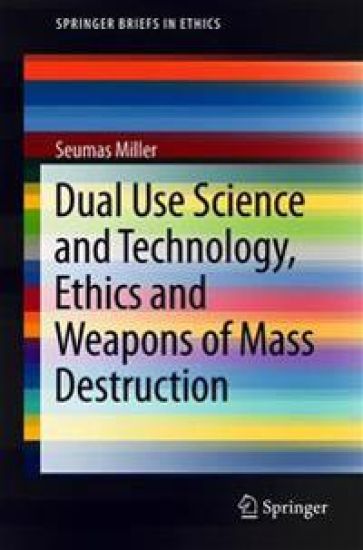
Dual Use Science and Technology, Ethics and Weapons of Mass Destruction

Dual Use Science and Technology, Ethics and Weapons of Mass Destruction

Seumas Miller

Springer International Publishing AG
2018
nidottu
This book deals with the problem of dual-use science research and technology. It first explains the concept of dual use and then offers analyses of collective knowledge and collective ignorance. It goes on to present a theory of collective responsibility, followed by four chapters focusing on a particular scientific field or industry of dual use concern: the chemical industry, the nuclear industry, cyber-technology and the biological sciences. The problem of dual-use science research and technology arises because such research and technology has the potential to be used for great evil as well as for great good. On the one hand, knowledge is a necessary condition, and perhaps a constitutive feature, of technologies that contribute greatly to individual and collective well-being. Consider, for example, nuclear technology that enables the generation of low cost electricity in populations without obvious alternative energy sources. So technological knowledge is a good thing and ignorance of it a bad thing. On the other hand, these same technologies can be extremely harmful to individuals and collectives, as with the atomic bombs dropped on Hiroshima and Nagasaki. So, at least with respect to some technologies evidently knowledge is a bad thing and ignorance a good thing. Accordingly, the question arises as to whether we ought to limit scientific research and/or the development of technology and, if so, which research or technology, in what manner and to what extent. This book examines the answer to that question.
Institutional Corruption

Institutional Corruption

Seumas Miller

Cambridge University Press
2017
sidottu
In this book, Seumas Miller develops distinctive philosophical analyses of corruption, collective responsibility and integrity systems, and applies them to cases in both the public and the private sectors. Using numerous well-known examples of institutional corruption, he explores a variety of actual and potential anti-corruption measures. The result is a wide-ranging, theoretically sophisticated and empirically informed work on institutional corruption and how to combat it. Part I defines the key concepts of corruption, power, collective responsibility, bribery, abuse of authority and nepotism; Part II discusses anti-corruption and integrity systems, corruption investigations and whistle-blowing; and Part III focuses on corruption and anti-corruption in specific institutional settings, namely policing, finance, business and government. Integrating theory with practical approaches, this book will be important for those interested in the philosophy and ethics of corruption as well as for those who work to combat it.
Shooting to Kill

Shooting to Kill

Seumas Miller

Oxford University Press Inc
2016
sidottu
Terrorism, the use of military force in Afghanistan, Iraq and Syria, and the fatal police shootings of unarmed persons have all contributed to renewed interest in the ethics of police and military use of lethal force and its moral justification. In this book, philosopher Seumas Miller analyzes the various moral justifications and moral responsibilities involved in the use of lethal force by police and military combatants, relying on a distinctive normative teleological account of institutional roles. His conception constitutes a novel alternative to prevailing reductive individualist and collectivist accounts. As Miller argues, police and military uses of lethal force are morally justified in part by recourse to fundamental natural moral rights and obligations, especially the right to personal self-defense and the moral obligation to defend the lives of innocent others. Yet the moral justification for police and military use of lethal force is to some extent role-specific. Both police officers and military combatants evidently have an institutionally-based moral duty to put themselves in harm's way to protect others. Under some circumstances, however, police have an institutionally based moral duty to use lethal force to uphold the law; and military combatants have an institutionally based moral duty to use lethal force to win wars. Two key notions in play are joint action and the natural right to self-defense. Miller uses a relational individualist theory of joint actions to construct the notion of multi-layered structures of joint action in order to explicate organizational action. He also provides a novel theory of justifiable killing in self-defense. Over the course of his book, Miller covers a variety of urgent topics, such as police shootings of armed offenders, police shooting of suicide-bombers, targeted killing, autonomous weapons, humanitarian armed intervention, and civilian immunity.
Shooting to Kill

Shooting to Kill

Seumas Miller

Oxford University Press Inc
2016
nidottu
Terrorism, the use of military force in Afghanistan, Iraq and Syria, and the fatal police shootings of unarmed persons have all contributed to renewed interest in the ethics of police and military use of lethal force and its moral justification. In this book, philosopher Seumas Miller analyzes the various moral justifications and moral responsibilities involved in the use of lethal force by police and military combatants, relying on a distinctive normative teleological account of institutional roles. His conception constitutes a novel alternative to prevailing reductive individualist and collectivist accounts. As Miller argues, police and military uses of lethal force are morally justified in part by recourse to fundamental natural moral rights and obligations, especially the right to personal self-defense and the moral obligation to defend the lives of innocent others. Yet the moral justification for police and military use of lethal force is to some extent role-specific. Both police officers and military combatants evidently have an institutionally-based moral duty to put themselves in harm's way to protect others. Under some circumstances, however, police have an institutionally based moral duty to use lethal force to uphold the law; and military combatants have an institutionally based moral duty to use lethal force to win wars. Two key notions in play are joint action and the natural right to self-defense. Miller uses a relational individualist theory of joint actions to construct the notion of multi-layered structures of joint action in order to explicate organizational action. He also provides a novel theory of justifiable killing in self-defense. Over the course of his book, Miller covers a variety of urgent topics, such as police shootings of armed offenders, police shooting of suicide-bombers, targeted killing, autonomous weapons, humanitarian armed intervention, and civilian immunity.
Integrity Systems for Occupations

Integrity Systems for Occupations

Andrew Alexandra; Seumas Miller

Routledge
2016
nidottu
An integrity system is an integrated assemblage of institutional mechanisms, designed to minimize ethical misconduct and promote ethical health in institutions, organizations, occupations and the like. This book analyses, describes and demonstrates the value of well-designed integrity systems for efficient, effective and ethically sustainable practice, in occupational groups in particular. Developing a blueprint for the design of integrity systems which can be tailored to the specific ethical needs of different occupational groups, this book furthers the general project of ethically informed institutional design ('designing-in' ethics). The approach taken reflects the authors' academic background in professional ethics, as well as their extensive experience in the application of ethical theories and perspectives to the problems and challenges encountered by various occupational groups, such as accountants, business people, lawyers, doctors, nurses, social workers, engineers, emergency service workers and police.
Ethical Issues in Policing

Ethical Issues in Policing

Seumas Miller; John Blackler

Routledge
2016
nidottu
Police Studies constitute an important area of academic inquiry and policing raises a large number of ethical questions, yet to date there has been a paucity of research on the subject. This significant volume provides an integrated mix of ethico-philosophical analysis combined with practitioner knowledge and experience to examine and address the large number of difficult ethical questions involved in modern-day policing. Key features: ¢ Outlines a distinctive philosophical theory of policing which promotes the human rights dimension of police work. ¢ Analyzes the phenomenon of noble cause corruption and ways to combat it. ¢ Examines the role of restorative justice. ¢ Discusses the related notions of police authority and police discretion. ¢ Assesses the use of coercive and deadly force. ¢ Provides a detailed discussion of recent issues such as privacy and confidentiality in the context of new communication and information technologies, and entrapment. Philosophical in approach and written in an accessible style, the book will be a valuable guide for all those with an interest or involvement in Police Studies, Criminology, Philosophy and Ethics.
Corruption and Anti-Corruption in Policing—Philosophical and Ethical Issues
High levels of police corruption have been a persistent historical tendency in police services throughout the world. While the general area of concern in this book is with police corruption and anti-corruption, the focus is on certain key philosophical and ethical issues that arise for police organisations confronting corruption. On the normative account proffered in this book the principal institutional purpose of policing is the protection of legally enshrined moral rights and the principal institutional anti-corruption arrangement is what is referred to as an integrity system. The latter includes oversight bodies with investigative powers and internal affairs departments as well as specific devices such as early warning indicators, professional reporting mechanisms and integrity tests. Key concepts analysed in the book include corruption, noble cause corruption and collective moral responsibility. The key ethical issues analysed include investigative independence, professionalreporting, covert operations and integrity tests.
Investigative Ethics

Investigative Ethics

Seumas Miller; Ian A. Gordon

Wiley-Blackwell (an imprint of John Wiley Sons Ltd)
2014
nidottu
Investigative Ethics: Ethics for Police Detectives and Criminal Investigators presents applied philosophical analyses of the ethical issues that arise for police detectives and other investigators in contemporary society. Explores ethical issues relating to investigative independence, rights of victims and suspects, use of informants, entrapment, privacy and surveillance, undercover operations, deception, and suspect interviewingRepresents the first monograph providing a detailed consideration of ethical issues in police investigationsFeatures authorship by an applied philosopher specializing in police ethics, and a former UK senior police officerCombined authorship ensures the text is anchored in actual police practice as well as providing high quality ethical analysis
Re-Thinking Theory

Re-Thinking Theory

Richard Freadman; Seumas Miller

Cambridge University Press
2010
pokkari
Re-thinking Theory offers a bold approach to literary studies, itself explicitly theoretical and yet making a searching critique of the modes, concepts and movements which comprise literary theory. Discussing key concepts such as ideology, signification and discourse, and analysing schools including that of F. R. Leavis, Althusserian Marxism, Derridean and Foucaultian poststructuralism, and New Historicism, the authors argue that there are major deficiencies in the conceptual foundations and the literary and political implications of much literary theory. These deficiencies are ascribed principally to three aspects of theoretical schools: the commitment to a non-referential view of language, the rejection of substantive accounts of the individual, and a repudiation of moral and aesthetic evaluation. The 'alternative account' offered by Professors Freadman and Miller incorporates the values renounced by this kind of literary theory and places a central emphasis on ethical discourse.
Integrity Systems for Occupations

Integrity Systems for Occupations

Andrew Alexandra; Seumas Miller

Ashgate Publishing Limited
2010
sidottu
An integrity system is an integrated assemblage of institutional mechanisms, designed to minimize ethical misconduct and promote ethical health in institutions, organizations, occupations and the like. This book analyses, describes and demonstrates the value of well-designed integrity systems for efficient, effective and ethically sustainable practice, in occupational groups in particular. Developing a blueprint for the design of integrity systems which can be tailored to the specific ethical needs of different occupational groups, this book furthers the general project of ethically informed institutional design ('designing-in' ethics). The approach taken reflects the authors' academic background in professional ethics, as well as their extensive experience in the application of ethical theories and perspectives to the problems and challenges encountered by various occupational groups, such as accountants, business people, lawyers, doctors, nurses, social workers, engineers, emergency service workers and police.
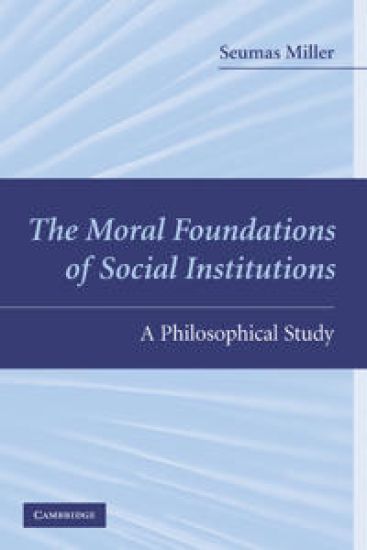
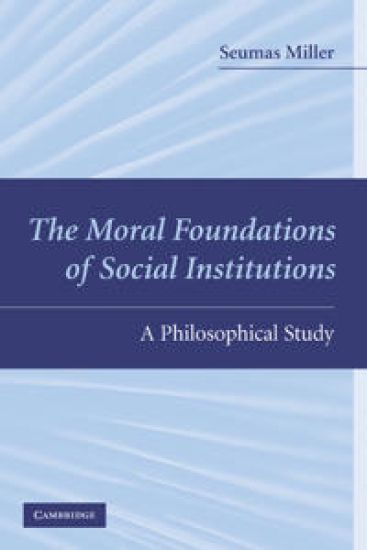
The Moral Foundations of Social Institutions

The Moral Foundations of Social Institutions

Seumas Miller

Cambridge University Press
2009
sidottu
In this book, Seumas Miller examines the moral foundations of contemporary social institutions. Offering an original general theory of social institutions, he posits that all social institutions exist to realize various collective ends, indeed, to produce collective goods. He analyses key concepts such as collective responsibility and institutional corruption. Miller also provides distinctive special theories of particular institutions, including governments, welfare agencies, universities, police organizations, business corporations, and communications and information technology entities. These theories are philosophical and, thus, foundational and synoptic in character. They are normative accounts of a sampling of contemporary social institutions, not descriptive accounts of all social institutions, both past and present. Miller also addresses various ethical challenges confronting contemporary institutional designers and policymakers, including the renovation of the international financial system, the 'dumbing down' of the media, the challenge of world poverty, and human rights infringements by security agencies combating global terrorism.
The Moral Foundations of Social Institutions

The Moral Foundations of Social Institutions

Seumas Miller

Cambridge University Press
2009
pokkari
In this book, Seumas Miller examines the moral foundations of contemporary social institutions. Offering an original general theory of social institutions, he posits that all social institutions exist to realize various collective ends, indeed, to produce collective goods. He analyses key concepts such as collective responsibility and institutional corruption. Miller also provides distinctive special theories of particular institutions, including governments, welfare agencies, universities, police organizations, business corporations, and communications and information technology entities. These theories are philosophical and, thus, foundational and synoptic in character. They are normative accounts of a sampling of contemporary social institutions, not descriptive accounts of all social institutions, both past and present. Miller also addresses various ethical challenges confronting contemporary institutional designers and policymakers, including the renovation of the international financial system, the 'dumbing down' of the media, the challenge of world poverty, and human rights infringements by security agencies combating global terrorism.
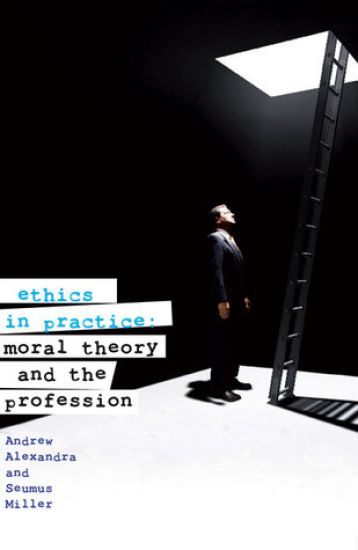
Ethics in Practice

Ethics in Practice

Andrew Alexandra; Seumas Miller

NewSouth Publishing
2009
nidottu
Dozens of times a day we are faced with moral dilemmas, and our judgments and actions are guided by our sense of what is right or wrong. But there are times when we find ourselves facing situations of moral complexity and uncertainty. Drawing on numerous case studies, Ethics in Practice is a practical and absorbing discussion on ethics and moral theory, and will help readers to make better informed, and more rationally justifiable, decisions about how to act and judge the actions of others, where there are morally hard choices to be made in their professional working life.
Ethical and Philosophical Consideration of the Dual-Use Dilemma in the Biological Sciences

Ethical and Philosophical Consideration of the Dual-Use Dilemma in the Biological Sciences

Seumas Miller; Michael J. Selgelid

Springer-Verlag New York Inc.
2008
nidottu
What Is the Dual-Use Dilemma? The so-called “dual-use dilemma” arises in the context of research in the biological and other sciences as a consequence of the fact that one and the same piece of sci- tific research sometimes has the potential to be used for harm as well as for good. A dual-use dilemma is an ethical dilemma, and an ethical dilemma for the researcher (and for those who have the power or authority to assist or impede the researcher’s work, e. g. , governments). It is an ethical dilemma since it is about promoting good in the context of the potential for also causing harm, e. g. , the p- motion of health in the context of providing the wherewithal for the killing of in- cents. It is an ethical dilemma for the researcher not because he or she is aiming at anything other than a good outcome; typically, the researcher intends no harm, but only good. Rather, the dilemma arises for the researcher because of the potential actions of others. Malevolent non-researchers might steal dangerous biological agents produced by the researcher; alternatively, other researchers—or at least their governments or leadership—might use the results of the original researcher’s work for malevolent purposes. The malevolent purposes in question include bioterrorism, biowarfare and blackmail for financial gain.