Kirjojen hintavertailu. Mukana 12 595 353 kirjaa ja 12 kauppaa.

Kirjailija

Shankar Sastry

Kirjat ja teokset yhdessä paikassa: 5 kirjaa, julkaisuja vuosilta 1999-2018, suosituimpien joukossa Generalized Principal Component Analysis. Vertaile teosten hintoja ja tarkista saatavuus suomalaisista kirjakaupoista.

5 kirjaa

Kirjojen julkaisuhaarukka 1999-2018.

Generalized Principal Component Analysis

Generalized Principal Component Analysis

René Vidal; Yi Ma; Shankar Sastry

Springer-Verlag New York Inc.
2016
sidottu
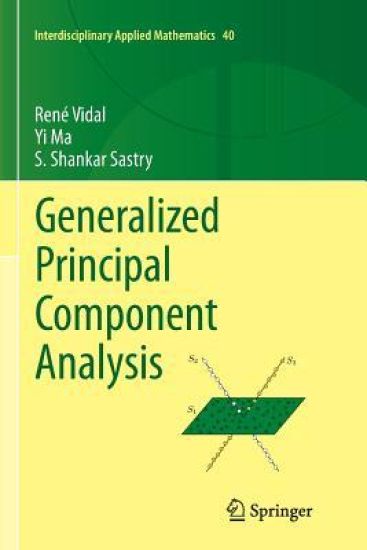
This book provides a comprehensive introduction to the latest advances in the mathematical theory and computational tools for modeling high-dimensional data drawn from one or multiple low-dimensional subspaces (or manifolds) and potentially corrupted by noise, gross errors, or outliers. This challenging task requires the development of new algebraic, geometric, statistical, and computational methods for efficient and robust estimation and segmentation of one or multiple subspaces. The book also presents interesting real-world applications of these new methods in image processing, image and video segmentation, face recognition and clustering, and hybrid system identification etc. This book is intended to serve as a textbook for graduate students and beginning researchers in data science, machine learning, computer vision, image and signal processing, and systems theory. It contains ample illustrations, examples, and exercises and is made largely self-contained with three Appendices which survey basic concepts and principles from statistics, optimization, and algebraic-geometry used in this book.René Vidal is a Professor of Biomedical Engineering and Director of the Vision Dynamics and Learning Lab at The Johns Hopkins University. Yi Ma is Executive Dean and Professor at the School of Information Science and Technology at ShanghaiTech University. S. Shankar Sastry is Dean of the College of Engineering, Professor of Electrical Engineering and Computer Science and Professor of Bioengineering at the University of California, Berkeley.
Generalized Principal Component Analysis

Generalized Principal Component Analysis

René Vidal; Yi Ma; Shankar Sastry

Springer-Verlag New York Inc.
2018
nidottu
This book provides a comprehensive introduction to the latest advances in the mathematical theory and computational tools for modeling high-dimensional data drawn from one or multiple low-dimensional subspaces (or manifolds) and potentially corrupted by noise, gross errors, or outliers. This challenging task requires the development of new algebraic, geometric, statistical, and computational methods for efficient and robust estimation and segmentation of one or multiple subspaces. The book also presents interesting real-world applications of these new methods in image processing, image and video segmentation, face recognition and clustering, and hybrid system identification etc. This book is intended to serve as a textbook for graduate students and beginning researchers in data science, machine learning, computer vision, image and signal processing, and systems theory. It contains ample illustrations, examples, and exercises and is made largely self-contained with three Appendices which survey basic concepts and principles from statistics, optimization, and algebraic-geometry used in this book.René Vidal is a Professor of Biomedical Engineering and Director of the Vision Dynamics and Learning Lab at The Johns Hopkins University. Yi Ma is Executive Dean and Professor at the School of Information Science and Technology at ShanghaiTech University. S. Shankar Sastry is Dean of the College of Engineering, Professor of Electrical Engineering and Computer Science and Professor of Bioengineering at the University of California, Berkeley.
Nonlinear Systems

Nonlinear Systems

Shankar Sastry

Springer-Verlag New York Inc.
2010
nidottu
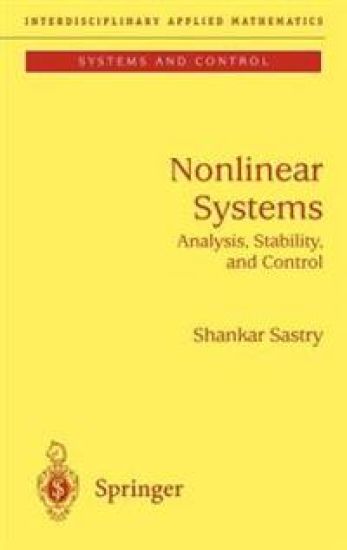
There has been a great deal of excitement in the last ten years over the emer­ gence of new mathematical techniques for the analysis and control of nonlinear systems: Witness the emergence of a set of simplified tools for the analysis of bifurcations, chaos, and other complicated dynamical behavior and the develop­ ment of a comprehensive theory of geometric nonlinear control. Coupled with this set of analytic advances has been the vast increase in computational power available for both the simulation and visualization of nonlinear systems as well as for the implementation in real time of sophisticated, real-time nonlinear control laws. Thus, technological advances havebolstered the impact of analytic advances and produced a tremendous variety of new problems and applications that are nonlinear in an essential way. Nonlinear controllaws have been implemented for sophisticated flight control systems on board helicopters, and vertical take offand landing aircraft; adaptive, nonlinearcontrollaws havebeen implementedfor robot manipulators operating either singly, or in cooperation on a multi-fingered robot hand; adaptive control laws have been implemented forjetengines andautomotive fuel injection systems, as well as for automated highway systems and air traffic management systems, to mention a few examples. Bifurcation theory has been used to explain and understand the onset of fiutterin the dynamics of aircraft wing structures, the onset of oscillations in nonlinear circuits, surge and stall in aircraft engines, voltage collapse in a power transmission network.
Nonlinear Systems

Nonlinear Systems

Shankar Sastry

Springer-Verlag New York Inc.
1999
sidottu
There has been a great deal of excitement in the last ten years over the emer­ gence of new mathematical techniques for the analysis and control of nonlinear systems: Witness the emergence of a set of simplified tools for the analysis of bifurcations, chaos, and other complicated dynamical behavior and the develop­ ment of a comprehensive theory of geometric nonlinear control. Coupled with this set of analytic advances has been the vast increase in computational power available for both the simulation and visualization of nonlinear systems as well as for the implementation in real time of sophisticated, real-time nonlinear control laws. Thus, technological advances havebolstered the impact of analytic advances and produced a tremendous variety of new problems and applications that are nonlinear in an essential way. Nonlinear controllaws have been implemented for sophisticated flight control systems on board helicopters, and vertical take offand landing aircraft; adaptive, nonlinearcontrollaws havebeen implementedfor robot manipulators operating either singly, or in cooperation on a multi-fingered robot hand; adaptive control laws have been implemented forjetengines andautomotive fuel injection systems, as well as for automated highway systems and air traffic management systems, to mention a few examples. Bifurcation theory has been used to explain and understand the onset of fiutterin the dynamics of aircraft wing structures, the onset of oscillations in nonlinear circuits, surge and stall in aircraft engines, voltage collapse in a power transmission network.