Kirjojen hintavertailu. Mukana 12 595 353 kirjaa ja 12 kauppaa.
Kirjailija
Shanthi Pavan
Kirjat ja teokset yhdessä paikassa: 4 kirjaa, julkaisuja vuosilta 2000-2026, suosituimpien joukossa Circuit Analysis for Analog, Mixed-Signal and RF Designers. Vertaile teosten hintoja ja tarkista saatavuus suomalaisista kirjakaupoista.
This new edition introduces operation and design techniques for Sigma-Delta converters in physical and conceptual terms, and includes chapters which explore developments in the field over the last decade Includes information on MASH architectures, digital-to-analog converter (DAC) mismatch and mismatch shapingInvestigates new topics including continuous-time ?S analog-to-digital converters (ADCs) principles and designs, circuit design for both continuous-time and discrete-time ?S ADCs, decimation and interpolation filters, and incremental ADCsProvides emphasis on practical design issues for industry professionals
There is an ever increasing trend towards putting entire systems on a single chip. This means that analog circuits will have to coexist on the same substrate along with massive digital systems. Since technologies are optimized with these digital systems in mind, designers will have to make do with standard CMOS processes in the years to come. We address analog filter design from this perspective. Filters form important blocks in applications ranging from computer disc-drive chips to radio transceivers. In this book, we develop the theory and techniques necessary for the implementation of high frequency (hundreds of megahertz) programmable continuous time filters in standard CMOS processes. Since high density poly-poly capacitors are not available in these technologies, alternative capacitor structures have to be found. Met- metal capacitors have low specific capacitance. An alternative is to use the (inherently nonlinear) capacitance formed by MOSFET gates. In Chapter 2, we focus on the use of MOS capacitors as integrating elements. A physics-based model which predicts distortion accurately is presented for a two-terminal MOS structure in accumulation. Distortion in these capacitors as a function of signal swing and bias voltage is computed. Chapter 3 reviews continuous-time filter architectures in the light of bias-dependent integrating capacitors. We also discuss the merits and demerits of various CMOS transconductance elements. The problems encountered in designing high frequency programmable filters are discussed in detail.
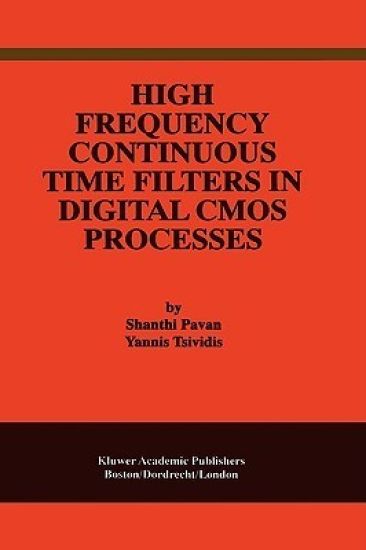
There is an ever increasing trend towards putting entire systems on a single chip. This means that analog circuits will have to coexist on the same substrate along with massive digital systems. Since technologies are optimized with these digital systems in mind, designers will have to make do with standard CMOS processes in the years to come. We address analog filter design from this perspective. Filters form important blocks in applications ranging from computer disc-drive chips to radio transceivers. In this book, we develop the theory and techniques necessary for the implementation of high frequency (hundreds of megahertz) programmable continuous time filters in standard CMOS processes. Since high density poly-poly capacitors are not available in these technologies, alternative capacitor structures have to be found. Met- metal capacitors have low specific capacitance. An alternative is to use the (inherently nonlinear) capacitance formed by MOSFET gates. In Chapter 2, we focus on the use of MOS capacitors as integrating elements. A physics-based model which predicts distortion accurately is presented for a two-terminal MOS structure in accumulation. Distortion in these capacitors as a function of signal swing and bias voltage is computed. Chapter 3 reviews continuous-time filter architectures in the light of bias-dependent integrating capacitors. We also discuss the merits and demerits of various CMOS transconductance elements. The problems encountered in designing high frequency programmable filters are discussed in detail.