Kirjojen hintavertailu. Mukana 12 657 676 kirjaa ja 12 kauppaa.

Kirjailija

Sharon Cameron

Kirjat ja teokset yhdessä paikassa: 33 kirjaa, julkaisuja vuosilta 1979-2026, suosituimpien joukossa Up from the Ashes. Vertaile teosten hintoja ja tarkista saatavuus suomalaisista kirjakaupoista.

33 kirjaa

Kirjojen julkaisuhaarukka 1979-2026.

The Bond of the Furthest Apart

The Bond of the Furthest Apart

Sharon Cameron

University of Chicago Press
2017
nidottu
In French filmmaker Robert Bresson's cinematography, the linkage of fragmented, dissimilar images challenges our assumption that we know either what things are in themselves or the infinite ways in which they are entangled. The "bond" of Cameron's title refers to the astonishing connections found both within Bresson's films and across literary works by Tolstoy, Dostoevsky, and Kafka, whose visionary rethinkings of experience are akin to Bresson's in their resistance to all forms of abstraction and classification that segregate aspects of reality. Whether exploring Bresson's efforts to reassess the limits of human reason and will, Dostoevsky's subversions of Christian conventions, Tolstoy's incompatible beliefs about death, or Kafka's focus on creatures neither human nor animal, Cameron illuminates how the repeated juxtaposition of disparate, even antithetical, phenomena carves out new approaches to defining the essence of being, one where the very nature of fixed categories is brought into question. An innovative look at a classic French auteur and three giants of European literature, The Bond of the Furthest Apart will interest scholars of literature, film, ethics, aesthetics, and anyone drawn to an experimental venture in critical thought.
The Forgetting

The Forgetting

Sharon Cameron

Scholastic Press
2016
sidottu
From beloved author of Rook comes a brilliant and genre-bending exploration of truth and memory, love and loss in this remarkable story of a civilization that undergoes a collective forgetting.What isn't written, isn't remembered. Even your crimes. Nadia lives in the city of Canaan, where life is safe and structured, hemmed in by white stone walls and no memory of what came before. But every twelve years the city descends into the bloody chaos of the Forgetting, a day of no remorse, when each person's memories -- of parents, children, love, life, and self -- are lost. Unless they have been written.In Canaan, your book is your truth and your identity, and Nadia knows exactly who hasn't written the truth. Because Nadia is the only person in Canaan who has never forgotten.But when Nadia begins to use her memories to solve the mysteries of Canaan, she discovers truths about herself and Gray, the handsome glassblower, that will change her world forever. As the anarchy of the Forgetting approaches, Nadia and Gray must stop an unseen enemy that threatens both their city and their own existence -- before the people can forget the truth. And before Gray can forget her.
Rook

Rook

Sharon Cameron

Scholastic Press
2016
nidottu
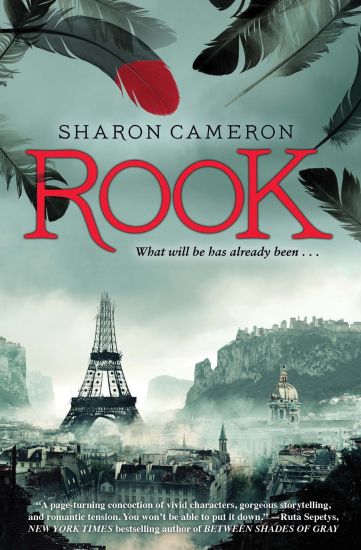
Who needs a wedding ring when you can pick up a sword? A remarkable and utterly inventive novel from Sharon Cameron, author of The Dark Unwinding, which USA TODAY called "spellbindingly imaginative."History has a way of repeating itself. In the Sunken City that was once Paris, all who oppose the new revolution are being put to the blade. Except for those who disappear from their prison cells, a red-tipped rook feather left in their place. The mysterious Red Rook is a savior of the innocent, and a criminal in the eyes of the government.Meanwhile, across the sea in the Commonwealth, Sophia Bellamy's arranged marriage to the wealthy Ren Hasard is the last chance to save her family from ruin. But when the search for the Red Rook comes straight to her doorstep, Sophia discovers that her fianc is not all he seems. Which is only fair, because neither is she. As the Red Rook grows bolder and the stakes grow ever higher, Sophia and Ren find themselves locked in a tantalizing game of cat and mouse. Daring intrigue, delicious romance, and spine-tingling suspense fill the pages of this extraordinary tale from award-winning author Sharon Cameron.
Impersonality

Impersonality

Sharon Cameron

University of Chicago Press
2007
sidottu
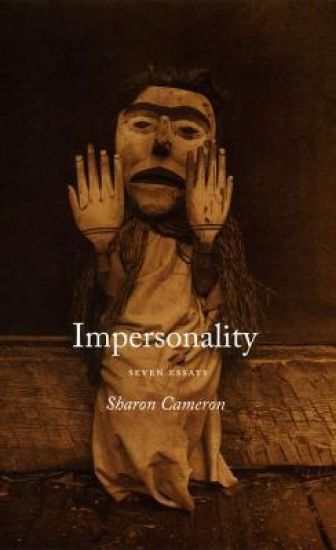
Philosophers have long debated the subjects of person and personhood. Sharon Cameron ushers this debate into the literary realm by considering impersonality in the works of major American writers and figures of international modernism—writers for whom personal identity is inconsequential and even imaginary. In essays on William Empson, Jonathan Edwards, Ralph Waldo Emerson, Herman Melville, T. S. Eliot, and Simone Weil, Cameron examines the impulse to hollow out the core of human distinctiveness, to construct a voice that is no one’s voice, to fashion a character without meaningful attributes, a being that is virtually anonymous. “To consent to being anonymous,” Weil wrote, “is to bear witness to the truth. But how is this compatible with social life and its labels?” Throughout these essays Cameron examines the friction, even violence, set in motion from such incompatibility—from a “truth” that has no social foundation. Impersonality investigates the uncompromising nature of writing that suspends, eclipses, and even destroys the person as a social, political, or individual entity, of writing that engages with personal identity at the moment when its usual markers vanish or dissolve.
Impersonality

Impersonality

Sharon Cameron

University of Chicago Press
2007
nidottu
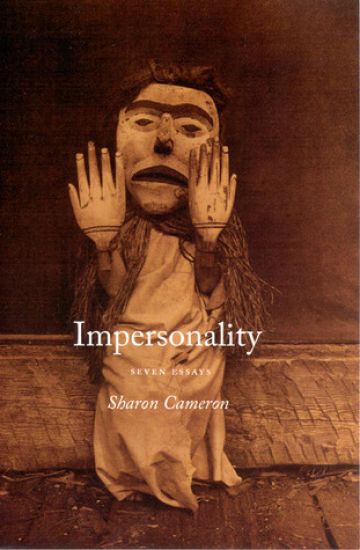
Philosophers have long debated the subjects of person and personhood. Sharon Cameron ushers this debate into the literary realm by considering impersonality in the works of major American writers and figures of international modernism—writers for whom personal identity is inconsequential and even imaginary. In essays on William Empson, Jonathan Edwards, Ralph Waldo Emerson, Herman Melville, T. S. Eliot, and Simone Weil, Cameron examines the impulse to hollow out the core of human distinctiveness, to construct a voice that is no one’s voice, to fashion a character without meaningful attributes, a being that is virtually anonymous. “To consent to being anonymous,” Weil wrote, “is to bear witness to the truth. But how is this compatible with social life and its labels?” Throughout these essays Cameron examines the friction, even violence, set in motion from such incompatibility—from a “truth” that has no social foundation. Impersonality investigates the uncompromising nature of writing that suspends, eclipses, and even destroys the person as a social, political, or individual entity, of writing that engages with personal identity at the moment when its usual markers vanish or dissolve.
Beautiful Work

Beautiful Work

Sharon Cameron

Duke University Press
2000
sidottu
The stories one tells about pain are profound ones. Nothing is more legible than these stories. But something is left out of them. If there were no stories, there might be a moment of innocence. A moment before the burden of the stories and their perceived causes and consequences. For Anna, the narrator of Beautiful Work, there were moments when it was not accurate to say in relation to pain "because of this‚" or "leading to that." They were lucid moments. And so she began to hunger for storylessness.In order to understand the nature of pain, Anna undertakes a meditation practice. We tend to think of pain as self-absorbing and exclusively our own ("my pain," "I am in pain"). In distinction, Sharon Cameron’s Anna comes to explore pain as common property, and as the basis for a radically reconceived selfhood. Resisting the limitations of memoir, Beautiful Work speaks from experience and simultaneously releases it from the closed shell of personal ownership. Outside of the not quite inevitable stories we tell about it, experience is less protected, less compromised, and more vivid than could be supposed.Beautiful Work brings to bear the same interest in consciousness and intersubjectivity that characterizes Cameron’s other work.
Choosing Not Choosing

Choosing Not Choosing

Sharon Cameron

University of Chicago Press
1993
nidottu
Although Emily Dickinson copied and bound her poems into manuscript notebooks, in the century since her death her poems have been read as single lyrics with little or no regard for the context she created for them in her fascicles. Choosing Not Choosing is the first book-length consideration of the poems in their manuscript context. Sharon Cameron demonstrates that to read the poems with attention to their placement in the fascicles is to observe scenes and subjects unfolding between and among poems rather than to think of them as isolated riddles, enigmatic in both syntax and reference. Thus Choosing Not Choosing illustrates that the contextual sense of Dickinson is not the canonical sense of Dickinson. Considering the poems in the context of the fascicles, Cameron argues that an essential refusal of choice pervades all aspects of Dickinson's poetry. Because Dickinson never chose whether she wanted her poems read as single lyrics or in sequence (nor is it clear where any fascicle text ends, or even how, in context, a poem is bounded), "not choosing" is a textual issue; it is also a formal issue because Dickinson refused to chose among poetic variants; it is a thematic issue; and, finally, it is a philosophical one, since what is produced by "not choosing" is a radical indifference to difference. Extending the readings of Dickinson offered in her earlier book Lyric Time, Cameron continues to enlarge our understanding of the work of this singular American poet.
Choosing Not Choosing

Choosing Not Choosing

Sharon Cameron

University of Chicago Press
1993
sidottu
Although Emily Dickinson copied and bound her poems into manuscript notebooks, in the century since her death her poems have been read as single lyrics with little or no regard for the context she created for them in her fascicles. Choosing Not Choosing is the first book-length consideration of the poems in their manuscript context. Sharon Cameron demonstrates that to read the poems with attention to their placement in the fascicles is to observe scenes and subjects unfolding between and among poems rather than to think of them as isolated riddles, enigmatic in both syntax and reference. Thus Choosing Not Choosing illustrates that the contextual sense of Dickinson is not the canonical sense of Dickinson. Considering the poems in the context of the fascicles, Cameron argues that an essential refusal of choice pervades all aspects of Dickinson's poetry. Because Dickinson never chose whether she wanted her poems read as single lyrics or in sequence (nor is it clear where any fascicle text ends, or even how, in context, a poem is bounded), "not choosing" is a textual issue; it is also a formal issue because Dickinson refused to chose among poetic variants; it is a thematic issue; and, finally, it is a philosophical one, since what is produced by "not choosing" is a radical indifference to difference. Extending the readings of Dickinson offered in her earlier book Lyric Time, Cameron continues to enlarge our understanding of the work of this singular American poet.
Thinking in Henry James

Thinking in Henry James

Sharon Cameron

University of Chicago Press
1991
nidottu
Thinking in Henry James identifies what is genuinely strange and radical about James's concept of consciousness—first, the idea that it may not always be situated within this or that person but rather exists outside or "between," in some transpersonal place; and second, the idea that consciousness may have power over things and people outside the person who thinks. Examining these and other counterintuitive representations of consciousness, Cameron asks, "How do we make sense of these conceptions of thinking?"
The Corporeal Self

The Corporeal Self

Sharon Cameron

Columbia University Press
1991
pokkari
The Corporeal Self argues that questions about identity, conceived in bodily terms, are not only relevant for Melville and Hawthorne, the two nineteenth-century authors whose works are positioned at opposite extremes of the consideration of human identity, but lie at the heart of the American literary tradition, and have, in that tradition, their own revisionary status.
Writing Nature

Writing Nature

Sharon Cameron

University of Chicago Press
1989
nidottu
At his death, Henry Thoreau left the majority of his writing unpublished. The bulk of this material is a journal that he kept for twenty-four years. Sharon Cameron's major claim is that this private work (the Journal) was Thoreau's primary work, taking precedence over the books that he published in his lifetime. Her controversial thesis views Thoreau's Journal as a composition that confounds the distinction between public and private—the basis on which our conventional treatment of discourse depends.
Lyric Time

Lyric Time

Sharon Cameron

Johns Hopkins University Press
1979
pokkari
"Lyric Time" offers a detailed critical reading of a particularly difficult poet, an analysis of the dominance of temporal structures and concerns in the body of her poetry, and finally, an important original contribution to a theory of the lyric. Poised between analysis of Emily Dickinson's poetic texts and theoretical inquiry, "Lyric Time" suggests that the temporal problems of Dickinson's poems are frequently exaggerations of the features that distinguish the lyric as a genre. "It is precisely the distance some of Dickinson's poems go toward the far end of coherence, precisely the outlandishness of their extremity, that allows us to see, magnified, the fine workings of more conventional lyrics," writes Sharon Cameron. "Lyric Time" is written for the literary audience at large-- Dickinsonians, romanticists, theorists, anyone interested in American poetry, or in poetry at all, and especially anyone who admires a risky book that succeeds.