Kirjojen hintavertailu. Mukana 12 595 353 kirjaa ja 12 kauppaa.

Kirjailija

Sharon K. Person

Kirjat ja teokset yhdessä paikassa: 3 kirjaa, julkaisuja vuosilta 2015-2022, suosituimpien joukossa St. Louis Rising. Vertaile teosten hintoja ja tarkista saatavuus suomalaisista kirjakaupoista.

3 kirjaa

Kirjojen julkaisuhaarukka 2015-2022.

Dawn's Light Woman & Nicolas Franchomme

Dawn's Light Woman & Nicolas Franchomme

Carl J. Ekberg; Sharon K. Person

SOUTHERN ILLINOIS UNIVERSITY PRESS
2022
nidottu
Native women’s marital rights and roles in colonial Illinois society Kaskaskia, Illinois, once the state’s capital, torn from the state by flood waters, and now largely forgotten, was once the home to a couple who helped transform the region in the 1720s from a frontier village to a civil society. In the heart of France’s North American empire, the village was a community of French -Canadian fur traders and Kaskaskia Indians who not only lived together but often intermarried. These Indigenous and French intermarriages were central to colonial Illinois society, and the coupling of Marguerite 8assecam8c8e (Dawn’s Light Woman) and Nicolas Franchomme, in particular, was critical to expanding the jurisdiction of French law. While the story of Marguerite and Nicolas is unknown today, it is the story of how French customary law (Coutume de Paris) governed colonial marriage, how mixed Indian-French marriages stood at the very core of early colonial Illinois society, and how Illinois Indian women benefited, socially and legally, from being married to French men. All of this came about due to a lawsuit in which Nicolas successfully argued that his wife had legal claim to her first husband’s estate—a legal decision that created a precedent for society in the Illinois Country. Within this narrative of a married couple and their legal fight—based on original French manuscripts and supported by the comprehensively annotated 1726 Illinois census—is also the story of the village of Kaskaskia during the 1720s, of the war between Fox Indians and French settlers, with their Indian allies, in Illinois, and of how the spread of plow agriculture dramatically transformed the Illinois Country’s economy from largely fur trade–based to expansively agricultural.
St. Louis Rising

St. Louis Rising

Carl J. Ekberg; Sharon K. Person

University of Illinois Press
2015
nidottu
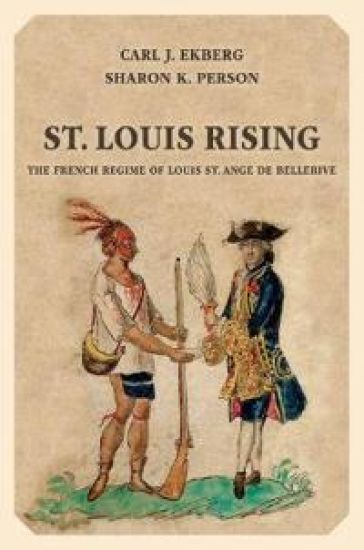
The standard story of St. Louis's founding tells of fur traders Pierre Laclède and Auguste Chouteau hacking a city out of wilderness. St. Louis Rising overturns such gauzy myths with the contrarian thesis that French government officials and institutions shaped and structured early city society. Of the former, none did more than Louis St. Ange de Bellerive. His commitment to the Bourbon monarchy and to civil tranquility made him the prime mover as St. Louis emerged during the tumult following the French and Indian War. Drawing on new source materials, the authors delve into the complexities of politics, Indian affairs, slavery, and material culture that defined the city's founding period. Their alternative version of the oft-told tale uncovers the imperial realities--as personified by St. Ange--that truly governed in the Illinois Country of the time, and provide a trove of new information on everything from the fur trade to the arrival of the British and Spanish after the Seven Years' War.
St. Louis Rising

St. Louis Rising

Carl J. Ekberg; Sharon K. Person

University of Illinois Press
2015
sidottu
The standard story of St. Louis's founding tells of fur traders Pierre Laclède and Auguste Chouteau hacking a city out of wilderness. St. Louis Rising overturns such gauzy myths with the contrarian thesis that French government officials and institutions shaped and structured early city society. Of the former, none did more than Louis St. Ange de Bellerive. His commitment to the Bourbon monarchy and to civil tranquility made him the prime mover as St. Louis emerged during the tumult following the French and Indian War. Drawing on new source materials, the authors delve into the complexities of politics, Indian affairs, slavery, and material culture that defined the city's founding period. Their alternative version of the oft-told tale uncovers the imperial realities--as personified by St. Ange--that truly governed in the Illinois Country of the time, and provide a trove of new information on everything from the fur trade to the arrival of the British and Spanish after the Seven Years' War.