Kirjojen hintavertailu. Mukana 12 591 738 kirjaa ja 12 kauppaa.

Kirjailija

Shaun Bowler

Kirjat ja teokset yhdessä paikassa: 6 kirjaa, julkaisuja vuosilta 1998-2021, suosituimpien joukossa Demanding Choices. Vertaile teosten hintoja ja tarkista saatavuus suomalaisista kirjakaupoista.

6 kirjaa

Kirjojen julkaisuhaarukka 1998-2021.

Electoral Reform and Minority Representation

Electoral Reform and Minority Representation

Shaun Bowler

Ohio State University Press
2021
pokkari
Questions of minority representation have long plagued the U.S. voting systems. The standard election often leaves political, racial, or ethnic minorities with little chance of being represented. Race-conscious districting remains the primary policy tool used for providing representation of racial and ethnic minorities in the United States-and it continues to generate tremendous conflict. Can alternatives to race-conscious, single-member districts offer benefits that extend beyond simply providing descriptive representations of minorities? This study examines one such "semi-proportional" representation election system: Cumulative Voting (CV). For over a decade, scores of local U.S. governments have been elected by Cumulative Voting. This provides us with the ability to examine the effects of CV elections over time. Moreover, the use of CV in the United States allows us to compare politics in places that adopted CV to highly similar places that did not. Electoral Reform and Minority Representation shares evidence that CV elections can produce minority representation that matches levels generated with the drawing of race-conscious "majority-minority" districting. It also offers evidence that the quality of democratic processes in CV communities is in several ways higher that those under districts. Given America's growing racial and ethnic diversity, and given successful legal challenges that limit the use of race-conscious districting Electoral Reform and Minority Representation suggests that Cumulative Voting may be a better way to achieve minority representation in U.S. politics.
The Limits of Electoral Reform

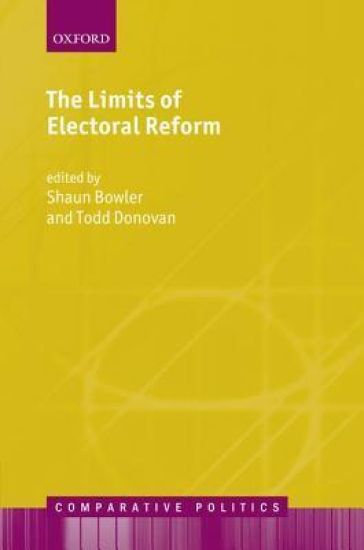
The Limits of Electoral Reform

Shaun Bowler; Todd Donovan

Oxford University Press
2013
sidottu
Institutions 'matter' to electoral reform advocates and political scientists - both argue that variation in electoral institutions affect how elected officials and citizens behave. Change the rules, and citizen engagement with politics can be renewed. Yet a look at the record of electoral reform reveals a string of disappointments. This book examines a variety of reforms, including campaign finance, direct democracy, legislative term limits, and changes to the electoral system itself. This study finds electoral reforms have limited, and in many cases, no effects. Despite reform advocates' claims, and contrary to the 'institutions matter' literature, findings here suggest there are hard limits to effects of electoral reform. The explanations for this are threefold. The first is political. Reformers exaggerate claims about transformative effects of new electoral rules, yet their goal may simply be to maximize their partisan advantage. The second is empirical. Cross-sectional comparative research demonstrates that variation in electoral institutions corresponds with different patterns of political attitudes and behaviour. But this method cannot assess what happens when rules are changed. Using examples from the US, UK, New Zealand, Australia, and elsewhere this book examines attitudes and behaviour across time where rules were changed. Results do not match expectations from the institutional literature. Third is a point of logic. There is an inflated sense of the effects of institutions generally, and of electoral institutions in particular. Given the larger social and economic forces at play, it is unrealistic to expect that changes in electoral arrangements will have substantial effects on political engagement or on how people view politics and politicians. Institutional reform is an almost constant part of the political agenda in democratic societies. Someone, somewhere, always has a proposal not just to change the workings of the system but to reform it. The book is about how and why such reforms disappoint. Comparative Politics is a series for students, teachers, and researchers of political science that deals with contemporary government and politics. Global in scope, books in the series are characterised by a stress on comparative analysis and strong methodological rigour. The series is published in association with the European Consortium for Political Research. For more information visit: www.ecprnet.eu. The Comparative Politics series is edited by Professor David M. Farrell, School of Politics and International Relations, University College Dublin, and Kenneth Carty, Professor of Political Science, University of British Columbia.
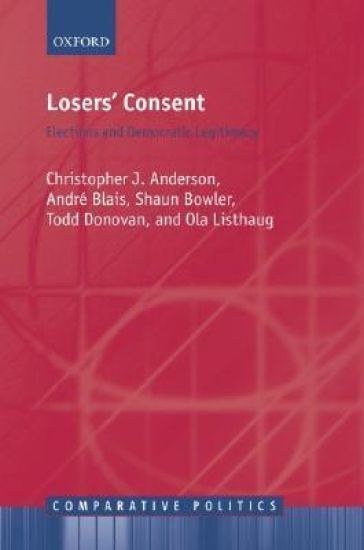
Losers' Consent

Losers' Consent

Christopher J. Anderson; André Blais; Shaun Bowler; Todd Donovan; Ola Listhaug

Oxford University Press
2005
sidottu
Democratic elections are designed to create unequal outcomes: for some to win, others have to lose. This book examines the consequences of this inequality for the legitimacy of democratic political institutions and systems. Using survey data collected in democracies around the globe, the authors argue that losing generates ambivalent attitudes towards political authorities. Because the efficacy and ultimately the survival of democratic regimes can be seriously threatened if the losers do not consent to their loss, the central themes of this book focus on losing: how losers respond to their loss and how institutions shape losing. While there tends to be a gap in support for the political system between winners and losers, it is not ubiquitous. The book paints a picture of losers' consent that portrays losers as political actors whose experience and whose incentives to accept defeat are shaped both by who they are as individuals as well as the political environment in which loss is given meaning. Given that the winner-loser gap in legitimacy is a persistent feature of democratic politics, the findings presented in this book contain crucial implications for our understanding of the functioning and stability of democracies.
Demanding Choices

Demanding Choices

Shaun Bowler; Todd Andrew Donovan

The University of Michigan Press
2000
nidottu
Referenda on important public policy questions have come to play a central role in policy making in many states. Referenda, or ballot propositions, have resulted in limits on taxation and limits on the number of terms of elected officials, and have dealt with bilingual education, campaign finances, and affirmative action, in states all over the country. Shaun Bowler and Todd Donovan present a searching and original examination of how voters make decisions in direct referenda. The authors ask if voters have some information about the issue easily at their disposal and if they make choices that seem sensible given their interests and the information they have. Looking at the way voters respond to different kinds of questions, the authors suggest that while direct democracy has its failings, the flaws do not necessarily lie with citizens being "duped," nor with voters approving propositions they do not want or do not understand at some basic level.As cynicism about government has increased many have sought to take policy questions out of the hands of elected officials and put the questions directly before the voters for decision. And yet many are skeptical about the ability of voters to make intelligent decisions about complex policy issues. This important book demonstrates that voters are capable of responding thoughtfully to referenda questions.This book will appeal to students of contemporary American politics and electoral politics.Shaun Bowler is Associate Professor of Political Science, University of California at Irvine. Todd Donovan is Associate Professor of Political Science, Western Washington University.
Demanding Choices

Demanding Choices

Shaun Bowler; Todd Andrew Donovan

The University of Michigan Press
1998
sidottu
Referenda on important public policy questions have come to play a central role in policy making in many states. Referenda, or ballot propositions, have resulted in limits on taxation and limits on the number of terms of elected officials, and have dealt with bilingual education, campaign finances, and affirmative action, in states all over the country. Shaun Bowler and Todd Donovan present a searching and original examination of how voters make decisions in direct referenda. The authors ask if voters have some information about the issue easily at their disposal and if they make choices that seem sensible given their interests and the information they have. Looking at the way voters respond to different kinds of questions, the authors suggest that while direct democracy has its failings, the flaws do not necessarily lie with citizens being "duped," nor with voters approving propositions they do not want or do not understand at some basic level.As cynicism about government has increased many have sought to take policy questions out of the hands of elected officials and put the questions directly before the voters for decision. And yet many are skeptical about the ability of voters to make intelligent decisions about complex policy issues. This important book demonstrates that voters are capable of responding thoughtfully to referenda questions.This book will appeal to students of contemporary American politics and electoral politics.Shaun Bowler is Associate Professor of Political Science, University of California at Irvine. Todd Donovan is Associate Professor of Political Science, Western Washington University.