Kirjojen hintavertailu. Mukana 12 595 353 kirjaa ja 12 kauppaa.

Kirjailija

Sheng Xu

Kirjat ja teokset yhdessä paikassa: 7 kirjaa, julkaisuja vuosilta 2018-2025, suosituimpien joukossa Neural Networks with Model Compression. Vertaile teosten hintoja ja tarkista saatavuus suomalaisista kirjakaupoista.

7 kirjaa

Kirjojen julkaisuhaarukka 2018-2025.

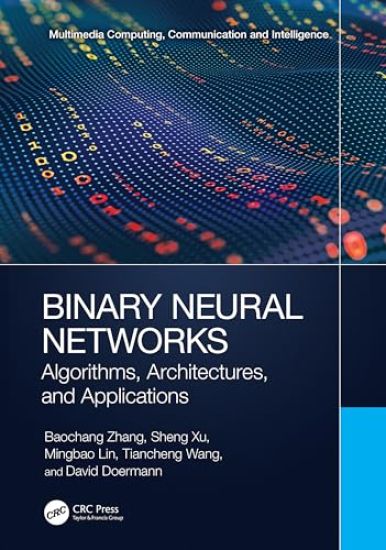
Binary Neural Networks

Binary Neural Networks

Baochang Zhang; Sheng Xu; Mingbao Lin; Tiancheng Wang; David Doermann

TAYLOR FRANCIS LTD
2025
nidottu
Deep learning has achieved impressive results in image classification, computer vision, and natural language processing. To achieve better performance, deeper and wider networks have been designed, which increase the demand for computational resources. The number of floatingpoint operations (FLOPs) has increased dramatically with larger networks, and this has become an obstacle for convolutional neural networks (CNNs) being developed for mobile and embedded devices. In this context, Binary Neural Networks: Algorithms, Architectures, and Applications will focus on CNN compression and acceleration, which are important for the research community. We will describe numerous methods, including parameter quantization, network pruning, low-rank decomposition, and knowledge distillation. More recently, to reduce the burden of handcrafted architecture design, neural architecture search (NAS) has been used to automatically build neural networks by searching over a vast architecture space. Our book will also introduce NAS and binary NAS and its superiority and state-of-the-art performance in various applications, such as image classification and object detection. We also describe extensive applications of compressed deep models on image classification, speech recognition, object detection, and tracking. These topics can help researchers better understand the usefulness and the potential of network compression on practical applications. Moreover, interested readers should have basic knowledge of machine learning and deep learning to better understand the methods described in this book.Key FeaturesReviews recent advances in CNN compression and accelerationElaborates recent advances on binary neural network (BNN) technologiesIntroduces applications of BNN in image classification, speech recognition, object detection, and more
An Introduction to Scientific Computing with MATLAB® and Python Tutorials
This textbook is written for the first introductory course on scientific computing. It covers elementary numerical methods for linear systems, root finding, interpolation, numerical integration, numerical differentiation, least squares problems, initial value problems and boundary value problems. It includes short Matlab and Python tutorials to quickly get students started on programming. It makes the connection between elementary numerical methods with advanced topics such as machine learning and parallel computing.This textbook gives a comprehensive and in-depth treatment of elementary numerical methods. It balances the development, implementation, analysis and application of a fundamental numerical method by addressing the following questions.•Where is the method applied?•How is the method developed?•How is the method implemented?•How well does the method work?The material in the textbook is made as self-contained and easy-to-follow as possible with reviews and remarks. The writing is kept concise and precise. Examples, figures, paper-and-pen exercises and programming problems are deigned to reinforce understanding of numerical methods and problem-solving skills.
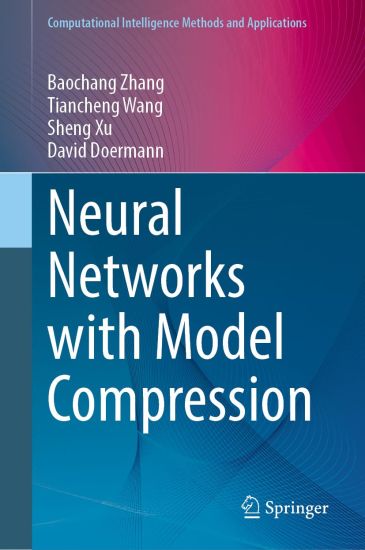
Neural Networks with Model Compression

Neural Networks with Model Compression

Baochang Zhang; Tiancheng Wang; Sheng Xu; David Doermann

SPRINGER VERLAG, SINGAPORE
2024
sidottu
Deep learning has achieved impressive results in image classification, computer vision and natural language processing. To achieve better performance, deeper and wider networks have been designed, which increase the demand for computational resources. The number of floating-point operations (FLOPs) has increased dramatically with larger networks, and this has become an obstacle for convolutional neural networks (CNNs) being developed for mobile and embedded devices. In this context, our book will focus on CNN compression and acceleration, which are important for the research community. We will describe numerous methods, including parameter quantization, network pruning, low-rank decomposition and knowledge distillation. More recently, to reduce the burden of handcrafted architecture design, neural architecture search (NAS) has been used to automatically build neural networks by searching over a vast architecture space. Our book will also introduce NAS due to its superiority and state-of-the-art performance in various applications, such as image classification and object detection. We also describe extensive applications of compressed deep models on image classification, speech recognition, object detection and tracking. These topics can help researchers better understand the usefulness and the potential of network compression on practical applications. Moreover, interested readers should have basic knowledge about machine learning and deep learning to better understand the methods described in this book.
Binary Neural Networks

Binary Neural Networks

Baochang Zhang; Sheng Xu; Mingbao Lin; Tiancheng Wang; David Doermann

TAYLOR FRANCIS LTD
2023
sidottu
Deep learning has achieved impressive results in image classification, computer vision, and natural language processing. To achieve better performance, deeper and wider networks have been designed, which increase the demand for computational resources. The number of floatingpoint operations (FLOPs) has increased dramatically with larger networks, and this has become an obstacle for convolutional neural networks (CNNs) being developed for mobile and embedded devices. In this context, Binary Neural Networks: Algorithms, Architectures, and Applications will focus on CNN compression and acceleration, which are important for the research community. We will describe numerous methods, including parameter quantization, network pruning, low-rank decomposition, and knowledge distillation. More recently, to reduce the burden of handcrafted architecture design, neural architecture search (NAS) has been used to automatically build neural networks by searching over a vast architecture space. Our book will also introduce NAS and binary NAS and its superiority and state-of-the-art performance in various applications, such as image classification and object detection. We also describe extensive applications of compressed deep models on image classification, speech recognition, object detection, and tracking. These topics can help researchers better understand the usefulness and the potential of network compression on practical applications. Moreover, interested readers should have basic knowledge of machine learning and deep learning to better understand the methods described in this book.Key FeaturesReviews recent advances in CNN compression and accelerationElaborates recent advances on binary neural network (BNN) technologiesIntroduces applications of BNN in image classification, speech recognition, object detection, and more
An Introduction to Scientific Computing with MATLAB® and Python Tutorials
This textbook is written for the first introductory course on scientific computing. It covers elementary numerical methods for linear systems, root finding, interpolation, numerical integration, numerical differentiation, least squares problems, initial value problems and boundary value problems. It includes short Matlab and Python tutorials to quickly get students started on programming. It makes the connection between elementary numerical methods with advanced topics such as machine learning and parallel computing.This textbook gives a comprehensive and in-depth treatment of elementary numerical methods. It balances the development, implementation, analysis and application of a fundamental numerical method by addressing the following questions.•Where is the method applied?•How is the method developed?•How is the method implemented?•How well does the method work?The material in the textbook is made as self-contained and easy-to-follow as possible with reviews and remarks. The writing is kept concise and precise. Examples, figures, paper-and-pen exercises and programming problems are deigned to reinforce understanding of numerical methods and problem-solving skills.
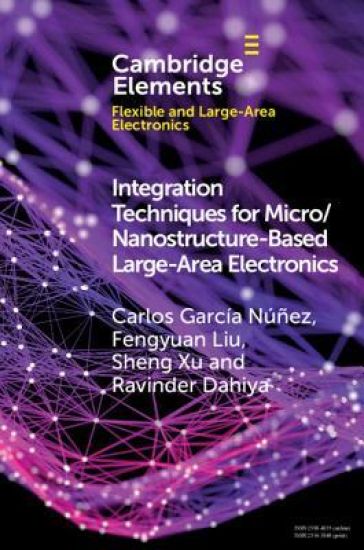
Integration Techniques for Micro/Nanostructure-based Large-Area Electronics

Integration Techniques for Micro/Nanostructure-based Large-Area Electronics

Carlos García Núñez; Fengyuan Liu; Sheng Xu; Ravinder Dahiya

Cambridge University Press
2018
pokkari
Advanced nanostructured materials such as organic and inorganic micro/nanostructures are excellent building blocks for electronics, optoelectronics, sensing, and photovoltaics because of their high-crystallinity, long aspect-ratio, high surface-to-volume ratio, and low dimensionality. However, their assembly over large areas and integration in functional circuits are a matter of intensive investigation. This Element provides detailed description of various technologies to realize micro/nanostructures based large-area electronics (LAE) devices on rigid or flexible/stretchable substrates. The first section of this Element provides an introduction to the state-of-the-art integration techniques used to fabricate LAE devices based on different kind of micro/nanostructures. The second section describes inorganic and organic micro/nanostructures, including most common and promising synthesis procedures. In the third section,different techniques are explained that have great potential for integration of micro/nanostructures over large areas. Finally, the fourth section summarizes important remarks about LAE devices based on micro/nanostructures, and future directions.