Kirjojen hintavertailu. Mukana 12 514 778 kirjaa ja 12 kauppaa.

Kirjailija

Shinil Cho

Kirjat ja teokset yhdessä paikassa: 16 kirjaa, julkaisuja vuosilta 2018-2026, suosituimpien joukossa Monte Carlo Simulations Using Microsoft EXCEL®. Vertaile teosten hintoja ja tarkista saatavuus suomalaisista kirjakaupoista.

16 kirjaa

Kirjojen julkaisuhaarukka 2018-2026.

Education and Social Stratification in South Korea

Education and Social Stratification in South Korea

Shin Arita; Shinil Cho

University of Tokyo Press
2026
sidottu
South Korea is noted for hard-fought competition in university admission exams, which are widely believed to determine one’s prospects and shape their takers’ entire lives. Long after graduation, do admissions exams still influence social circumstances? In this book, Shin Arita validates this belief with vast amounts of sociological data. He traces the mechanisms that show the test’s role in the formation of social strata.
Mathematical Methods for Physics using Microsoft EXCEL
In Mathematical Methods for Physics using Microsoft Excel, readers will investigate topics from classical to quantum mechanics, which are often omitted from the course work. Some of these topics include rocket propulsion, Rutherford scattering, precession and nutation of a top under gravity, parametric oscillation, relativistic Doppler effect, concepts of entropy, kinematics of wave packets, and boundary value problems and associated special functions as orthonormal bases. Recent topics such as the Lagrange point of the James Webb Space Telescope, a muon detector in relation to Cherenkov’s radiation, and information entropy and H-function are also discussed and analyzed. Additional interdisciplinary topics, such as self-avoiding random walks for polymer length and population dynamics, are also described.This book will allow readers to reproduce and replicate the data and experiments often found in physics textbooks, with a stronger foundation of knowledge. While investigating these subjects, readers will follow a step-by-step introduction to computational algorithms for solving differential equations for which analytical solutions are often challenging to find. For computational analysis, features of Microsoft Excel® including AutoFill, Iterative Calculation, and Visual Basic for Applications are useful to conduct hands-on projects. For the visualization of computed outcomes, the Chart output feature can be readily used. There are several first-time attempts on various topics introduced in this book such as 3D-like graphics using Euler’s angle and the behavior of wave functions of harmonic oscillators and hydrogen atoms near the true eigenvalues.
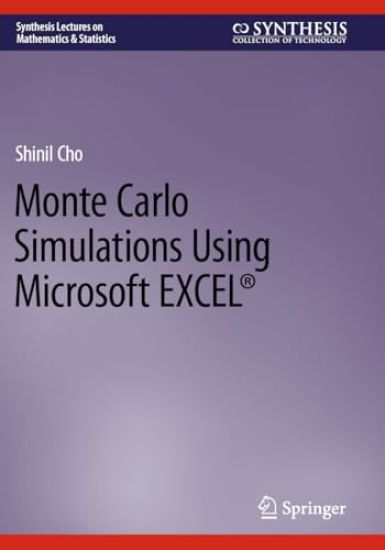
Monte Carlo Simulations Using Microsoft EXCEL®

Monte Carlo Simulations Using Microsoft EXCEL®

Shinil Cho

Springer International Publishing AG
2024
nidottu
This book ?offers step-by-step descriptions of various random systems and explores the world of computer simulations. In addition, this book offers a working introduction to those who want to learn how to create and run Monte Carlo simulations. Monte Carlo simulation has been a powerful computational tool for physics models, and when combined with the programming language Excel, this book is a valuable resource for readers who wish to acquire knowledge that can be applied to more complex systems. Visualization of the simulation results via the Visual Basic built in Microsoft EXCEL is presented as the first step towards the subject. Prior experience with the Excel add-in VBA is kept to a minimum. In addition, a chapter on quantum optimization simulation utilizing Python is added to explore the quantum computation. Readers will gain a fundamental knowledge and techniques of simulation physics, which can be extended to STEM projects and other research projects.
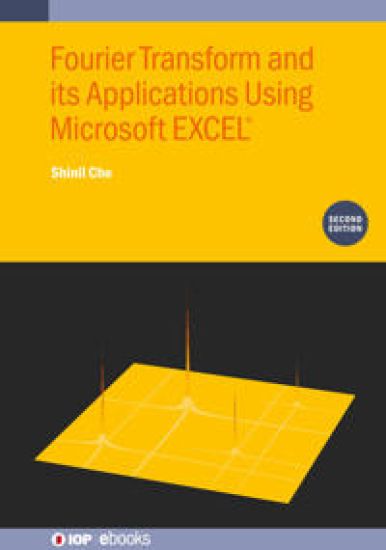
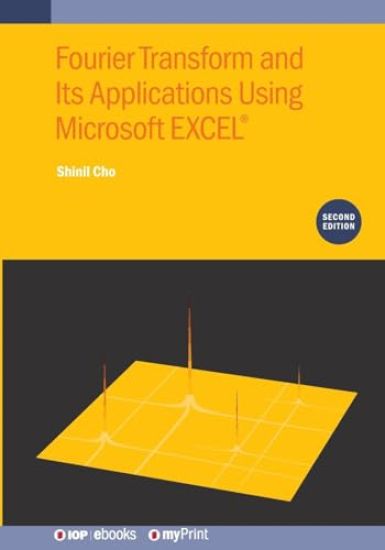
Fourier Transform and Its Applications Using Microsoft EXCEL® (Second Edition)
This book demonstrates Microsoft EXCEL(R)-based Fourier transform of selected physics examples, as well as describing spectral density of the auto-regression process in relation to Fourier transform. Rather than offering rigorous mathematics, the book provides readers with an opportunity to gain an understanding of Fourier transform through the examples. They will acquire and analyze their own data following the step-by-step procedure outlined, and a hands-on acoustic spectral analysis is suggested as the ideal long-term student project.This new edition updates and greatly expands upon the first, with additional examples and exercises in various application domains as well as a new chapter on Quantum random walks and Fourier analysis.Key Features: Hands on practical acoustic analysisExtended new editionIncorporates many new areas of applications in physics and engineeringIncludes quantum random walks
Monte Carlo Simulations Using Microsoft EXCEL®

Monte Carlo Simulations Using Microsoft EXCEL®

Shinil Cho

Springer International Publishing AG
2023
sidottu
This book ?offers step-by-step descriptions of various random systems and explores the world of computer simulations. In addition, this book offers a working introduction to those who want to learn how to create and run Monte Carlo simulations. Monte Carlo simulation has been a powerful computational tool for physics models, and when combined with the programming language Excel, this book is a valuable resource for readers who wish to acquire knowledge that can be applied to more complex systems. Visualization of the simulation results via the Visual Basic built in Microsoft EXCEL is presented as the first step towards the subject. Prior experience with the Excel add-in VBA is kept to a minimum. In addition, a chapter on quantum optimization simulation utilizing Python is added to explore the quantum computation. Readers will gain a fundamental knowledge and techniques of simulation physics, which can be extended to STEM projects and other research projects.
Numerical Calculation for Physics Laboratory Projects Using Microsoft EXCEL®
This book covers essential Microsoft EXCEL®'s computational skills while analyzing introductory physics projects.Topics of numerical analysis include; multiple graphs on the same sheet, calculation of descriptive statistical parameters, a 3-point interpolation, the Euler and the Runge-Kutter methods to solve equations of motion, the Fourier transform to calculate the normal modes of a double pendulum, matrix calculations to solve coupled linear equations of a DC circuit, animation of waves and Lissajous figures, electric and magnetic field calculations from the Poisson equation and its 3D surface graphs, variational calculus such as Fermat's least traveling time principle and the least action principle. Nelson's stochastic quantum dynamics is also introduced to draw quantum particle trajectories.
Numerical Calculation for Physics Laboratory Projects Using Microsoft EXCEL®
This book covers essential Microsoft EXCEL®'s computational skills while analyzing introductory physics projects.Topics of numerical analysis include; multiple graphs on the same sheet, calculation of descriptive statistical parameters, a 3-point interpolation, the Euler and the Runge-Kutter methods to solve equations of motion, the Fourier transform to calculate the normal modes of a double pendulum, matrix calculations to solve coupled linear equations of a DC circuit, animation of waves and Lissajous figures, electric and magnetic field calculations from the Poisson equation and its 3D surface graphs, variational calculus such as Fermat's least traveling time principle and the least action principle. Nelson's stochastic quantum dynamics is also introduced to draw quantum particle trajectories.
Fourier Transform and Its Applications Using Microsoft EXCEL®
This book demonstrates Microsoft EXCEL-based Fourier transform of selected physics examples. Spectral density of the auto-regression process is also described in relation to Fourier transform. Rather than offering rigorous mathematics, readers will "try and feel" Fourier transform for themselves through the examples. Readers can also acquire and analyze their own data following the step-by-step procedure explained in this book. A hands-on acoustic spectral analysis can be one of the ideal long-term student projects.
Fourier Transform and Its Applications Using Microsoft EXCEL®
This book demonstrates Microsoft EXCEL-based Fourier transform of selected physics examples. Spectral density of the auto-regression process is also described in relation to Fourier transform. Rather than offering rigorous mathematics, readers will "try and feel" Fourier transform for themselves through the examples. Readers can also acquire and analyze their own data following the step-by-step procedure explained in this book. A hands-on acoustic spectral analysis can be one of the ideal long-term student projects.
Fourier Transform and Its Applications Using Microsoft EXCEL(R)
This book demonstrates Microsoft EXCEL(R)-based Fourier transform of selected physics examples, as well as describing spectral density of the auto-regression process in relation to Fourier transform. Rather than offering rigorous mathematics, the book provides readers with an opportunity to gain an understanding of Fourier transform through the examples. They will acquire and analyze their own data following the step-by-step procedure outlined, and a hands-on acoustic spectral analysis is suggested as the ideal long-term student project.