Kirjojen hintavertailu. Mukana 12 437 055 kirjaa ja 12 kauppaa.

Kirjailija

Shmuel Sandler

Kirjat ja teokset yhdessä paikassa: 6 kirjaa, julkaisuja vuosilta 1993-2024, suosituimpien joukossa Israel at the Polls, 1992. Vertaile teosten hintoja ja tarkista saatavuus suomalaisista kirjakaupoista.

6 kirjaa

Kirjojen julkaisuhaarukka 1993-2024.

Superpower Involvement In The Middle East

Superpower Involvement In The Middle East

Paul Marantz; Blema Steinberg; John Sigler; Shmuel Sandler

TAYLOR FRANCIS LTD
2024
nidottu
The contributors to this book offer an explanation of Soviet and U.S. policy in the Middle East by exploring how the superpowers define their goals in the region, the factors that both stimulate and constrain the United States and the Soviet Union in the implementation of their objectives, and how their mutual perceptions influence behavior. The ch
Superpower Involvement In The Middle East

Superpower Involvement In The Middle East

Paul Marantz; Blema Steinberg; John Sigler; Shmuel Sandler

Routledge
2020
sidottu
The contributors to this book offer an explanation of Soviet and U.S. policy in the Middle East by exploring how the superpowers define their goals in the region, the factors that both stimulate and constrain the United States and the Soviet Union in the implementation of their objectives, and how their mutual perceptions influence behavior. The ch
The Jewish Origins of Israeli Foreign Policy
The conventional understanding of Israeli foreign policy has been that it is a relatively new phenomenon, with some claiming that the ‘Jewish People’ is an invention by mid-19th century Jewish historians, or simply an ‘imagined community’. This book disputes these claims by demonstrating that the Jews have a tradition of foreign relations based on an historical political tradition that goes back thousands of years, and that this tradition has been carried over to the State of Israel. The Jewish political tradition in foreign policy has always been defensive-oriented, whether under sovereignty or in the Diaspora. Power has generally been only a means for achieving survival rather than a goal in itself, whereas Jewish national identity has always been related to historical Zion. In order to explore the question of whether it is possible to identify patterns of international behaviour in the foreign policy of the Jews, the book begins with the Bible and continues through the period of the First and Second Temples, then looks at the long generations when the Jewish people were stateless, and ultimately concludes with an examination of the sovereign Jewish state of Israel. The underlying assumption is that an understanding of these characteristics will allow us to derive a better understanding of the Jewish origins of Israel’s foreign policy, which should in turn help to eliminate many of the harshest criticisms of Israel’s foreign policy. By presenting a nuanced and intricate examination of longstanding Jewish foreign policy principles, this book will appeal to students and scholars of Jewish Studies, Israeli Studies, International Relations and anyone with an interest in the relationship between religion and foreign policy.
The Jewish Origins of Israeli Foreign Policy
The conventional understanding of Israeli foreign policy has been that it is a relatively new phenomenon, with some claiming that the ‘Jewish People’ is an invention by mid-19th century Jewish historians, or simply an ‘imagined community’. This book disputes these claims by demonstrating that the Jews have a tradition of foreign relations based on an historical political tradition that goes back thousands of years, and that this tradition has been carried over to the State of Israel. The Jewish political tradition in foreign policy has always been defensive-oriented, whether under sovereignty or in the Diaspora. Power has generally been only a means for achieving survival rather than a goal in itself, whereas Jewish national identity has always been related to historical Zion. In order to explore the question of whether it is possible to identify patterns of international behaviour in the foreign policy of the Jews, the book begins with the Bible and continues through the period of the First and Second Temples, then looks at the long generations when the Jewish people were stateless, and ultimately concludes with an examination of the sovereign Jewish state of Israel. The underlying assumption is that an understanding of these characteristics will allow us to derive a better understanding of the Jewish origins of Israel’s foreign policy, which should in turn help to eliminate many of the harshest criticisms of Israel’s foreign policy. By presenting a nuanced and intricate examination of longstanding Jewish foreign policy principles, this book will appeal to students and scholars of Jewish Studies, Israeli Studies, International Relations and anyone with an interest in the relationship between religion and foreign policy.

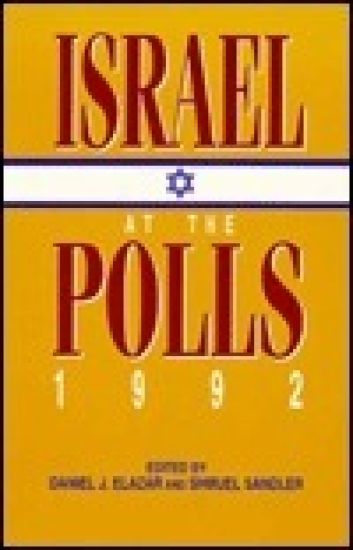
Israel at the Polls, 1992

Israel at the Polls, 1992

Daniel J. Elazar; Shmuel Sandler

Rowman Littlefield
1995
nidottu
The results of the June 1992 Israeli elections at first indicated a normal transition of power from Likud to Labor in the tradition of Western democracies, rather than an upset. However, one and one-half years later there were signs of a major change. Israel at the Polls, 1992 looks at the parties, election campaigns, major institutions, and analyzes the policies of the new government's first year. Co-published with the Jerusalem Center for Public Affairs.
The State of Israel, The Land of Israel

The State of Israel, The Land of Israel

Shmuel Sandler

Praeger Publishers Inc
1993
sidottu
Sandler contends that the impact of the nation in foreign policy is not synonymous with that of the State. Understanding the effect of the nation is important because of the contemporary reawakening of primordial national aspirations. This study is designed to test these views by examining nation-centered concerns in foreign policy as practiced within Israel. It reviews and analyzes the roots of the territorial dimension in Israeli foreign policy since the establishment of the state up to the present; the impact of Israeli domestic politics; and the rise and fall of ethnonationalism in Israeli foreign policy. As such, the work is of concern to all students of Israeli politics and foreign policy and the Arab-Israeli conflict.