Kirjojen hintavertailu. Mukana 12 657 676 kirjaa ja 12 kauppaa.

Kirjailija

Shuai Li

Kirjat ja teokset yhdessä paikassa: 15 kirjaa, julkaisuja vuosilta 2017-2026, suosituimpien joukossa Nonparametric Bayesian Learning for Collaborative Robot Multimodal Introspection. Vertaile teosten hintoja ja tarkista saatavuus suomalaisista kirjakaupoista.

15 kirjaa

Kirjojen julkaisuhaarukka 2017-2026.

Nonparametric Bayesian Learning for Collaborative Robot Multimodal Introspection

Nonparametric Bayesian Learning for Collaborative Robot Multimodal Introspection

Xuefeng Zhou; Hongmin Wu; Juan Rojas; Zhihao Xu; Shuai Li

Springer Verlag, Singapore
2020
nidottu
This open access book focuses on robot introspection, which has a direct impact on physical human–robot interaction and long-term autonomy, and which can benefit from autonomous anomaly monitoring and diagnosis, as well as anomaly recovery strategies. In robotics, the ability to reason, solve their own anomalies and proactively enrich owned knowledge is a direct way to improve autonomous behaviors. To this end, the authors start by considering the underlying pattern of multimodal observation during robot manipulation, which can effectively be modeled as a parametric hidden Markov model (HMM). They then adopt a nonparametric Bayesian approach in defining a prior using the hierarchical Dirichlet process (HDP) on the standard HMM parameters, known as the Hierarchical Dirichlet Process Hidden Markov Model (HDP-HMM). The HDP-HMM can examine an HMM with an unbounded number of possible states and allows flexibility in the complexity of the learned model and the development of reliable and scalable variational inference methods.This book is a valuable reference resource for researchers and designers in the field of robot learning and multimodal perception, as well as for senior undergraduate and graduate university students.
Generalized Matrix Inversion: A Machine Learning Approach

Generalized Matrix Inversion: A Machine Learning Approach

Predrag S. Stanimirovic; Yimin Wei; Shuai Li; Dimitrios Gerontitis; Xinwei Cao

Springer Nature Switzerland AG
2026
sidottu
mso-fareast-theme-font: minor-latin;">Based on the authors’ research that has been published in leading scientific journals, the book spans a variety of disciplines, including linear and multilinear algebra, generalized inverses, recurrent neural networks, dynamical systems, time-varying problem solving, and unconstrained nonlinear optimization.
Grasslands on the Third Pole of the World

Grasslands on the Third Pole of the World

Shikui Dong; Yong Zhang; Hao Shen; Shuai Li; Yudan Xu

Springer International Publishing AG
2024
nidottu
This book comprehensively covers the topics of origin and distribution, evolution and types, regional and global importance, biodiversity conservation, plant-soil interfaces, ecosystem functions and services, social-ecological systems, climate change adaptations, land degradation and restoration, grazing management and pastoral production, and sustainable future of the grasslands on the Qinghai-Tibetan Plateau (QTP), which is a globally unique eco-region called the "Roof of the World" because of its high elevation, “Third Pole on Earth" because of its alpine environment and the "Water Tower in Asia" because of its headwater location. The grassland ecosystem covers above 60% of QTP, which is about 2.5 million km2, 1/4 of Chinese total territorial lands. The grassland ecosystem of the QTP (the Third Pole) is an important part of the palaearctic region, which features alpine cover and low oxygen. The Third Pole's grasslands not only provide important ecosystem functions such as biodiversity conservation, carbon storage, water resource regulation, climate control, and natural disaster mitigation at a global scale, but also provide critical ecosystem services such as pastoral production, cultural inheritance, and tourism and recreation at local and regional scales. The purposes of this monograph are to address the following questions: (1) What are the special features of the Third Pole's grasslands? (2) How have climate changes and human activities changed the structures and functions of the Third Pole's grasslands? (3) How can we cope with land degradation and climate change through innovative restoration and protective actions for Third Pole's grasslands? And (4) How can we promote the sustainable development of social-ecological systems of the Third Pole's grasslands through best management practices including grazing. The goal of this book is to attract the attention of international audiences to realize the importance of the Third Pole’s grasslands, and to call for the actions of global communities to effectively protect and sustainably use the Third Pole's grasslands. This book can be served as textbooks, teaching materials and documentaries for different audiences. The target audiences include students, teachers, researchers, policy makers, planners, government officials, and NGOs in agricultural, environmental and natural resources sectors.
Grasslands on the Third Pole of the World

Grasslands on the Third Pole of the World

Shikui Dong; Yong Zhang; Hao Shen; Shuai Li; Yudan Xu

Springer International Publishing AG
2023
sidottu
This book comprehensively covers the topics of origin and distribution, evolution and types, regional and global importance, biodiversity conservation, plant-soil interfaces, ecosystem functions and services, social-ecological systems, climate change adaptations, land degradation and restoration, grazing management and pastoral production, and sustainable future of the grasslands on the Qinghai-Tibetan Plateau (QTP), which is a globally unique eco-region called the "Roof of the World" because of its high elevation, “Third Pole on Earth" because of its alpine environment and the "Water Tower in Asia" because of its headwater location. The grassland ecosystem covers above 60% of QTP, which is about 2.5 million km2, 1/4 of Chinese total territorial lands.The grassland ecosystem of the QTP (the Third Pole) is an important part of the palaearctic region, which features alpine cover and low oxygen. The Third Pole's grasslands not only provide important ecosystem functions such as biodiversity conservation, carbon storage, water resource regulation, climate control, and natural disaster mitigation at a global scale, but also provide critical ecosystem services such as pastoral production, cultural inheritance, and tourism and recreation at local and regional scales.The purposes of this monograph are to address the following questions: (1) What are the special features of the Third Pole's grasslands? (2) How have climate changes and human activities changed the structures and functions of the Third Pole's grasslands? (3) How can we cope with land degradation and climate change through innovative restoration and protective actions for Third Pole's grasslands? And (4) How can we promote the sustainable development of social-ecological systems of the Third Pole's grasslands through best management practices including grazing. The goal of this book is to attract the attention of international audiences to realize the importance of the Third Pole’s grasslands, and to call for the actions of global communities to effectively protect and sustainably use the Third Pole's grasslands. This book can be served as textbooks, teaching materials and documentaries for different audiences. The target audiences include students, teachers, researchers, policy makers, planners, government officials, and NGOs in agricultural, environmental and natural resources sectors.
Robot Control and Calibration

Robot Control and Calibration

Xin Luo; Zhibin Li; Long Jin; Shuai Li

SPRINGER VERLAG, SINGAPORE
2023
nidottu
This book mainly shows readers how to calibrate and control robots. In this regard, it proposes three control schemes: an error-summation enhanced Newton algorithm for model predictive control; RNN for solving perturbed time-varying underdetermined linear systems; and a new joint-drift-free scheme aided with projected ZNN, which can effectively improve robot control accuracy. Moreover, the book develops four advanced algorithms for robot calibration – Levenberg-Marquarelt with diversified regularizations; improved covariance matrix adaptive evolution strategy; quadratic interpolated beetle antennae search algorithm; and a novel variable step-size Levenberg-Marquardt algorithm – which can effectively enhance robot positioning accuracy. In addition, it is exceedingly difficult for experts in other fields to conduct robot arm calibration studies without calibration data. Thus, this book provides a publicly available dataset to assist researchers from other fields in conductingcalibration experiments and validating their ideas. The book also discusses six regularization schemes based on its robot error models, i.e., L1, L2, dropout, elastic, log, and swish. Robots’ positioning accuracy is significantly improved after calibration. Using the control and calibration methods developed here, readers will be ready to conduct their own research and experiments.
Machine Behavior Design And Analysis

Machine Behavior Design And Analysis

Yinyan Zhang; Shuai Li

Springer Verlag, Singapore
2021
nidottu
In this book, we present our systematic investigations into consensus in multi-agent systems. We show the design and analysis of various types of consensus protocols from a multi-agent perspective with a focus on min-consensus and its variants. We also discuss second-order and high-order min-consensus. A very interesting topic regarding the link between consensus and path planning is also included. We show that a biased min-consensus protocol can lead to the path planning phenomenon, which means that the complexity of shortest path planning can emerge from a perturbed version of min-consensus protocol, which as a case study may encourage researchers in the field of distributed control to rethink the nature of complexity and the distance between control and intelligence. We also illustrate the design and analysis of consensus protocols for nonlinear multi-agent systems derived from an optimal control formulation, which do not require solving a Hamilton-Jacobi-Bellman (HJB) equation. The book was written in a self-contained format. For each consensus protocol, the performance is verified through simulative examples and analyzed via mathematical derivations, using tools like graph theory and modern control theory. The book’s goal is to provide not only theoretical contributions but also explore underlying intuitions from a methodological perspective.
Deep Reinforcement Learning with Guaranteed Performance

Deep Reinforcement Learning with Guaranteed Performance

Yinyan Zhang; Shuai Li; Xuefeng Zhou

Springer Nature Switzerland AG
2020
nidottu
This book discusses methods and algorithms for the near-optimal adaptive control of nonlinear systems, including the corresponding theoretical analysis and simulative examples, and presents two innovative methods for the redundancy resolution of redundant manipulators with consideration of parameter uncertainty and periodic disturbances.It also reports on a series of systematic investigations on a near-optimal adaptive control method based on the Taylor expansion, neural networks, estimator design approaches, and the idea of sliding mode control, focusing on the tracking control problem of nonlinear systems under different scenarios. The book culminates with a presentation of two new redundancy resolution methods; one addresses adaptive kinematic control of redundant manipulators, and the other centers on the effect of periodic input disturbance on redundancy resolution.Each self-contained chapter is clearly written, making the book accessible to graduate students as well as academic and industrial researchers in the fields of adaptive and optimal control, robotics, and dynamic neural networks.
Management and Intelligent Decision-Making in Complex Systems: An Optimization-Driven Approach

Management and Intelligent Decision-Making in Complex Systems: An Optimization-Driven Approach

Ameer Hamza Khan; Xinwei Cao; Shuai Li

Springer Verlag, Singapore
2020
nidottu
In this book, the authors focus on three aspects related to the development of articulated agents: presenting an overview of high-level control algorithms for intelligent decision-making of articulated agents, experimental study of the properties of soft agents as the end-effector of articulated agents, and accurate management of low-level torque-control loop to accurately control the articulated agents. This book summarizes recent advances related to articulated agents. The motive behind the book is to trigger theoretical and practical research studies related to articulated agents.
AI based Robot Safe Learning and Control

AI based Robot Safe Learning and Control

Xuefeng Zhou; Zhihao Xu; Shuai Li; Hongmin Wu; Taobo Cheng; Xiaojing Lv

Springer Verlag, Singapore
2020
nidottu
This open access book mainly focuses on the safe control of robot manipulators. The control schemes are mainly developed based on dynamic neural network, which is an important theoretical branch of deep reinforcement learning. In order to enhance the safety performance of robot systems, the control strategies include adaptive tracking control for robots with model uncertainties, compliance control in uncertain environments, obstacle avoidance in dynamic workspace. The idea for this book on solving safe control of robot arms was conceived during the industrial applications and the research discussion in the laboratory. Most of the materials in this book are derived from the authors’ papers published in journals, such as IEEE Transactions on Industrial Electronics, neurocomputing, etc. This book can be used as a reference book for researcher and designer of the robotic systems and AI based controllers, and can also be used as a reference book for senior undergraduateand graduate students in colleges and universities.
Nonparametric Bayesian Learning for Collaborative Robot Multimodal Introspection

Nonparametric Bayesian Learning for Collaborative Robot Multimodal Introspection

Xuefeng Zhou; Hongmin Wu; Juan Rojas; Zhihao Xu; Shuai Li

Springer Verlag, Singapore
2020
sidottu
This open access book focuses on robot introspection, which has a direct impact on physical human–robot interaction and long-term autonomy, and which can benefit from autonomous anomaly monitoring and diagnosis, as well as anomaly recovery strategies. In robotics, the ability to reason, solve their own anomalies and proactively enrich owned knowledge is a direct way to improve autonomous behaviors. To this end, the authors start by considering the underlying pattern of multimodal observation during robot manipulation, which can effectively be modeled as a parametric hidden Markov model (HMM). They then adopt a nonparametric Bayesian approach in defining a prior using the hierarchical Dirichlet process (HDP) on the standard HMM parameters, known as the Hierarchical Dirichlet Process Hidden Markov Model (HDP-HMM). The HDP-HMM can examine an HMM with an unbounded number of possible states and allows flexibility in the complexity of the learned model and the development of reliable and scalable variational inference methods.This book is a valuable reference resource for researchers and designers in the field of robot learning and multimodal perception, as well as for senior undergraduate and graduate university students.
AI based Robot Safe Learning and Control

AI based Robot Safe Learning and Control

Xuefeng Zhou; Zhihao Xu; Shuai Li; Hongmin Wu; Taobo Cheng; Xiaojing Lv

Springer Verlag, Singapore
2020
sidottu
This open access book mainly focuses on the safe control of robot manipulators. The control schemes are mainly developed based on dynamic neural network, which is an important theoretical branch of deep reinforcement learning. In order to enhance the safety performance of robot systems, the control strategies include adaptive tracking control for robots with model uncertainties, compliance control in uncertain environments, obstacle avoidance in dynamic workspace. The idea for this book on solving safe control of robot arms was conceived during the industrial applications and the research discussion in the laboratory. Most of the materials in this book are derived from the authors’ papers published in journals, such as IEEE Transactions on Industrial Electronics, neurocomputing, etc. This book can be used as a reference book for researcher and designer of the robotic systems and AI based controllers, and can also be used as a reference book for senior undergraduateand graduate students in colleges and universities.
Machine Behavior Design And Analysis

Machine Behavior Design And Analysis

Yinyan Zhang; Shuai Li

Springer Verlag, Singapore
2020
sidottu
In this book, we present our systematic investigations into consensus in multi-agent systems. We show the design and analysis of various types of consensus protocols from a multi-agent perspective with a focus on min-consensus and its variants. We also discuss second-order and high-order min-consensus. A very interesting topic regarding the link between consensus and path planning is also included. We show that a biased min-consensus protocol can lead to the path planning phenomenon, which means that the complexity of shortest path planning can emerge from a perturbed version of min-consensus protocol, which as a case study may encourage researchers in the field of distributed control to rethink the nature of complexity and the distance between control and intelligence. We also illustrate the design and analysis of consensus protocols for nonlinear multi-agent systems derived from an optimal control formulation, which do not require solving a Hamilton-Jacobi-Bellman (HJB) equation. The book was written in a self-contained format. For each consensus protocol, the performance is verified through simulative examples and analyzed via mathematical derivations, using tools like graph theory and modern control theory. The book’s goal is to provide not only theoretical contributions but also explore underlying intuitions from a methodological perspective.
Deep Reinforcement Learning with Guaranteed Performance

Deep Reinforcement Learning with Guaranteed Performance

Yinyan Zhang; Shuai Li; Xuefeng Zhou

Springer Nature Switzerland AG
2019
sidottu
This book discusses methods and algorithms for the near-optimal adaptive control of nonlinear systems, including the corresponding theoretical analysis and simulative examples, and presents two innovative methods for the redundancy resolution of redundant manipulators with consideration of parameter uncertainty and periodic disturbances.It also reports on a series of systematic investigations on a near-optimal adaptive control method based on the Taylor expansion, neural networks, estimator design approaches, and the idea of sliding mode control, focusing on the tracking control problem of nonlinear systems under different scenarios. The book culminates with a presentation of two new redundancy resolution methods; one addresses adaptive kinematic control of redundant manipulators, and the other centers on the effect of periodic input disturbance on redundancy resolution.Each self-contained chapter is clearly written, making the book accessible to graduate students as well as academic and industrial researchers in the fields of adaptive and optimal control, robotics, and dynamic neural networks.
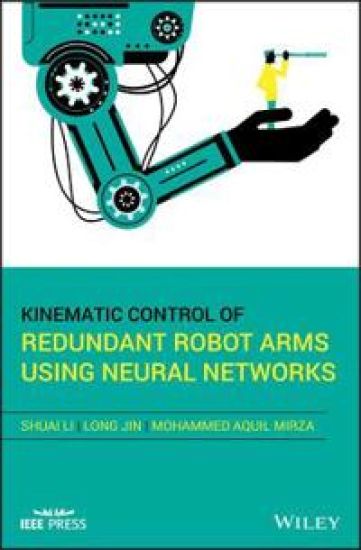
Kinematic Control of Redundant Robot Arms Using Neural Networks

Kinematic Control of Redundant Robot Arms Using Neural Networks

Shuai Li; Long Jin; Mohammed Aquil Mirza

Wiley-Blackwell
2019
sidottu
Presents pioneering and comprehensive work on engaging movement in robotic arms, with a specific focus on neural networks This book presents and investigates different methods and schemes for the control of robotic arms whilst exploring the field from all angles. On a more specific level, it deals with the dynamic-neural-network based kinematic control of redundant robot arms by using theoretical tools and simulations. Kinematic Control of Redundant Robot Arms Using Neural Networks is divided into three parts: Neural Networks for Serial Robot Arm Control; Neural Networks for Parallel Robot Control; and Neural Networks for Cooperative Control. The book starts by covering zeroing neural networks for control, and follows up with chapters on adaptive dynamic programming neural networks for control; projection neural networks for robot arm control; and neural learning and control co-design for robot arm control. Next, it looks at robust neural controller design for robot arm control and teaches readers how to use neural networks to avoid robot singularity. It then instructs on neural network based Stewart platform control and neural network based learning and control co-design for Stewart platform control. The book finishes with a section on zeroing neural networks for robot arm motion generation. Provides comprehensive understanding on robot arm control aided with neural networksPresents neural network-based control techniques for single robot arms, parallel robot arms (Stewart platforms), and cooperative robot armsProvides a comparison of, and the advantages of, using neural networks for control purposes rather than traditional control based methodsIncludes simulation and modelling tasks (e.g., MATLAB) for onward application for research and engineering development By focusing on robot arm control aided by neural networks whilst examining central topics surrounding the field, Kinematic Control of Redundant Robot Arms Using Neural Networks is an excellent book for graduate students and academic and industrial researchers studying neural dynamics, neural networks, analog and digital circuits, mechatronics, and mechanical engineering.
Neural Networks for Cooperative Control of Multiple Robot Arms

Neural Networks for Cooperative Control of Multiple Robot Arms

Shuai Li; Yinyan Zhang

Springer Verlag, Singapore
2017
nidottu
This is the first book to focus on solving cooperative control problems of multiple robot arms using different centralized or distributed neural network models, presenting methods and algorithms together with the corresponding theoretical analysis and simulated examples. It is intended for graduate students and academic and industrial researchers in the field of control, robotics, neural networks, simulation and modelling.